


 Francais
 Deutsch
 Italiano
Refine Your Search
2nd-Rangers-D-Day stock footage and images
- Showing 397 to 402 of 13614 results more
more Hide
Hide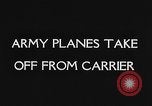
U.S. Army Air Force pilots fly P-40 airplanes off the USS Ranger, to captured Vichy French airport in Morocco during World War II
Seventy five U.S. Army Curtiss P-40L airplanes are ferried across the Atlantic Ocean to within flying range of Morocco, North Africa, by the Aircraft Carrier, USS Ranger (CV-4), during World War 2. U.S. Army Air Force pilots prepare to fly the P-40s to the former Vichy French Anfa Airport near Casablance, captured by the Allies in Operation Torch. The Army pilots and support personnel are seen being briefed on the flight deck. Navy deck crews help move a P-40 into position. USAAF 57th Fighter Group commander, Colonel Frank H. Mears shakes hands with a navy officer from the cockpit of his P-40. Carrier officer seen signaling for take off. Colonel Mears takes off. More P-40s follow. Navy officers and sailors watch the departing P-40s and give thumbs up for approval. The P-40s buzz the carrier as they form up to depart.
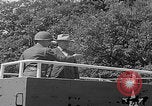
President Harry S. Truman and officials review soldiers and tanks at the German Autobahn
United States President Harry S. Truman reviews the 2nd Armored Division at the Autobahn in Germany soon after end of World War 2 in Europe. President Truman, Admiral William D. Leahy, Secretary of State James F. Byrnes, and other military staff ride a United States M3 half-track vehicle (“Bess” USA 4064790). President Truman and his retinue (on the half-track) review an armored Division lined up along the Autobahn. A long line of M4 Sherman tanks and tank destroyers are parked along the Autobahn. A United States Army soldier hanging on to the M3 half-track’s rear. Soldiers in front of the tanks salute to President Truman. Soldiers holding the United States flag and their divisional insignia. President Truman and his retinue come to attention as they pass by the soldiers holding the United States flag and divisional insignia. President Truman removes his hat while other officials salute to soldiers from both the moving half-track and on the ground. President Truman and entourage resume the motorcade. Soldiers riding on motorcycle during motorcade. Closer view of soldiers and M4 Sherman tanks. Soldiers holding the United States flag while others salute. Some soldiers present arms. Close up of soldiers saluting. President Truman and officials standing on half-track. A military official reads a speech. President Truman attaches a special banner to a divisional standard. Another official holds a paper for President Truman. President Truman and officials in motorcade on the Autobahn.
2nd Sino-Japanese war, precursor to World War II in the Pacific. Pearl Harbor attack. Early phase of Pacific conflict between Japan and the U.S.
The film 'Sea power in the Pacific' showing Japanese dominance in China and at start of World War 2. Then it chronicles U.S. efforts to build Navy and fight back on sea and in the air. Opening scene shows Japanese Mitsubishi G3M (Type 96) bombers high overhead, and then closeup in formation. View from bomber of bomb bays open with bombs falling and view from ground of explosions and destruction. Overlay on film says: "China---1931." (This is not correct. The G3M bomber was not yet in service.) This film depicts Japanese attacks during second Sino-Japanese War, commencing 1937, Chinese civilians running to escape Japanese bombing of Singapore. Buildings destroyed and on fire. Next, Japanese troops, carrying the Rising Sun flag, are seen establishing a beachhead in an Amphibious assault. More scenes of Japanese infantry advancing through Singapore, ad it is being destroyed and burned. Soldiers charging along an alleyway, with pagoda in background. Next, Japanese soldiers are seen attacking Nanking, and committing atrocities and killing Chinese during the so-called "Rape of Nanking," in December, 1937. Chinese civilians being summarily shot and dumped into a large open grave after execution. Two Chinese prisoners with hands bound, being executed by rifle fire. Jubilant Japanese troops celebrating their victory. Map shows areas of China occupied during second Sino-Japanese war and the East Indies to the South. View of oil tanks; an open pit tin mine; a native cutting rubber tree bark to collect latex. Flags on map show regions of English, French, and Dutch colonial interest. It also shows Islands to the East, fortified by the Japanese. Cartoon shows Japanese soldier opposed by and American sailor (representing U.S. Sea Power). Next, famous images of the Japanese attack on Pearl Harbor, Hawaii, December 7, 1941, are shown, including the USS Arizona burning and sinking. Hawaii, Midway, Wake, and the Philippines Islands, are highlighted on a map and Japanese control of the Pacific is illustrated. Japanese soldiers are seen displaying a captured American flag. U.S. Lieutenant General Jonathan M. Wainwright is seen surrendering the garrison at Corregidor, on May 6, 1942. View of Japanese General Masahara Homma discussing surrender terms with Wainright. Map shows interlocking web of Japanese fortified bases in Pacific and need for seapower to oppose it. View of American shipyard with hundreds of workers, employed to build ships for the war effort, in World War 2. Views welding, metal fabrication, and other shipbuilding activity. A new ship going down the ways and a woman christening a new ship with splash from bottle of champagne. A new "Liberty Ship," the Richard Bassett, going down the ways at Bethlehem-Fairfield Shipyard Inc. Baltimore, Maryland. Closeup view as the stern of another ship enters the water upon launching. View of it from a distance. Shipyard workers knock supports from under what may be a landing craft, as it is launched. Japanese warships underway in the Pacific and firing their naval guns. Explosions on a shoreline from naval bombardment. Japanese infantry wading ashore during an amphibious assault. Map shows where Japanese forces attempt an amphibious assault on Southern New Guinea, thwarted by the U.S. Navy in the battle of the Coral Sea of May, 1942. In June, 1942, a Japanese attempt against Midway Island, was again checked by the U.S. Navy in the Battle of Midway. View of USS Wasp (CV-7) carrier deck filled with airplanes, including Grumman F4F Wildcats. A Douglas SBD Dauntless dive bomber being cleared for takeoff from the Wasp. Gun camera film showing Japanese airplanes being shot down by pursuing U.S. aircraft.
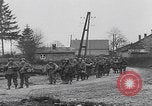
82nd Airborne troops take surrounding villages near Stavelot, Belgium (WW2)
United States Army 82nd Airborne troops take positions around Stavelot, Belgium in World War II. The soldiers make a “Sign of the Cross” during a brief religious service led by chaplain of the 504th Parachute Infantry. Soldiers running in Stavelot. 82nd Airborne troops in prone position shoot with rifles. A soldier shooting with an M1919 Browning machine gun. Abandoned and damaged German heavy equipment and vehicles scattered near Stavelot. 82nd Airborne troops take surrounding villages south of Stavelot. A soldier fires a bazooka near a house. Another soldier throws a grenade into a window of a basement where German soldiers may be hiding. 82nd Airborne troops engage in street fighting. Soldier fires a rifle from behind a stone wall. A battalion of the 35th infantry division marching through snow covered forests and over steep hills on the southern side of the salient. 35th infantry division makes a maneuver in the Sauer River section to outflank a town on the Belgian-Luxembourg border.
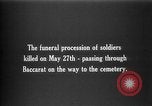
American Expeditionary Forces(A.E.F.) 42nd (Rainbow Division) bury their fallen at Baccarat, France, in World War I
A cortege of U.S. Army trucks, covered with American flags and laden with flag-covered coffins of American soldiers,who fell in combat on May 27th, 1918,proceeds through the streets of Baccarat, France, in World War 1. U.S. soldiers of the 42nd Infantry Division march as escorts, beside the trucks. Local citizens observe from the sides of the road. Scene shifts to Memorial Day (May 30, 1918), when U.S. Army Major General Charles T. Menoher and U.S. Army Colonel Douglas MacArthur,of the 42nd Infantry Division, are joined by French Generals Dupont and Penet, in decorating the graves of fallen American soldiers, during a ceremony at a rugged battlefield cemetery containing new graves marked by wooden crosses. A little French girl places a bouquet (reportedly made by Major General Menoher) upon the grave of an American soldier.She is accompanied by other French children who also place bouquets on the graves. An honor guard of American soldiers fires a salute. Scene shifts to a gathering of American soldiers at their base in Baccarat, where they surround a small outdoor stage, to watch a Miss Hart, of the YMCA theatrical Corps dance the Higland Fling. She is dressed in traditional costume of Scotland and accompanied by a violinist. A group of Army musicians, seated close to the stage, watch the performance along with the rest of the troops.
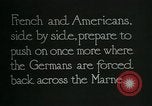
French and American Soldiers fight side-by-side in 2nd Battle of the Marne in World War I.
Camera pans over French soldiers in several trench locations along the Marne line during World War 1. Some are also seen digging new trenches next to a road. Several French troops and a farmer stand near two French Schneider tanks, one with a White diamond painted on its side. In far background troops are seen marching single-file. Scene switches to American Expeditionary Forces (AEF) moving single-file along a tree line. The film is destroyed between time code: 01:23 and 2:02, where it picks up again showing American soldiers gathered in a clearing in the woods. Horses and wagons, trucks, and a staff car are also seen. Next scene shows a long line of U.S. troops and trucks clogging a road. German prisoners, including some ambulatory wounded, walk past French canvas-covered wagons, and are seen near French soldiers. French troops with wagons pulled by donkeys, pass German prisoners of war, and enter the town of Longmont. Mounted French soldiers pull a caisson. The destroyed Abbey of Longmont is seen in the background as mounted French soldiers ride into the town. More German POWs walk towards the rear, past them. More views of the destroyed Abbey. A contingent of French troops with wagons and caissons advances toward the front.
CRITICALPAST.COM: About Us | Contact Us | FAQs - How to Order | License Agreement | My Account | My Lightboxes | Shopping Cart | Advanced Search | Featured Collections | Website Terms & Conditions | Privacy Policy ©2026 CriticalPast LLC.
License Agreement |
Terms & Conditions |
Privacy Policy
©2026 CriticalPast LLC.