


 Francais
 Deutsch
 Italiano
Refine Your Search
2nd-Rangers-D-Day stock footage and images
- Showing 4789 to 4794 of 13612 results more
more Hide
Hide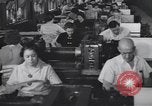
Armed Service Forces men and women ready for invasion of Europe in World War 2, including printing of invasion money.
Armed Service Forces (ASF) personnel at work in the United States during World War 2. Interior of a building. Men and women working. They print invasion money (temporary currency for use in Europe after the Allied invasion, until local currencies can be stabilized). Bills passing through printing machinery. The plan of actions is seen being typed on a typewriter and passed through the ASF network command. An officer talks on phone.
The production of war films and other work in the Signal Corps Photographic Center in the United States (WW2)
Soldiers of the U.S. Signal Corps in the European Theater during World War II. Signal Corps cameramen of Army Pictorial Service photograph and film an amphibious landing. The soldiers wade ashore. U.S. soldiers advance on a battlefield, firing rifles. Camera man present. Street fighting on the war front. The wall of a building leans and crashes to the ground as a U.S. Army camera man captures moving image footage on camera. U.S. soldier rips a Nazi German eagle symbol from a building and it crashes to the street. A U.S. Army Air Corps B-17 aircraft in flight , seen from beside and close up from below and beside. View of exterior of Signal Corps Photographic Center building in New York. Men working inside the Signal Corps Photographic Center in the United States. Soldiers at film cutting machines at work, and view of film canisters in storage. The production of films in the center including a segment from "Why We Fight" and one from "The Fighting Men" pictures. Several war related films, and training and orientation films are produced. The foreign version of the films are also made so that they can be seen by other countries. Scene of an American soldier speaking Japanese in a U.S. military created film. Bing Crosby singing "Accentuate the Positive" during a filmed segment for the American G.I. audience at a USO show. Elevated view of war material and equipment stacked in a massive warehouse building, with Signal Corps workers moving about in the building. Men working and placing more equipment in the building. 'MacArthur's Headquarters' written on a wooden shipping crate. Boxes of war materiel being loaded into trucks, railroad train cars, and ships for transport to the war front in World War 2. Views of various kinds of Signal Corps communication equipment, radios, transmitters, cameras, vacuum tubes and other electronic equipment that was innovated during World War II. A moisture-proof switchboard is tested in the field. A U.S. Army Signal Corps soldier holding a phone during the switchboard testing.
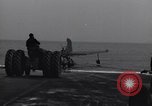
Curtiss SO3C Seamew, OS2U Kingfisher and a bi plane being launched and retrieved at Montauk, Long Island.
Seaplanes being launched and retrieved from water at the beach in Montauk, Long Island during World War II. Crewmen standing at the beach. A Curtiss SO3C Seamew is launched from a ramp into the water. A bi-plane is eased down the ramp into the water. A U.S. Navy OS2U Kingfisher is towed back up the ramp after returning from flight.
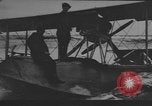
A still photograph of men standing on a Curtiss HS-1 or HS-2
A still photograph of a two place U.S. Navy Curtiss HS-1 or HS-2 flying boat, circa 1918. Men standing on the parked airplane.
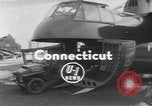
Marines board the U.S. Marine Corps twin engined Sikorsky XHR2S helicopter at an airbase in California.
A new Marine helicopter takes off from Connecticut in the United States. The twin engined Sikorsky XHR2S helicopter parked on the airbase. Marines board and a jeep is loaded in the helicopter. Officers watching the helicopter. The helicopter takes off.
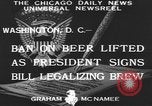
President Franklin Delano Roosevelt signs the Cullen-Harrison act, legalizing 3.2% beer and wine, late in Prohibition
President Roosevelt signs the Cullen-Harrison Act, an amendment to the Volstead Act late in Prohibition, allowing the sale of beer and wine with an alcohol limit of 3.2% by weight. President Franklin Delano Roosevelt seated at a desk in his office. He signs the bill. Men in a beer bar. A man drinking beer.
CRITICALPAST.COM: About Us | Contact Us | FAQs - How to Order | License Agreement | My Account | My Lightboxes | Shopping Cart | Advanced Search | Featured Collections | Website Terms & Conditions | Privacy Policy ©2026 CriticalPast LLC.
License Agreement |
Terms & Conditions |
Privacy Policy
©2026 CriticalPast LLC.