


 Francais
 Deutsch
 Italiano
Refine Your Search
2nd-Rangers-D-Day stock footage and images
- Showing 4795 to 4800 of 13612 results more
more Hide
Hide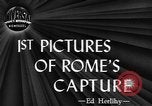
Civilians cheer as the Allied troops enter Rome after liberation from the German army (WW2)
Liberation of Rome, Italy from German forces by Allied troops during World War 2. Opening scenes are of German occupation of Rome earlier in the war during winter campaign, and German forces marching British and American captured allied forces through the streets of Rome. The Roman Colosseum (Piazza del Colosseo, 1, 00184 Roma RM, Italy) seen in background as Allied forces are marched by German armed guards. Buildings along the sides of the street. Damaged buildings and wrecked equipment scattered are seen in the city. German Field Marshall Albert Kesselring looking through field glasses at battlefield. Smoke arises due to firing and bombardment from the Allied and the German army. Heavy artillery is fired including German 280mm cannon. After Germans retreat, the U.S. forces of the 5th Army enter Rome in triumph. U.S. Army General Mark Clark enters with other officers and soldiers in the city. Civilians cheering and applauding. U.S. troops and tanks passing through the city. Bells of Saint Peters basilica ringing. A large crowd gathers in Saint Peters Square (Piazza San Pietro 00120 Città del Vaticano Vatican City) inside the Vatican. Pope Pius XII addressing the crowd. Prince Umberto II of Italy arrives in front of the crowd. Crowd cheering and applauding. American soldiers queue to enjoy real beer served from wooden barrels, made from supplies shipped from the United States. Smiling soldiers fill metal cups with beer. Wrecked railroad marshalling yards in Civitavecchia Italy are seen, as U.S. Army soldiers inspect an abandoned large German Krupp K5 rail gun (Krupp 28-cm-Kanone 5 (E). The gun shown here is either "Robert" or "Leopold" as termed by the Germans, also known by Allied names "Anzio Annie" or "Anzio Express".
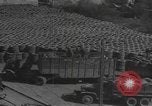
Soldiers and POWs engaged in repairing and reclamation of tires, inner tubes, shoes, and coats during World War 2.
Salvage and reclamation activities in the European Theater during World War II. Trucks parked in a tire servicing area. Tires of vehicles stacked. Men unloading tires from a truck. They are repaired by men inside a building. Techniques and machinery for tire salvage, repair, and reclamation are shown. Completely worn out tires are stacked to be used for other purposes including shoes for soldiers. German prisoners of war are shown making new shoes using reclaimed rubber. German POWs are also shown processing old coats and repairing them for reuse by American soldiers in World War 2. Narrator explains that unusable coats become typewriter covers.

World War 2 commuters in Washington DC; views of new Pentagon War Department Building and DC security personnel
A documentary depicts activities of U.S. Department of War workers in the United States during World War 2. Scenes of various 1940's clocks on bedside tables. War department workers wake up with the alarms. They get ready for work. Cars passing on the streets of Washington DC. Buildings along the sides of the street. People lined up waiting for public conveyance. A bus arrives. Bus and car traffic on the "Highway Bridge" over the Potomac River toward Arlington Virginia. (The Highway Bridge, a swing-span through-truss bridge, was part of the 14th Street Bridge complex over the years. It was eventually replaced by the George Mason Memorial Bridge, and in 1967 the Highway Bridge was removed and taken to the Naval Surface Warfare Center in Dahlgren Virginia, to be used for bombing practice). View of the newly built Pentagon War Department building in Arlington Virginia, and views of large parking lots at the Pentagon filled with cars. Workers walking inside the Pentagon building corridors. A line of women seated and working at telephone switchboards in the Pentagon, and consulting an updated telephone directory. A sign at the door of a room reads 'Security Office, Identification Section'. A woman goes inside. Woman named 'Phyllis Hood' gets her identification card and finger prints for her identification in the office. She is seen taking an oath. Hood working at her desk. She files statistical reports. Exteriors of various Washington DC buildings being guarded by United States Army personnel for the Military District of Washington during World War II. A covered anti-aircraft gun installation in Washington DC is shown opening as US Army soldiers take up positions to use the artillery during practice drills. A guard standing outside the White House building.
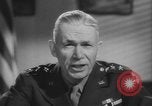
ASF Commanding General Brehon Somervell speaking about the problem of substitution and conversion of needed World War 2 supplies
Production of supplies for American soldiers during World War II. Commanding General of Army Service Forces( ASF ) Brehon B. Somervell seated at a desk in his office in the United States. He explains the serious problem of substitution and conversion and what is being done by American science to meet these needs. Somervell states that he is issuing an order: A command to think along new lines regarding every product essential to the war. He asks: 1) Can it be made as well of some less critical material; 2) Can it be made better, faster, or in greater quantity by some other method of production? He calls on viewers to draw on the brains and ingenuity. View of ordnance insignia. Interior of an office. An officer and a draftsman examine a machine gun. Exhibit of mannequins wearing uniforms with supplies for soldiers and nurses. Miniature tents and kitchen equipment. An officer and executives from two rubber production companies check synthetic rubber and collaborate on improvements. Radio engineers at work in front of equipment checking new type equipment. Workers weighing equipment and finding ways to make needed supplies lighter in weight. Chemical warfare officers at work. A soldier with a new plastic gas mask comes out of a room. Medical and other industry leaders around a conference table. Men gathered around tables planning improvements. Workers entering a large aircraft production factory. A man places a paper in a suggestion box labeled "ideas for increasing production."
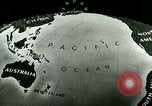
African American soldiers engaged on all fronts in World War 2
Film opens with map of the world showing the various theaters of operation in World War II. Narrator refers to Allies liberating town after town, as they advance. View of American troops being welcomed in a European town during an advance (probably Italy in 1944). Next, African American troops are seen boarding troop transport ships. A huge convoy of ships is seen from the air. Huge piles of war materiel on a dock. Ammunition being delivered by landing craft from the transport ship USS Hunter Liggett (APA-14) to American troops at a beachhead in the Pacific. An African American sailors directs the lowering of a piece of artillery from a ship into a landing craft. Construction equipment being used to clear the way for a new landing field. Docks, roads, and bridges being built as the Allies advance. American troops in the swamps of the South Pacific. American Army engineers clearing trees to build the Alaska Highway (ALCAN Highway) in 1942. Corps of Engineers building the Ledo Road (from India to China) during the war. African American soldiers building a bridge across a river in Europe. A U.S. Army truck under fire, driving along a dirt road in Europe as shells burst all around it. U.S. troops firing various kinds of field artillery and tank guns. U.S. infantryman using a flame thrower. Closeup of African American soldier using a bayonet and others firing small arms. A tank being blown up by artillery fire. A Japanese Mitsubishi A6M3 Zero aircraft maneuvers overhead in the Pacific theater. An African American soldier runs to man his Browning .50-caliber, water-cooled antiaircraft machine gun, and begins firing as the Zero fighter plane strafes his position. Closeup of Japanese pilot in his cockpit and his machine guns firing from leading edges of his plane. His rounds strike all around the U.S. gunner, who turns and follows him with more fire. His tracers show behind the plane. Closeup of the African American gunner as he continues firing. View of the Japanese airplane rolling over and diving. Next the Japanese plane, aflame, crashes on a tropical island and explodes. (Note: It is apparent that some of these combat scenes have been made up of clips from other sources, edited into this film.) (World War II; WW II; World War 2; World War Two)
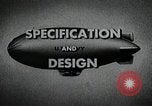
The design of a ZP2K airships is explained in the United States.
From a U.S. Navy training film in the United States on the working of airships. Specifications and designs of airships are explained. Fleet type airships are called ZP2K airships. Animation shows the design of an airship. Helium in the airship can lift 15 tons. A man aboard an aircraft carrier. Parts of an airship are explained.
CRITICALPAST.COM: About Us | Contact Us | FAQs - How to Order | License Agreement | My Account | My Lightboxes | Shopping Cart | Advanced Search | Featured Collections | Website Terms & Conditions | Privacy Policy ©2026 CriticalPast LLC.
License Agreement |
Terms & Conditions |
Privacy Policy
©2026 CriticalPast LLC.