


 Francais
 Deutsch
 Italiano
Refine Your Search
2nd-Rangers-D-Day stock footage and images
- Showing 5311 to 5316 of 13612 results more
more Hide
Hide
Demolished Homes in Shiba District of Tokyo city soon after end of World War 2
Demolished homes in Shiba district. Demolished Shiba district. Rubble on the ground from bomb damage and destruction. A woman cooks in a shanty dwelling during time of poverty.
Contrast between Chinese and Japanese national aspirations before Second Sino-Japanese War and WW2
Film reviews China's four thousand years of history. Scenes showing mountains, woods, and a farmer plowing with oxen in rural China. A mass of Chinese people tightly packed together as they walk along a narrow alleyway in a town. Fleeting glimpses of two Chinese soldiers; a child; a woman; a woman and child; and numerous other Chinese people in a montage splayed across a background of moving crowds. An open book of Chinese characters. Mariners compass superimposed on an moving image of an ocean liner. Views of several large-scale astrolabes and world globes. A Chinese worker placing porcelainware in an oven for glazing. A man spooning gunpowder into a dish, followed by glimpse of a Chinese firework igniting. Chinese paper Dragon and street celebrations. A book entitled: "Analects of Confucius," in which, on page 105, is found the admonition: "What you do not want done to yourself, do not do to others." Ancient statues of two men and of two riderless horses behind them. Tall Chinese pagodas. Chinese artillery field pieces firing. Chinese troops advancing in several situations during conflict with Japan. Map of China and illustration of Japanese samurai warrior emblazoned across it. A book entitled: "The Tanaka Memorial, (Japan's Dream of World Empire)." A still photograph of Japanese Foreign Minister Baron Tanaka Giichi in military uniform, with other Japanese officers. Excerpts shown, ostensibly from this book. Emperor Hirohito is seen with Baron Tanaka, and other officers, all in military uniforms, in front of a tent, circa 1928. Automated map ostensibly illustrates the elements of a Japanese plan of conquest, starting with Manchuria for raw materials; the absorption of China for manpower; followed by a sweep South for riches of the Indies and Australia; and lastly a sweep eastward to crush the United States. More views of crowds of Chinese people are followed by an. animated map illustrating early World War II events, including Nazi Operation Barbarossa against Russia, approved by German leader Adolf Hitler in 1940, and the Nazi German occupation of Denmark, Norway, and other European countries. (Note: Actual existence of the so-called "Tanaka Memorial Imperialist Conquest Plan" is a subject of debate among historians.)
Chinese employ guerrilla warfare against Japanese occupying forces in the Second Sino-Japanese War (WW2)
Opening scene shows closeups of many smiling Chinese Guerrilla fighters during the Second Sin-Japanese War (World War II). Animated map shows Japanese occupied areas as clinging to lines of communication (roads, railroads, and waterways), Japanese troops, carrying Rising Sun flag, march into a Chinese town. A Japanese armored boat, flying the naval ensign, cruises along a narrow stretch of river, with a large Chinese fortress in the background. Its officers watch carefully through binoculars. A Japanese armored train is seen patrolling a stretch of railroad. A long line of Chinese guerrilla fighters marching along a dusty road carrying a variety of weapons. Some, both men and women, are seen. One carries a homemade flag. The camera pans across them, all carrying shouldered arms. Chinese farmers threshing grain by shoveling it into the air, as they might have done before becoming guerrilla fighters. One guerrilla carrying two grenades around his neck. Many marching with shouldered arms and conical straw hats on their backs. Views of their feet clad in sandals. More scenes of Chinese guerrilla fighters marching. Animated map shows guerrilla attacks against Japanese-held lines of communication. A Chinese guerrilla fighter running through a field, banging a tin to sound a call to arms. Others picking up weapons and responding. Next, a group of them are seen diving into a river and moving along low to the water. Others are seen running across a ridge of rock. Still others come over a hill ostensibly attacking a Japanese patrol. Two large explosions and black smoke are seen behind running guerrilla fighters. Another scene also shows Chinese guerrillas running from an explosion. Heavy smoke and Wreckage of building and equipment at a railroad site. Japanese troops struggling to transit marshes and mud, with horses pulling artillery pieces, and many men pulling a rope to retrieve a sunken field piece from a stream. One Japanese officer wipes his face with a handkerchief, as he confers with others about the situation.
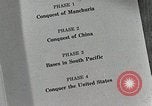
Japanese aggression in China and various events leading to Japanese attack on U.S. at Pearl Harbor (WW2)
A hand writes check marks beside “Bases in the South Pacific” and “Conquer the United States” on the summary report purporting to reflect phases of Japanese so-called "Tanaka Plan". Animated map shows pressure by German forces in offensive against Soviet Union and illustrates German air war against Britain. Scenes of bombing destruction in Britain, including overturned double-decker bus in ruins of buildings. A Nelson Class British battleship viewed from dead ahead. She is followed by the aircraft carrier HMS Illustrious. The U.S. Capitol building in Washington, DC. American newspaper headline reads: "Navy Bill Passes House." and "Huge Sum Voted for Two Ocean Navy." A line of U.S. Navy battleships underway, led by the USS Mississippi (BB-41). A field full of U.S. M3 Lee tanks moving in formation, as they are overflown by several Douglas B-18 bombers. Assembled Japanese leaders in a forum. Japanese Naval officers in a planning conference. Closeup shows Admirals Shigeyoshi Inoue and Raizō Tanaka pointing at a chart and conversing as other officers look on. Next, bomb bursts and black smoke rises as the attack on Pearl Harbor is underway. The USS West Virginia, USS Tennessee, and the USS Arizona, burning on Battleship row, during the attack. Generalissimo Chiang Kai-Shek with staff officers walks to a waiting car. Forces allied with China, including American troops marching; British troops marching; and Dutch Colonial troops marching (in Batavia, the Capital of the Dutch East Indies). Japanese troops continuing their conquest of China, firing a field piece, and infantry charging. Newspapers announce Japanese advances into Malay Peninsula and Hong Kong. Others cite the Fall of Singapore and the Fall of Corregidor in the Philippines (6 May, 1942). Animated map shows Japanese occupation encompassing Indochina, Thailand, and Burma (with loss of the Burma Road) all of which compounded China's war efforts.
U.S. Lieutenant General Daniel Sultan explains Japanese aggression in China and need for troops in India and Burma during WW2
World War II film about the China, Burma, India (CBI) Theater of Operations. A soldier is seen filling out a form seeking information about him and inviting him to write in questions about anything he hadn't learned through normal information channels. Scene shifts to Information and Education Department of the Burma-India Command, where it is being processed by a soldier. Lieutenant General Dan I. Sultan, commander of Burma-India Theater, is seen next, seated at a desk, with wall map of the region behind him. He is appearing in an information film intended to inform troops under his command. He notes that more than half the troops who filled out the information form, asked why American troops were stationed in India and Burma. He refers to the recent recall of General Stillwell and the splitting of CBI into two theaters (China and India/Burma). He states that the purpose is a path toward Japan. An animated map shows China (that narrator notes has been fighting Japan since 1937). Animation shows Japan walling off China from the outside world, by seizing her ports, and then concentrating its grip on the Eastern part of the country. Without access by sea, the allies had only one option to assist China in the fight against Japan. That was to open the Burma Road. Film shifts to scenes of Japanese bombing of Shanghai and Chinese civilians abandoning the city in 1937 during Second Sino-Japanese War. Wounded and injured Chinese fighting fires while tending casualties in an open area. Glimpse of Chinese soldiers near one of their few large artillery pieces. A gun crew manning one of her few antiaircraft guns. Chinese jam road in trek to the unoccupied provinces of the country. Chinese carrying casualties on stretchers, making do without ambulances. Chinese coping in the face of all kinds of shortages. In contrast, well supplied Japanese troops are shown in formation. Japanese troops, military vehicles and equipment are seen. Japanese firing machine guns and heavy artillery against Chinese positions. Japanese armor and long lines of troops engaged against the Chinese, who continue to resist in spite of shortages and hardship. Chinese soldiers without shoes, marching in a column.
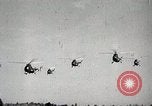
Technological advances in the United States after World War 2 shared with other NATO member countries
U.S. Marines dropped off from U.S. marine helicopters at a landing zone during maneuvers. and then running on a field. Representatives of United Nations permanent member countries in a weekly conference session meeting of the permanent council. Exterior views of U.S. Capitol building with American flag flying. U.S. Congress in session in Capitol building. Technological advances in U.S. U.S. President Eisenhower on a visit passes beneath a sign "Atoms for Peace" and observes various displays dealing with atomic power and nuclear power. An early nuclear power plant in Idaho, and view of an electical power plant control room that uses power from the nuclear plant. Doctor in a hospital checks a patient using a atomic scanner. American workers work in Oil fields in the United States -- view of many oil rigs in one area and two oil workers working on an oil rig. Tractors and modern large harvesting devices being used in farms. Miners sit in mining rail carts and then enter a mine on the rail cart. Sign on wall at coal mine entrance reads, "Inland Steel Company." And below it another sign, "Price Mine Number 1. 1950." (deep mining operation in Price, Kentucky). Mechanical mining cutter used in mine is seen turning out many large chunks of coal. Rail carts transport raw ore out from the Price, Kentucky coal mine.
CRITICALPAST.COM: About Us | Contact Us | FAQs - How to Order | License Agreement | My Account | My Lightboxes | Shopping Cart | Advanced Search | Featured Collections | Website Terms & Conditions | Privacy Policy ©2026 CriticalPast LLC.
License Agreement |
Terms & Conditions |
Privacy Policy
©2026 CriticalPast LLC.