


 Francais
 Deutsch
 Italiano
Refine Your Search
2nd-Rangers-D-Day stock footage and images
- Showing 547 to 552 of 13614 results more
more Hide
Hide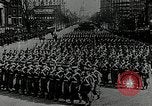
Early 20th century America footage; establishment and early circumstances of the U.S. Department of Labor
Film opens with view from a building overlooking President Woodrow Wilson's Inauguration Day parade along Pennsylvania Avenue, on March 4, 1913. A large contingent of U.S. Army West Point cadets march in forefront of the parade. Spectators line the sidewalks. Several stand atop buildings. Outgoing President, William Howard Taft is seen in his office signing a bill establishing the U.S. Department of Labor. Closeup of the bill and Taft signing it. Scenes of traffic and pedestrians in New York City. Some of the pedestrians appear to be wealthy class. Crowded early 20th century city streets filled with various horse drawn carriages together with bus traffic and early automobiles in chaotic confusion. A double decker bus with open top and sign "Fifth Avenue" and lower sign "To 22nd Street Only" operates in busy traffic on 5th Avenue beside horse drawn carriages and other motorized vehicles. Glimpses of women working in a factory; Men pouring molten metal into molds; Women punching time clocks as they leave a factory. Newly arrived immigrants at Ellis Island, New York City circa 1910 or during first 10 years of the 1900 decade. View of the Statue of Liberty. Women working in a textile factory. Men tapping a furnace in a steel plant. Pushcarts and peddlers at market lining the curb in a Jewish neighborhood of New York City (possibly lower east side). Brief view of pioneer Labor leader Samuel Gompers, founder of the American Federation of Labor. He hold a walking stick and doffs his hat. Sketches illustrating scenes of labor-related violence. Department of Labor sign being affixed to its location. A horse and wagon, representing the first assets of the new Department. A group of persons illustrative of the employees in the Department's Bureau of Labor Statistics.
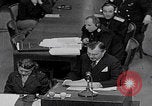
Chief Prosecutor Robert H. Jackson enumerates German laws during the Nuremberg trials
United States Chief Prosecutor Robert H. Jackson continues his speech on the Criminality of Organizations during Day 70 of the Nuremberg Trials. Robert H. Jackson speaks to the tribunal at the Nuremberg Palace of Justice (Fürther Str. 110, 90429 Nürnberg, Germany). Secretary take down notes beside him. Other guests listen to his speech from their seats behind him. Jackson enumerates the various laws from the German Strafgesetzbuch (1871 Penal Code of the German Empire) that prohibits secret associations and associations inimical to the state. Jackson also cites Weimar Republic laws such as the March 22nd 1921 Law against paramilitary groups and July 1922 law against organizations aimed to overthrow the constitution of the German republic.
United States 182nd Regiment lands and invades city of Cebu in Philippines.
U.S. 182nd Regiment lands on Cebu. U.S. landing crafts approach Cebu beach. Troops wade ashore. Palm trees in the background. Major General William H Arnold mapping the drive to city. Equipment is unloaded by men. U.S. troops advance toward Cebu city and encounter road blocks. They sweep for land mines on their way to city. A Bomb is taken out of a hole. Dead body of American soldier killed by land mine. 4.2 inch mortars are brought forward by the 80th Chemical Mortar Battalion (CMB) on beach. Tanks and troops advance towards a village where first organized enemy resistance is encountered. Troops take cover behind trees and fire rifles at Japanese snipers hiding in houses. Trooper throws grenade in house and moves back. Explosion in house. House is set on fire. Wounded Japanese comes out of house and falls down. Troops advance further. Troops greeted by civilians. Native carriages, tanks and troops advance in village. Japanese prisoners under guard. Troops move through rubble and wreckage of building in village. Troops advance through old military installation Fort San Pedro. Wreckage of building. Troops move along streets of Cebu. (World War II; WWII;World War 2; WW2)
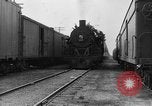
U.S. Army troops of the 442nd Regimental Combat Team arrive for training at Camp Shelby during World War II
Training of American troops of Japanese ancestry, at Camp Shelby in Mississippi, during World War 2. Film opens showing a steam locomotive heading toward the camera, pulling a long train of passenger cars from which U.S. Army troops of the 442nd Regimental Combat Team, comprising American soldiers of Japanese ancestry, are seen waving from the windows. They step from the train, carrying their personal gear in duffle bags. Two African American train porters in white coats assist some soldiers as they leave the train. The troops load their gear and climb aboard canvas covered 2-1/2 ton army trucks that drive into Camp Shelby. The camp's Water tower and chapel building are seen in background. One soldier reads newspaper with headline:"Rommel Reported Moving Out Men,"(referring to German General Rommel and his Afrika Korps). Next scene shows troops gathering up their gear and marching off the their billets
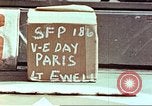
Ceremonies around Tomb of Unknown Soldier beneath Arc de Triomphe on V-E Day (Victory in Europe Day, WW2)
V-E Day (Victory in Europe Day) celebrations in Paris, France at the end of World War II. Eternal light under Arc de Triomphe (Pl. Charles de Gaulle, 75008 Paris, France). The Tomb of Unknown Soldier decorated with flowers and civilians pay respect. Parisians applaud. Floral piece of French insignia carried by two British soldiers. Ceremonies around the Tomb of Unknown Soldier. Loudspeakers being used in ceremony. U.S. P-47 Thunderbolt fighter aircraft dives and goes in a Victory Roll.
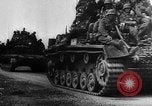
Montage of World War II images,covering Eastern Front, Pacific, and European theaters of operation
German troops advance on the Eastern Front during World War 2. Russians employ scorched earth policy . Oil tanks ablaze and dams and structures blown up. Germans lay siege to Stalingrad. A Soviet troops in urban combat in Stalingrad. A German soldier is shot and falls. Views of awful destruction. Animated map showing Leningrad and the Gulf of Finland and Lake Ladoga on either side. Views of Leningrad in snow. Citizens bundled against the cold, walk near historic structures. Food being distributed. Soviet troops in defensive positions. Animated map shows outbreak of Soviet forces in pincer movement that surrounds the German 6th Army. Two Soviet armies meet as they close the pincer. German Field Marshal Friedrich Paulus surrendering to Soviet forces on 31 January 1943. Troops of the German 6th Army make their way through the snow as they surrender. Battlefield cemetery, with markers of German soldier's graves. Numerous Soviet citizens, victims of the fighting, seen lying in the snow, as relatives grieve. Scene shifts to the Pacific theater with view of Japanese bombers flying over an installation flying the Rising Sun flag. Scenes of the Pearl Harbor attack. American workers fill yard near a war plant during shift change. Defense industry workers in the plants. Liberty ships being launched. American forces in amphibious assaults. U.S. forces engaged in North Africa and on Pacific islands. American soldiers at battlefield gravesite. General Dwight D. Eisenhower with General Omar Bradley and Allied military leaders, look over a map of Europe, following the June 6th invasion in Normandy. Fields filled with Sherman tanks and other war materiel, in England. The wing of an American airplane in D-day stripes as it takes off. Views from cockpit of an American bomber striking targets on D-day. B-17 bombers in formation at high altitude, leaving condensation trails in the sky. Pilots in cockpit of an American bomber, as they drop bombs. Allied fighters in D-day stripes peeling off to attack. Gun camera views of fighters strafing German targets. Explosions and fires.
CRITICALPAST.COM: About Us | Contact Us | FAQs - How to Order | License Agreement | My Account | My Lightboxes | Shopping Cart | Advanced Search | Featured Collections | Website Terms & Conditions | Privacy Policy ©2026 CriticalPast LLC.
License Agreement |
Terms & Conditions |
Privacy Policy
©2026 CriticalPast LLC.