


 Francais
 Deutsch
 Italiano
Refine Your Search
2nd-Rangers-D-Day stock footage and images
- Showing 559 to 564 of 13614 results more
more Hide
Hide
U.S. soldiers aboard a Landing Ship Tank and aboard a LCI(L) preparing for the invasion of France in World War II
American troops preparing for the invasion of Europe during World War 2. United States Army soldiers on board an LST (Landing Ship Tank) docked in England, three days before D-Day. (Slate month is wrong.) Soldiers eat C rations on the deck of LST. They rinse their mess kits in hot water. Several soldiers assigned kitchen police duties wear helmets displaying "KP." Soldiers sit along gunwales of Landing Craft Infantry LCI(L) number 88. (This craft is one of five that will land on Omaha Beach on D-Day, as part of Assault Group O-1, Commanded overall by Captain Fritzche, U.S. Coast Guard. The LCI(L) 88 belongs to Flotilla 10, and is commanded by Lt. Henry K. Rigg, USCGR)
Red Devil paratroopers of British 1st Airborne Division, drop into Holland to outflank the German Siegfried Line in World War II
At start, the film shows a formation of American C-47 transport aircraft with paratroopers starting to jump from them during World War 2. Viewed moments later from the ground, the sky is filled with trooper' open chutes, descending. An animated map shows Netherlands, Belgium, Luxembourg, and Germany. It shows location of the Allied paratroopers drop in Holland, intended to spearhead a drive around the Main River into Germany. The map then shows German forces encircling the paratroopers and the Second British Army heading North to the rescue. Next, a huge number of American Soldiers are seen assembled out of doors in England. Closeup of General Dwight D. Eisenhower speaking in a microphone to the assembly. Closeups of soldiers including some who are American Army Air Corps pilots, and other aircrew members, mostly Lieutenants. Senior Paratrooper officers stand at attention in front of formation of troopers with American flag beside them.(Narrator says these were the men who made up the "lost division," heroes who fought alone for seven terrible days.) General Eisenhower makes his way between close ranks of the paratroopers. He is followed by Brigadier General and a Colonel. Lieutenant General Lewis H Bereton also makes his way through the ranks. Scene shifts to a base in England where many British Airspeed AS.51 Horsa gliders are seen with paratroopers heading across the airfield to board. American C-47 aircraft are seen in the background. All aircraft are painted with D-Day stripes. Several British and American paratroop officers review a map together. At a tent camp, A military policeman and two U.S. paratroopers checking their weapons and ammunition. Some troopers sharpen their knives. A trooper is issued Dutch and German money. A British and and American trooper in camouflaged helmets, pose before a glider with a huge British roundel on its side. British paratroopers boarding a Horsa glider, named "Gertie." A Horsa glider moving as it is towed by a British Whitley twin-engine bomber. View from side of runway as the bomber takes off with its towed glider behind. (Narrator comments: "Destination, Holland.") Formations of tow planes and gliders in flight. View of pilot in cockpit of a Whitley bomber. Formations of fighter aircraft in flight overhead. View from inside an aircraft as paratroopers exit through a side door. Sky filled with paratroopers in chutes descending. (Note: This Allied thrust into Holland to launch a drive around the German Siegfried Line was known as the Allied joint American-British "Operation Market Garden," which took place 17 to 25 September 1944, the 7 days referred to by the film Narrator. )
Allied invasion force departs England en route to France for invasion of Normandy, in World War II.
D-Day minus 1 (June 5, 1944) U.S. Invasion craft jammed into harbor at Weymouth, England, the day before D-day, during World War 2. Troops sitting on deck of LSI(L) 88, drinking coffee and playing dice game. One soldier looking through binoculars, at an English woman,in doorway of her flat, who is looking back through her binoculars. Several other women in the flat complex are hanging laundry out to dry.The American soldier cups his hands and tries to call out to the woman.One of his friends joins in the fun. Scene shifts to Formation of U.S. B-26 bombers in flight. A city is viewed from a bomber, with smoke rising from bomb bursts. Formation of U.S. B-17 bombers escorted by P-47 fighters. Scene shifts back to troops at port of embarkation, where large group is seen at a Catholic mass being held on a pier by U.S. chaplain.LCI(L)s numbers 49, 89, and 93, are seen tied up in background. A U.S.Coast Guard officer briefs his crewmen. Several of the invasion fleet ships begin moving out of the harbor. A U.S. Navy Captain, conversing with Major General Clarence R. Huebner, Commander, U.S. 1st Infantry Division, on deck of a ship. Buckley-Class Destroyer escort, in camouflage paint, is seen with other other escorting warships. Barrage Balloons fly aloft. View from LCI(L) departing pier in Weymouth. Several others preparing to depart as well. LCI(L) 498 is seen closeby. Columns of invasion craft underway. Captain Miles Imlay,USCG, deputy commander, Assault Group O-1, and Commander of Flotilla 10, on the bridge of his flagship, LCI(L) 87. The U.S. Attack transport USS Samuel Chase (APA-26) is seen. Soldiers loading rounds into an ammunition belt. Crew members on an invasion ship man an antiaircraft gun (as friendly aircraft fly overhead). An 83-ft Coast Guard rescue cutter. U.S. Battleships. Soldiers napping on deck of the USS Samuel Chase. Below decks, a Coast Guard Commander joins others being briefed with help of a mockup of the Normandy coastline.
Wreckage of American military vehicles and equipment at the beach of Iwo Jima island of Japan, during World War II.
Seven days after D-day in the Battle of Iwo Jima. Wreckage of American amphibious craft and war materiel in aftermath of amphibious assault by U.S. marines on Iwo Jima during World War 2. A solitary U.S. Marine climbs over section of wrecked Higgins Boat (Landing Craft Vehicle Personnel-LCVP) on the shore of Iwo Jima. An undamaged Landing Craft Infantry Large--LCI(L) seen in in water in background. Closeup of the wrecked Higgins Boat. Camera shifts focus to some wrecked Landing Vehicles Tracked at the water's edge. Wreckage of a landing craft stenciled: "L5V2-13." The surf inundating the wreckage. A jeep mired in sand at the water edge. A jumble of broken boats and parts in the surf.

Operations of United States 8th Air Force 492nd Bomb Group in England during World War II.
Operation Carpetbagger by the 492nd Bomb Group of United States 8th Air Force during World War II. View of automobile traffic on a London Street. London "Carpetbaggers" personnel working at the London headquarters of United States Army Air Forces 8th Air Force. At Harrington field men load supplies on trucks for French resistance forces (Maquis, FFI). Men workout the daily packing schedule. Men pack guns, grenades, machine guns and other ammunitions. Special H containers and C containers for loading 303 ammunition. Boots, socks being packed. Gasoline Jerry cans being put in containers. Men place guns in containers. Instructions in French also placed with the supplies for the French resistance forces. Men pack explosives and radio sets. Medical supplies put in baskets. Harness and parachute shops in Holmes where men attach parachutes to containers. Packages being transported to airfield for dropping to the targets. A man on a telephone informs about the daily supplies to Special Forces headquarters in London. S-2, an intelligence officer forwards the list received from London. A man plots the target area on a map. In the weather room detailed map of the area is being prepared. Officers make a selection of the targets. S-2 informs the headquarters about the route of the planes. Supplies being loaded onto United States B-24 aircraft specially configured to carry and drop the containers using the bomb rack system in the aircraft. Flight crew is briefed before the operation. Chief Navigator talks about the course to be taken by the planes and the targets to be hit. Pilots work on a flight plan. Aircraft take off. An officer reports about the take off of the aircraft to the 8th Air Force headquarters.
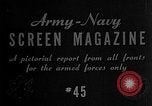
Film describing the 100th Infantry Battalion, 442nd Regimental Combat Team, comprising Americans of Japanese ancestry, in World War II.
Film opens showing relatives of fallen American soldiers of Japanese ancestry who made the ultimate sacrifice in the European theater of operations, during World War 2. The dead soldiers were members of the United states 100th Infantry Battalion, 442nd Regimental Combat Team. The relatives are assembled in an auditorium at a military installation in Hawaii, where the 100th Infantry is conducting a ceremony honoring their fallen heroes.Camera pans over some of the relatives. Decorations for valor are presented posthumously to some of the surviving relatives. A widow receives the Silver Star. A father receives the Distinguished Service Cross. A mother receives her son's award. Film shifts to scenes showing artillery batteries of the 100th Infantry in action at numerous battles in the Italian Campaign, including Naples, Cassino, Rapido River, Pisa, Anizo and others during World War 2. A column of 100th Infantry accompanied by armor, are seen entering Livorno, Italy. Members in a jeep are seen passing through area of complete destruction. Others pick their way through rubble, as civilians bass the opposite way,carrying salvaged belongings, Troops of the 100th move cautiously and deploy near barricades to shield from snipers. They escort captured German prisoners. Battle casualties are seen being carried into field hospitals. A medical team performing emergency surgery inside a tent. Wounded and convalescing patients being tended by a woman Army nurse. Others recovering outside tents at the field hospital. A group of 100th infantry troops taking a break. One of their medics is interviewed. Gunners seen with Browning M1917 machine gun. Troops preparing a meal in the field. A soldier presenting paper airplanes to Italian children who fly them. M4 Sherman tank parked on Italian street. Battalion members attending a Roman Catholic mass in the field. Army interviewer asks a Japanese-American Lieutenant why he fights in the U.S. Army. He responds saying "I'm fighting over here for the better things of life, and to preserve the American way of living."
CRITICALPAST.COM: About Us | Contact Us | FAQs - How to Order | License Agreement | My Account | My Lightboxes | Shopping Cart | Advanced Search | Featured Collections | Website Terms & Conditions | Privacy Policy ©2026 CriticalPast LLC.
License Agreement |
Terms & Conditions |
Privacy Policy
©2026 CriticalPast LLC.