


 Francais
 Deutsch
 Italiano

Refine Your Search
8-inch-howitzer stock footage and images
- Showing 595 to 600 of 2106 results more
 Hide

A uranium mine, a nuclear fission plant and technicians working on radioactive matter in Canada.
A film about the structure of atom and the use of radioactive isotopes in the treatment of cancer in Canada. Exteriors of a uranium mine at Great Bear Lake. Coal being transported in a narrow gauge mining train. A man pours coal from a container. Exteriors of the Nuclear Fission Plant at the Chalk River. Trucks driven in front of the plant. Director Dr. Keyes, Dr. Lewis and K. F. Topper discuss. A four inch lead wall block to protect technicians working on radio active matter.
Allied Naval Task Force operations supporting Amphibian assault on Salerno, Italy, in World War II
Opening scene shows the USS Savannah (CL 42), on 11 September, 1943, after being struck by a German remotely controlled glider bomb released from a high flying German aircraft, She was supporting Allied amphibious operations at Salerno, Italy, in World War 2. Next, after fires were put out and smoke cleared, The disabled Savannah is seen sitting low in the water, making way slowly, among other Naval Task force ships in the background. (She made way to Malta under her own steam for emergency repairs.) Views of the Savannah passing as she heads for Malta. A Fletcher class destroyer fires her naval guns at the shore. Attack transports and other support ships are seen nearby. More views of support ships, including the USS Samuel Chase (APA-26). A barrage balloon seen above the convoy in some scenes. Sailors manning a Bofors 40mm anti-aircraft gun aboard a U.S. warship. A British Escort Carrier with number 337 on her bow. Sailors with a Oerlikon 20 mm cannon aboard a warship. The British Escort Carrier seen earlier, (with number 337 on her bow) passes the camera ship. Aircraft are seen on her flight deck. A Navy warship firing 40mm Bofors and 5-inch guns as it lays down a smoke screen.
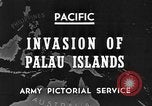
U.S. 1st Marine Division invades the Palau Islands during World War II.
Film opens with animated map showing places in the Pacific near the island of Palau. A formation of U.S. B-24 Liberator bombers is seen in flight. Glimpse from the air of the Palau archipelago. Aerial view from a B-24 of its bombs exploding on the center of a Japanese airfield below. Aerial view of a U.S. Independence-class Aircraft carrier of Task Force 58. Officers and sailors on carrier island watch as a Grumman F4F Wildcat aircraft takes off .from the aircraft displays geometric marking on its tail, known as a "G-symbol." In this case it is a large white diamond containing the airplane number inside another diamond. (The United States Navy Pacific Fleet, assigned G-Symbols to the CV and CVL class carriers of Task Force 58. These were assigned to each carrier and appeared on all aircraft operating from it. ) A formation of Grumman TBF Avenger aircraft flying above clouds. Closeup of one with diamond G-symbol and number on its tail. Broad view from the air of TBF Avenger aircraft in flight and Navy warships maneuvering in waters below. Sea level views of some warships in the Third Fleet. One is a Portland-class Cruiser. Wide aerial view of ships in the task force. Cruisers and battleships bombarding Palau and nearby targets. Closeup of heavy cruiser USS Louisville (CA 28) firing her port side 5 inch 25 caliber guns and 40 mm A/A guns from the stern.. A TBF Avenger dive bombs a shore target. More views of warships with shells bursting in background. Shells bursting at the shoreline. Closeup glimpse of marines in landing craft U.S. Marine Corps LVT(A)4 Amphibious Tanks heading toward the beach on September 15, 1944. An LCI(L) Landing Craft Infantry (Large) firing close to shore. Shells striking shoreline installations. View from aircraft of landing craft speeding toward the beach and many more maneuvering offshore. Closeup of marines moving about on the shore of Palau with smoke rising and sounds of gunfire. A marine running through foliage at the shore. Marines manning a command post and communications center in the jungle. Marines firing rifles from a tree line. One firing a Browning M1919 machine gun and another throwing a hand grenade. Marines firing rifle grenades. Marines move forward and encounter a dead Japanese soldier lying next to his flame thrower. They reach the edge of the airfield, where two Japanese aircraft are just barely seen. They walk past dead Japanese at a machine gun emplacement. More views of Marines fighting at the edge of the airfield, and entering into the open area of the field, where fires are burning. .Wrecked Japanese aircraft are seen on the field. Marine infantry cross the field behind an M4 Sherman tank. Barges are seen carrying construction cranes and equipment to the island. A tracked crane drives onto the airfield. Bulldozers work on the edge of the airfield. A power shovel fills trucks with coral deposit material for resurfacing the airfield. Trucks dumping their contents at the field. Bulldozers and earth scrapers level the airfield surface. A TBF Avenger aircraft is the first to land on the unpaved airfield.

A 6 year old boy gets a shave and bends a rod with his mouth in Toledo, Ohio.
Clarence Kehr with distinct characteristics in Toledo, Ohio. The 6 year old boy is 3 feet, 5 inches tall and unusually strong and physically developed for his young age. Clarence lying on a stretcher. Men and a woman perform tests on him. A man measures his muscles. He shows his muscles. Another man checks his memory. He writes on a blackboard. The boy bends a rod with his mouth. Clarence seated on a chair and gets a shave. A man combs his hair.
U.S. marines process Japanese prisoners on Betio, Tarawa, during World War II. Seabees begin restoring the airfield
U.S. 2nd Division Marines process about 10 Japanese soldiers taken prisoner on Betio, Tarawa atoll, during the battle there in World War 2. They cut away the prisoners' clothing to assure they don't carry weapons or explosives. (Narrator states they were later given replacement clothing from captured supplies.) Marines tend to a wounded Japanese prisoner. Japanese prisoners carrying their own wounded to a pier for evacuation. Marines cleaning up using water from captured Japanese steel barrels. Marines stand on fortifcations containing British Vickers BL 15 inch Mark I coastal defense guns captured by the Japanese in Singapore. These were knocked out by U.S. naval gunfire during the pre-assault bombardment. Closeup of one breech of a gun. A knocked out Japanese light tank at the South side of Japanese Rear Admiral Shibasaki's headquarters on Betio. (Shibasaki, commander of the Japanese forces there, was reportedly killed by U.S. Naval gunfire early in the assault.) Panning view of the remains of the reinforced concrete Japanese headquarters structure. U.S. Seabees using power shovel, dump trucks, graders, and heavy rollers, to restore the airfield for U.S. operations.

NCAA Track and Field events in Austin Texas, June, 1957
Gregory C. (Greg) Bell, a sophomore at Indiana University, is seen making his record-setting long jump of 26' 7", to win the national collegiate title on June 14, 1957, in Austin Texas. Bell sitting on the ground after his jump. Sequence shifts to the track where Don Bowden, of California, is running well ahead of favored Ron Delany, of Villanova, to win the 800 meter run in 1 minute and 47.2 seconds. (Note: Delany won the 1500 meter run in 4 minutes 6 and a half minutes.) The next day, on June 15, 1957, Bob Gutowski, of Occidental College,California, is seen breaking the World record in the pole vault at a height of 15 feet 9 3/4 inches. He poses momentarily afterwards.