


 Francais
 Deutsch
 Italiano

Refine Your Search
8-inch-howitzer stock footage and images
- Showing 601 to 606 of 2106 results more
 Hide
Color Sound
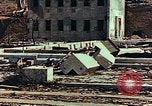
The damaged buildings in a Medical School and the damaged stone monument after the atomic bombings in Nagasaki, Japan.
Physical damage caused by the atomic bombings in Nagasaki, Japan towards the end of World War II. The Medical School. A collapsed granite column in the destroyed building which originally stood between building H and J. The direction the column fell. The mannered in which the column sheared when it hit the stone steps. The granite column which originally stood just south of the entrance of a wooden frame building between buildings H and J. The columns and relative distance they were moved. A wall of a building H. The remains of the wooden frame structure which was situated between buildings H and J. The face of the building H clearly shows manner in which this building was attached to south wall of building H. The face of building J in the background with foundation of a wooden frame structure, which was destroyed by fire in the foreground. The wall of building D of reinforced concrete structure. The shadows cast on flash burn surface of building by roof overhang and a water pipe and copper down spout. The wall of the building F, a reinforced concrete structure, whose west wall although affected by blast did not fail completely. The three fourth inch concrete stucco scrubbed off. The dissecting tables in a small building which was employed as an autopsy room. A monument off the north east corner of building G, the direction trees fallen on monument with the column of building in the background. The stone monument with following inscription engraved in German 'Perseverance Leads to Success'.

British troops with their luggage embark a ship and a salvage crew takes out a sunken ship hulk from the Suez Canal in Egypt.
British troops evacuating from Port Said in Egypt. United Nations Commander General Eedson Louis Millard Burns gets off from an aircraft. He is greeted by officers. British troops at a dock. The troops aboard a ship leaving for England. The troops with their luggage embark a ship. The ship leaves the dock. A statue. Sunken ships in the Suez Canal. A diver jumps in water for preliminary survey. The sunken ships in the canal. The salvage crew aboard a ship tie a 9 inch cable for taking out hulks. The attached cable. A ship hulk taken out from the canal. The ships in the canal.

A conductor takes full fare from children in a streetcar according to a height rule in Detroit, Michigan.
A height rule to decide fare for children in Detroit, Michigan. The height rule decides a child's age- if the height is more than 44 inches, the child is equal to or more than 6 years and has to pay full fare. Children and their parents get on a streetcar. A conductor takes fare from the children. The children get down the streetcar.

The barrel of a railroad gun is lowered during World War I.
U.S. soldier stands on top of a railroad car as another on a platform operates controls to lower the barrel of a 14 inch railway gun.

Women using old newspapers for padding in order to conserve cotton in Europe during World War I.
Salvage of cotton, needed for explosives in Europe during World War I. Women spread old newspapers on a table and make a stack of the papers. The women sew the stack with thread. After sewing they cover the stack and stitch it in equal distances by measuring inch tapes.

Japanese Naval guns and aircraft attack British targets in Indian Ocean and environs, in World War II
Animated map shows Indian Ocean,with Bay of Bengal; Ceylon; India and cities of Madras and Calcutta; and Burma and city of Rangoon. Two Japanese aircraft carriers are seen in waters off Rangoon, during World War 2. Officers aboard looking through binoculars. Antiaircraft guns on one of the carriers. A Japanese Mitsubishi A6M (zero/Zeke) airplane is readied and takes off from the carrier, followed by another. Several are seen flying in formation over the city of Rangoon. Sounds of explosions and smoke rising, as the Japanese bomb the city. Black smoke from exploding flak is also seen. Scene shifts to a Japanese warship firing 5.5 inch guns at a British ship which is hit by shellfire. The ship explodes emitting dense white smoke, and sinks from sight. Three A6M Zeros fly overhead. Aerial view of a British ship being bombed, and burning.
CRITICALPAST.COM: About Us | Contact Us | FAQs - How to Order | License Agreement | My Account | My Lightboxes | Shopping Cart | Advanced Search | Featured Collections | Website Terms & Conditions | Privacy Policy ©2026 CriticalPast LLC.
License Agreement |
Terms & Conditions |
Privacy Policy
©2026 CriticalPast LLC.