


 Francais
 Deutsch
 Italiano

Refine Your Search
8-inch-howitzer stock footage and images
- Showing 67 to 72 of 2105 results more
 Hide

World War 2 film promoting public investment in War Bonds and stamps to aid the war effort and temper inflation
World War 2 era film that also includes some World War 1 scenes. Show girls or chorus girls in follies-like show, costumed as U.S. silver dollars and marching to tune and lyrics alluding to dramatic increase of currency in circulation, over the years. Animation with stacks of coins shows increase in national income from $46 billion,in 1933, to $71 billion, in 1939, and $142 billion in 1943. Back to the "follies dollars," a boy asks why, and then scenes of the Japanese attack on Pearl Harbor,are shown, with U.S. battleships being sunk. Wartime arms plants are shown. An M2A3 Light Tank rolls off a production line. Ships being constructed in a shipyard. B-24 Liberator bombers being built in a factory. Artillery shells being produced. Defense workers receiving their pay. The "follies dollars" group themselves to illustrate the fractions of income devoted to taxes and savings. But other spending is curtailed by wartime shortages. A woman talking with clerk in a drug store. U.S. Army troops crossing a pontoon bridge in open trucks, towing 75mm M1A1 howitzers. Infantry on the march. Animation showing industrial production devoted to war materiel and lots of dollars chasing few civilian goods. A grocery clerk offers to sell a woman customer butter for more than the established price, and she agrees. The "follies" performers then introduce the idea of an "inflationary dollar," and some history of past U.S. inflations. Animated examples of price inflation are shown. Glimpses of World War I scenes are seen, circa 1917 -1918, including: a 12-inch railway gun firing; a huge explosion from shell bursting near the camera; various scenes of United States infantry soldiers and French soldiers in battle action, running to bomb craters for cover and emerging from trenches to go up "over the top" into no-mans land during combat. Meanwhile, singing narration refers to the home front inflation due to competition for limited civilian goods. Map shows Europe and singing narration cites rising prices for food in occupied France and other countries suffering ravages of World War II. Montage of scenes showing needy civilians obtaining food in those countries. Animation shows increases, by 1944, in cost of U.S. civilian goods since the Pearl Harbor attack. "Follies" character called "Double-duty dollar," appears explaining he serves the war and curtails inflation on the home front by being saved through investments in War Bonds and stamps.
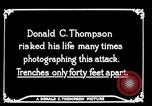
French soldiers engaged in trench warfare, during World War I
French troops engage Germans (not seen) from trenches only 40 feet apart, during World War 1. explosions create a line of white smoke in background, as French troops are photographed in a deep trench by camera from above. Glimpse of a French Schneider 240 mm howitzer firing. Shells striking and heavy white smoke rising. French troops in a deep trench, lined with woven wood sticks. They use a grenade launcher to propel ball grenades. Grenades striking and raising clouds of white smoke. A French soldier by several canisters placed in a trench. He ignites one that begins to emit white smoke. He quickly leaves the trench as all the canisters ignite and generate large clouds of white gas that drifts toward the German trenches. Views from evacuated position of the gas rising and drifting. Several French artillerymen firing a heavy gun. They run to the rear of the gun as it fires and some cover their ears. More views of the gas drifting toward German trenches. A German shell explodes on or near the French trench where the gas is being generated. A battery of French 120mm long guns mounted on railway flat cars. They fire tear gas shells. View of the same trenches shown earlier, with gas continuing to cloud the area, and a shell exploding in the midst of it. French soldiers in a fortified position,load,tighten,and release a grenade launcher, propelling a grenade toward German positions. An Aasen mortar (Mortier Aasen) 3.5-inch (88.9-mm) gun-mortar firing gas shells from a trench. White smoke rising from shell strikes. Small German shell or grenade, exploding just outside a French trench. French soldiers hunched down and moving quickly through a trench, and then going "over the top," in a charge. (Note: This footage was filmed by the famous American World War 1 photographer, Donald C. Thompson, as indicated in the opening slate.)
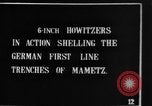
British soldiers fire at German positions before the Battle of Somme in France during World War I
British Army at the Battle of Somme in France during World War 1. A 6 inch Howitzer fired at German first line in Mametz, France. Explosions occur and smoke rises. A Canadian 60 pounder fired at German positions. Soldiers fire the 60 pounder from behind sand bag mounds. Shrapnels burst over German trenches. Infantry and cavalry units of London Scottish and East Yorkshire march forward for the battle area. A Priest conducts a prayer service as soldiers stand around him in a circle before the Battle of Somme.
Scenes of battle during World War I. Signing of the Kellogg-Briand Pact in 1928
Opening scene shows a British Siege battery of several 9.2 inch howitzers. View from a protected position, of a huge shell exploding. A formation of French Spad airplanes in flight. A French Renault F-17 light tank traversing rough terrain near a forest. Bombs being dropped by hand from an open cockpit airplane. Three bombs exploding on the ground. German troops running past the camera. Glimpse of others in a trench in the background, who appear to be wearing Pickelhauben. Explosions with dense white smoke. A fallen soldier on a litter, on the ground. Nighttime view of artillery flashes. Troops silhouetted against fires burning in the background as they move at night. Smoke blowing across the scene, as artillery fires. A railroad gun firing. A battery of two French 320 mm railway guns. A shell exploding in a field. French 320mm gun firing. Two French 370mm railway guns. One is firing. A soldier sheltering in a deep shell hole and smoke rising all over No-Man's Land. Wounded soldiers recuperating in a hospital. Patients and medical staff posing for photographs in a ward. Signing of the Kellogg-Briand (Pact of Paris) outlawing war, on Aug. 27, 1928, at the Palais D'Orsay, in Paris, France.
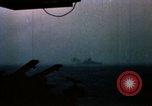
U.S. Marines land on an island and ships battle enemy during the Pacific campaign of World War II.
U.S. ships battle enemy during the Pacific campaign of World War II. The battleships fire rockets in distant background during a night battle. A landing craft moves through water between the ships. Marines go down a net into a boat. LCVP (Landing Craft Vehicle Personnel) loaded with marines ready to leave the side of a ship. American flag flies from LCVP. A photographer in the boat as itheads for a beach. Camouflaged destroyer underway. Main battery on the ship fires guns. Twin 5 inch gun barrels fire. Shells strike near the shoreline. The landing craft heads for the beach during invasion. LSMR (Landing Ship Medium Rocket) fires rockets at the beach. The island partially obscured by smoke arising from rocket explosions. Camouflaged cruiser class ship fires. Explosions on beach of island. Destroyer fires. Three planes in flight over water. Marines look skyward. Formation of aircraft in the sky. Rockets and bombs explode in the beach area. Destroyer underway is firing guns. Landing crafts underway in all directions in water. LCVP underway. The photographer in a landing craft takes pictures. An LCVP hits the beach. Marines disembark from the landing craft. They move inland past debris and hide behind dunes. 155mm howitzer is fired. Dead body of a Japanese soldier.
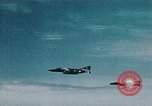
The battle of Khe Sanh in the Vietnam War.
Film begins showing two U.S. Air Force McDonald Douglas F4 Phantom jet fighters in flight. Narrator says American intelligence reports on January 29, 1968, of a 4th North Vietnamese Regular Army Division in the Khe Sanh area, bringing total enemy strength to about 40 thousand regular troops. View of photo interpreter rolling large wet film taken by Air Force surveillance aircraft. Map of Hue, area of South Vietnam, showing disposition of American forces in the region. American Marine Colonel David E Lownds, Commander of Khe Sanh garrison, describes North Vietnamese offensives against some American held positions. Views of North Vietnamese attacks being repelled by artillery and air strikes as well as organic infantry weapons like the A1 millimeter mortars, 3.5 rockets, and M79 machine guns. U.S. aircraft drop munitions on enemy positions. Infantry firing guns mounted on vehicles. An F4 Phantom drops napalm that creates a swath of fire. Closeup of North Vietnamese newspaper warns that the Americans face a defeat comparable to that of the French at Dienbienphu. American newspapers express concerns about the fate of the Marine Garrison at Khe Sanh. U.S. Army General William Westmoreland, Commander of U.S. troops in Vietnam, is seen and heard expressing confidence that American forces would win the battle of Khe Sanh. American troops listen as he speaks. Marines in briefings and in combat, including African American Marines. American artillerymen load and fire a 175 mm field gun at Camp Carrol, and a location called the Rock pile with a network of trenches. Inside that base, are seen Ontos M50A1 multi barrel anti-tank tracked vehicles armed with 105 mm recoiless rifles. A marine fires a 4.2 inch mortar, and another fires a recoiless rifle. Marines firing a 155mm howitzer. Scene shifts to deck of an aircraft carrier. View of Navy F4J phantom fighter aircraft being launched from the USS Ticonderoga (CVA 14) (Note: this may be an anachronism. Reportedly, the F4J was not operating from aircraft carriers in the Vietnam until after 1968). F-4 Phantom fighters taking off from an Air Force base. Aerial view of a U.S. Air Force B-52 bomber dropping conventional bombs on North Vietnamese targets. View from the air of bombs exploding on the ground over battlefield terrain. A C-130 transport plane dropping supplies to U.S. marines on the ground. View from below of the parachutes descending with supplies. Closeup of C-130 dropping mail from above. More views of parachute drops from C-130 aircraft to Khe Sanh. C-123 transport landing at a Marine base and a C-130 taking off. Another C-123 landing. Another having load delivered by low level extraction. Marines on the ground at Khe sanh opening packages of supplies and using a tractor to transport large boxes. On February 13, Marines suffered casualties when a platoon was ambushed just outside the base perimeter. View of Marine on a litter. Heavy black smoke rises at the base from shelling by North Vietnamese artillery. A C-123 aircraft takes off with dense black smoke in the background. Another napalm attack by a U.S plane creates a large conflagration. View from above of a B-52 dropping bombs only yards outside the Khe Sanh perimeter. Marines patrolling close in the base. More views of B-52s bombing North Vietnamese targets. View of nighttime bombing operations. A Marine plotting enemy movements on a plexiglass chart. Marines manning machine guns as enemy rockets and mortars continue to pound the garrison. Officers are seen in CINCPAC Command center. Continued U.S. bombardment and air strikes appear to prevent massing of enemy forces for an assault. Marines controlling hills in the area. A UH-1 Iroquois (Huey) helicopter flying low over the base. During a lull in battle Marines fill sand bags, maintain their weapons, play cards, and keep occupies as they sit and wait. Some play basketball with an outdoor improvised backboard and net. Some marines select books from a library. A marine plays a guitar as some others listen. Closeups of Marines in trenches including white and African American Marines. Marines doing their wash and having a meal of C rations. Marines preparing their own combinations of ingredients into meals being cooked over open fires. Views of many marines eating the various mixes of C-rations they called "casseroles." Marines in trucks pursuing retreating elements of North Vietnamese on Highway 9 that had been opened by Marine engineers. U.S. Army First Air Cavalry reinforcements arrive in operation Pegasus. Marine engineers working to restore bridges and roads needing repairs. Soldiers detecting and neutralizing mines. Bell UH-1 helicopters ferry troops. Captured enemy arms and ammunition. Surrendered North Vietnamese soldier prisoners of war marched under guard.