


 Francais
 Deutsch
 Italiano

Refine Your Search
8-inch-howitzer stock footage and images
- Showing 73 to 78 of 2105 results more
 Hide
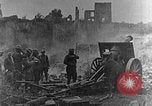
Troops fire artillery at German enemy causing heavy explosions in Europe, World War I.
British artillerymen fire a British 18 pounder Field Gun during World War I. Some soldiers cover their ears with hands during firing.Shell explodes raising smoke and dirt. British artillerymen firing rail gun. Impacting shell raises huge upheaval of earth. Gas shell bursts in no man's land. British troops sheltering in large bomb crater, are forced to advance out of the crater as gas or smoke canisters land nearby. British artillerymen operating two rail guns. One is fired. Exploding artillery shell in distant town. British artillerymen manning a 4.5 inch howitzer that has just been fired, behind a brick wall in midst of destroyed buildings. Smoke emerges from the gun barrel. A shell bursting in the distance. British infantry charging over the top out of trenches. A medic comes back to aid a wounded soldier on the battlefield. Russian Imperial cavalry moving in formation on a field.
Numerous scenes showing evolution of mechanized warfare emphasizing World War I. but including footage as late as 1934
Montage of scenes illustrating development of mechanized warfare beginning with American Expeditionary Forces (AEF) engaged in World War I. U.S. Army infantry soldiers moving out of trenches going "over the top" into "no man's land" and advancing on battlefield. U.S. troops firing Browning M1917 machine gun,1903 Springfield rifles, and Stokes mortar from trench positions. Soldiers firing mortar are wearing gas masks. AEF trucks and other vehicles ostensibly an improvement over horses, but seen having difficulty in mud. A truck pulling a large artillery gun. A German 80cm K (E) rail gun (developed in 1934) shown at the Rugenwalde Test Range in Germany. It moves along curving rails and is elevated to its maximum elevation (65 degrees). Two World War 1 rail guns firing. An American World War I Naval 14-inch rail gun firing. Allied heavy howitzers firing in World War 1 (one with gun crew in gas masks). American gunners with a French 75 field piece and caisson. French soldier advancing in no-mans-land. The Wright brothers brought warfare into the air with their Wright Flyer airplane, seen being maneuvered on the ground by U.S. Army personnel at Fort Myer, Virginia in July 1909. A De Havilland DH-4 airplane taking off in World War I. A German Fokker D.VIII aircraft in flight. Three U.S. Army Air Service Curtiss P-1B Hawk pursuit aircraft in flight, circa 1926. Aerial dogfight scene including view from behind a pilot in open cockpit biplane (from feature film, circa 1927). Brief view of Renault FT tank maneuvering in World War I. Narrative and clips shift to historical perspective of warfare, showing use of horse and chariot, starting in ancient Assyria and use of elephants in later years by Hannibal. Pictures of mounted soldiers, in the middle ages, waging war in armor, and being transported in a wagon. Shift to World War I showing British Mark IV tanks maneuvering in a field.
81st Infantry Division “Wildcats” attack Suicide Hill during the Battle of Angaur (WW2)
81st Infantry Division “Wildcats” mortar and artillery crews bombard Japanese positions at Suicide Hill during the Battle of Angaur in World War II. Artillery officers communicate and give orders through telephone and walkie-talkie. An M2 4.2-inch mortar firing as a crewman load shells into it. Explosion from mortar fire hitting Japanese positions. Artillery crew firing howitzer. Crewmen duck and cover their ears as mortar fire. Japanese positions are bombarded by mortar and artillery fire all day and night. Medics treat wounded patients the day after the bombardment. Medics lay down a stretcher carrying a soldier. They place another soldier on a stretcher. The medics carry the soldier away. Medics drive a Jeep carrying a wounded soldier on a stretcher. A wounded man being carried over by two soldiers. Soldiers resting outside a makeshift hospital. A doctor treats the wounds of 322nd Regimental Commander Colonel Benjamin W. Venable. Colonel Venable receives IV fluids Close view of IV fluid bottles hanging from ceiling. Medics carry Colenel Venable out of hospital.
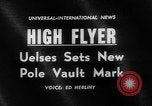
John Ueslses sets a new pole vault record of 16 feet three fourth inches in Santa Barbara , California.
A new pole vault record being set in Santa Barbara, California. John Ueslses tries to set a 16 feet pole vault record. He uses a pole vault to jump over a bar. He registers a mark of 15 feet and 8 inches. In his second attempt he jumps over the bar and sets the record of jumping over a height of 16 feet and three fourth inches. An official measures the height jumped over by Ueslses.
Condensed highlights of U.S. forces engaging Japanese in Pacific island-hopping campaign (WW2)
Aerial view from high altitude, shows convoy of American warships underway in the Pacific War in 1943 (World War II). Nearest ship seen is an aircraft carrier. Illustrated globe and animated map show a Naval Task Force headed through the Gilbert and Marshall Islands. Three U.S. Navy Douglas Dauntless dive bombers seen flying in formation with an aircraft carrier steaming in the background. Glimpse of more aircraft carriers. Sailors in the powder handling room of the Cruiser USS Chicago (CA-29) carrying cylinders of powder for her 8-inch guns. Sailors, stripped to the waist, in one of her gun turrets, load an 8-inch shell and powder charges into the breech of one of Chicago's guns. Interesting view from below, as they close the breech and step back as the gun fires. Glimpse of Naval guns firing from a U.S. warship. Another view of sailors loading an 8-inch gun on the USS Chicago. (Note: The USS Chicago was lost between Rennel Island and Guadalcanal in the Solomon Islands on 30 January 1943.) A Baltimore Class Cruiser firing its guns. Flashes from naval guns firing from several American warships in close succession. Fire directed at the shore of a Japanese held island. Gun camera footage from a U.S. warplane strafing Japanese aircraft on the ground at an enemy air base. More gun camera footage of strafing and bombing. Closeup of a U.S. Army Air Forces B-26 Liberator bomber in flight, with others in the background. Views from U.S. Aircraft as their bombs strike Japanese targets on the ground below. A U.S. Navy TBF Avenger aircraft flying overhead as viewed from a landing craft. View from inside a landing craft full of U.S. troops heading toward an amphibious landing. Closeup glimpse of Coxswain in landing craft and troops aboard behind him. Amphibious landings being made under fierce friendly and enemy fire. U.S. troops leaving their landing craft under enemy fire. Marines firing small arms, machine guns, and using hand grenades, in Tarawa, Kiribati. Views of fallen Japanese defenders on Tarawa. Closeup of Marine smoking a cigarette. Another is binding shoulder wound of a buddy. American flag raised on one of the few still standing palm trees. American Marines saluting the flag. Bodies of fallen American marines floating at the shore and on the sands of Tarawa. Marines departing Tarawa. Scene shifts to Chinese Kuomintang (KMT) leader Generalissimo Chiang Kai-Shek, seated with President Franklin D. Roosevelt and British Prime Minister Winston Churchill at Cairo, Egypt on 25 November 1943. Leading Allied military leaders sit at a table to hammer out details of postwar plans. American officers present include U.S. Army Chief of Staff George Marshall and Chief of the Army Air Forces, General Henry H. ("Hap") Arnold.
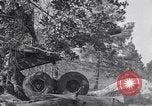
Howitzer in forest, firing on target and receiving directions on phone via liaison plane,Naples Italy.
Naples Italy during World War II. 8" Howitzer under cover of trees, firing at a target. U.S. Army soldiers talk on field radio phone and receive directions from a liaison plane. Soldier read maps and plot coordinates for firing of howitzer. American soldiers look through sights of the Howitzer and adjust controls. View through howitzer barrel shows rifling inside. View of liaison planes parked in a field.