


 Francais
 Deutsch
 Italiano

Refine Your Search
Adak Alaska USA 1943 stock footage and images
- Showing 55 to 60 of 27411 results more
 Hide
Color Sound

Tourists ride a sightseeing train of the Alaska Railroad from vicinity of Mount McKinley, to Seward, Alaska.
Tourists seeing Alaska from train of the Alaska Railroad. View from interior of a sightseeing car of the railroad. Passengers stand about and look out at the scenery as the train moves along parts of Alaska. View from the train traversing rail line along a river in vicinity of Mount Mckinley. Snow on the ground. View to the rear showing rugged terrain over which the rail line passes along the edge of a river. Closeup of a building with sign reading "Anchorage" and noting 353 miles to Fairbanks and 114 miles to Seward. View from inside the train as it passes through a Snow shed (aka avalanche gallery) where the light creates interesting effects. View exiting the snow shed. Steep mountain sides with snow in that area. View looking back at a curved trestle and track already passed over. Change of scene to the waterfront at Seward, where the train has arrived. Commercial boats and ships in the water. View of a seaman climbing a rope ladder in rigging of a ship. A mountain overlooking the city
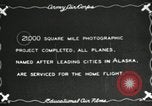
Members of the U.S. Army Air Corps 1934 Alaska Flight complete their photo-mapping mission and are ready to fly home
The U.S. Army Air Corps (USAAC) Alaska Flight of 1934. The YB-10 aircraft of the project after completing their photo-mapping of 21 thousand square miles of Alaska. The aircraft have each been named for leading Alaskan cities and are fueled and ready to fly home. View of the YB-10 flown by Expedition Commander, Lieutenant Colonel Henry Arnold, displaying painted name "City of Fairbanks" and flag containing stars of Big Dipper and Polaris (North Star). The symbol of the expedition is also painted on the fuselages of all the airplanes, consisting of a totem pole topped by an Eagle with two arrows, superimposed on a map of Alaska. Names: Anchorage, Fort Yukon, Tanana, and Kodiak, are seen painted on airplanes. Aviators of the USAAC Alaska Flight pose for a picture in front of a YB-10 aircraft. Lieutenant Colonel Henry Arnold, Commander of the expedition, is in the center of the first row of men. To his right, is a pipe-smoking officer in a campaign hat, holding a puppy Husky dog. Arnold pets the puppy

H W Terhune, the Executive Game Commissioner of Alaska inspects moose head along a lake in Alaska.
The Carpenter-Whitney Expedition in Alaska. Largest species of moose family, Kenai Moose spotted in a forest area. The moose walks into the bushes. H W Terhune, the Executive Game Commissioner of Alaska, with assistants, arrives by boat. The Commissioner inspects a large moose head along a lake.

The Army Air Corps Alaska Flight support ship, "El Aquario," underway in the Gulf of Alaska
Views from the deck of the Army Air Corps Alaska Flight support ship, "El Aquario," as she makes way close to shore in the Gulf of Alaska. Snow covered mountains dominate the landscape. Bow waves break as the ship heads into less protected waters. She beins to roll in white-capped seas and then pitches and rolls with water breaking over her bow, in heavy seas.

Fliers of the 1934 U.S.Army Air Corps Alaska Flight, amuse themselves in Fairbanks, Alaska
View of the new Federal Building on Courthouse Square, in Fairbanks, Alaska, where members, of the 1934 U.S. Army Air corps Alaska Flight set up an office, during their stay in Fairbanks. A flight mechanic attending to one of the YB-10 aircraft has with him, two black bear cubs on chain leashes. They cavort on the aircraft wing for the camera. Next, one bear cub is seen on the nose of the airplane. Finally, the two cubs play on a step ladder in front of an aircraft.

Views of Alaska mountain range from photo-mapping YB-10 aircraft of the USAAC 1934 Alaska Flight.
Film shot during the U.S. Army Air Corps (USAAC) Alaska Flight of 1934. View from a YB-10 aircraft flying over snowy mountains in Alaska. Perspective of the cameraman inside the YB-10. Downward view of mountains covered in deep snow. Some mountains at lower elevations with streams flowing down their slopes. Cumulus clouds obscuring the ground and interfering with the photo-mapping mission for the photograpers. Cloud capped Mount McKinley (aka Denali) seen off the aircraft wing at a distance of 75 miles.
CRITICALPAST.COM: About Us | Contact Us | FAQs - How to Order | License Agreement | My Account | My Lightboxes | Shopping Cart | Advanced Search | Featured Collections | Website Terms & Conditions | Privacy Policy ©2026 CriticalPast LLC.
License Agreement |
Terms & Conditions |
Privacy Policy
©2026 CriticalPast LLC.