


 Francais
 Deutsch
 Italiano
Refine Your Search
Adak Alaska USA 1943 stock footage and images
- Showing 643 to 648 of 27381 results more
more Hide
Hide
The crew of whaler Herman visits the village of Gambell on St. Lawrence Island.
Cruise of the whaler Herman to the Arctic. The whaler at St. Lawrence Island in Alaska. The crew visits the village of Gambell. Tents in the village. Dogs with sledges. Native women with children on their shoulders. Native families. Dogs lie on the ground.
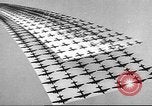
United States Air Transport Command operations during World War II.
Animated description of the U.S. Air Transport Command (ATC) network of routes covering 110 thousand miles connecting U.S. Air Forces bases across the globe in World War 2. Formation of C-47 transport planes flying overhead. Air Force dispatcher annotating blackboard with flight schedules. A C-47 taking off. A crew arrives in a jeep and goes to their C-87, 4-engine transport plane, parked outside the operations building of the Aloha Transport Command, Honolulu, Hawaii. C-47s in flight. A C-45 landing at a remote Pacific island. Cargo, including a jeep and a live pack animal.being loaded into a C-46 Commando airplane. C-47s delivering an operating field hospital to Alaska and delivering shipments of grenades to troops on Guadalcanal, who are seen using them in combat. A Consolidated C-87 cargo aircraft in flight.(its landing gear not fully retracted).

The whaler 'Herman' returns home to Alaska.
The whaler 'Herman' returns home. A glimpse of the midnight sun. Man handles the steering wheel of the ship during stormy weather. Waves splash over the deck. Men work to control the ship, adjust sails. Pressure from ice packs against the shore piles the ice up in large ridges. The large ridges in the water. The crew on the ship. The ship touches San Francisco. A pier on the coast.
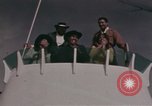
Montage of scenes previewing show "It couldn't be done." Band 5th Dimension aboard a boat singing song If I had a Hammer.
A television program named 'It couldn't be done' hosted by Lee Marvin. Vocal band the 5th Dimension aboard a boat sings the song,"If I had a hammer". Series of brief images show amazing human endeavors underway: Split screen view of face of George Washington being sculpted on Mount Rushmore Memorial by Lincoln Borglum, son of lead sculptor Gutzon Borglum. Animated cartoon image of a bridge from Alaska to Russia and the man behind the idea. View of Golden Gate Bridge under construction and split screen of one of the men who helped build it. View of Hoover Dam and Alaskan Highway. Dam building workers rappel down cliff sides during construction of Hoover Dam. View of Golden Gate Bridge completed. Dam worker throws switch to set off dynamite explosion during Hoover Dam construction process. Alaskan Highway under construction. Worker on Mount Rushmore rappelling over nose on one of the carved faces. NASA Apollo 11 Eagle Landing Module approaching the moon surface and view of moon surface below it. Neil Armstrong walking on the moon during first walk on the moon by a human being. Show host Lee Marvin walks on the beach. Construction workers with hard hats scaling steel girders of a tall skyscraper building under construction in a city.
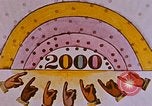
Development of technology over the years and forecasts for the future of technology; Buckminster Fuller interviewed.
Cartoon Animation shows the development of technology and inventions over the years and makes forecasts about new developments in the future, in the year 2000 and beyond. Harbor in Alaska, train enters tunnel, houses in caves. View of early aircraft and cars to the present day mode of transportation. Missile launched from launch pad. Vehicles that float on water and fly in air. Television program host Lee Marvin talks about increase in population in 2000, and scientists plans for floating cities and hover craft vehicles that will move about the earth's lands and oceans in the 21st century. Futurist, architect, inventor, and designer Buckminster Fuller is shown walking with his dog, and then shares his thoughts about the future during an interview.

Various "firsts" in U.S. aviation history from 1918 through 1924; early history of flight and vintage flight scenes
Shows several aviation "firsts" accomplished by U.S. Army Air Service aviators in the period from 1918 through 1924. A close formation of biplanes in flight. President and Mrs. Woodrow Wilson chat with Major Fleet, Officer in charge, on the occasion of the first air mail flight, inaugurated on May 15,1918 between Washington DC and New York.The mail is loaded into the Curtis JN-4 aircraft. Pilot in the cockpit. The aircraft takes off and in flight. Air Service. Mention of aviators helping spot forest fires. Smoke rising from forest fires and mountain ranges. In 1920, U.S. Army Captain St. Clair Streett is seen with some of his Squadron who flew four De Havilland DH-4 aircraft 9,000 miles, from New York City to Nome, Alaska. Two of the men play with pet dogs. Their itinerary is painted on the side of one of the aircraft, along with the names of pilot and mechanic (C.E. Crumline and J.E. Long). In 1923 the first non stop coast-to-coast flight was made in the Fokker T-2 aircraft. . A sign on the aircraft reads 'Army Air Service non stop coast to coast'.First Lieutenants Oakley O.Kelly and John A. Macready board the aircraft, at Roosevelt Field, Long Island, New York, on May 2, 1923. Their Fokker T-2 in flight. Their arrival at Rockwell Field, on Coronado Island (San Diego) California. In 1924, Lt. Russell Maughan is seen boarding his P-1 Hawk airplane at Mitchel Field, on Long Island, New York, and taking off , bound for Crissy Field at the Presidio, San Francisco, California. His goal is the first dawn-to-dusk, coast-to-coast flight. Views of his P-1 Hawk airplane flying over Manhattan, New York City.
CRITICALPAST.COM: About Us | Contact Us | FAQs - How to Order | License Agreement | My Account | My Lightboxes | Shopping Cart | Advanced Search | Featured Collections | Website Terms & Conditions | Privacy Policy ©2026 CriticalPast LLC.
License Agreement |
Terms & Conditions |
Privacy Policy
©2026 CriticalPast LLC.