


 Francais
 Deutsch
 Italiano
Refine Your Search
Adak Alaska USA 1943 stock footage and images
- Showing 823 to 828 of 27381 results more
more Hide
Hide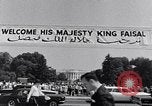
King Faisal of Saudi Arabia rides in a motorcade in Washington, DC, during a formal state visit to the U.S.A.
King Faisal ibn Abdul Aziz Al Saud of Saudi Arabia during a visit to Washington DC. A banner across the street reads 'Welcome His Majesty King Faisal'. Cars move out of the White House. Spectators line the sidewalks outside the White House. The White House in the background. Flags of the United States and Saudi Arabia. A military bands plays. U,S. military units parade. Spectators line the sidewalks. The King and President Johnson in a motorcade. A poster of King Faisal and President Johnson on a pole. A flag of Saudi Arabia and a poster beneath the flag. The King and the President ride in the rear seat of a limousine, with Secretary of State, while Dean Rusk, and another official occupy the seat in front of them. Secret Service agents stand on the rear of the limousine. People standing at the road side applaud to welcome the King. A flag of Saudi Arabia. U.S. military honor guard. The limousine stops at Blair House, across from the White House, on Pennsylvania Avenue. President Johnson and the King of Saudi Arabia step from the car. An greets them and presents the King with a token gift. Photographers take pictures. The King speaks into a microphone, thanking the official for the gift, and also shakes hands with the President. A soldier salutes. President Johnson escorts King Faisal up the steps ot Blair House.
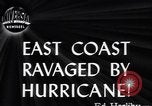
Destruction in coastal northeast USA from the 1944 "Great Atlantic Hurricane" (First example of a named hurricane in the US)
Views of The Great Atlantic Hurricane lashing at northeast United States areas (after having already hit the North Carolina Outer Banks), and views of the aftermath and early cleanup following the storm. Regions shown include Atlantic City, Long Island (where it came ashore as a category 3 hurricane on September 15, 1944), New York City suburbs, and parts of New England. High surf flooding boardwalks and coastal cities. Trees bent over and snapped in high winds. People walking with difficulty in the high winds. Streets of towns submerged in water. Coastal docks destroyed and large boats scattered high onto shore areas. Trees, poles, and wires downed over roads and homes. Entire homes moved off of their foundations and placed down the street. The "Great Atlantic Hurricane" was the first example of a named hurricane by the Miami Hurricane Warning Office, which later became the National Hurricane Center. The name was meant to reflect the hurricane's size and intensity.
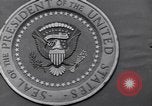
Secretary of State George C. Marshall going for talks, as a representative of the President of USA.
Secretary of State George C. Marshall arrives with President Harry Truman in a car at an airport. The Secretary talks with persons there. President shakes hands with him and bids goodbye. He moves to an airplane which displays on the door an official seal of the President of United States. The Secretary waves goodbye towards the people at the airport. The plane takes off.
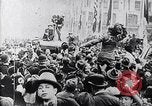
Post World War I political issues in the U.S.A. including Red Scare, anarchists, labor strife, and KKK
A huge crowd on streets of New York City cheering and celebrating victory over Germany in World War I after signing of the Armistice. A cemetery of U.S. soldiers died in World War I. Cross burning and views of hooded Klan members at a Ku Klux Klan (KKK) ceremony, with several uniformed U.S. Army soldiers in foreground, dimly lit (possibly at Stone Mountain Georgia but location not confirmed). Palmer Raid victims: Suspected leftists, left wing, and anarchists seen being led away in a group by police after their homes were raided and searched without search warrants, and some were deported, under program led by U.S. Attorney General A. Mitchell Palmer, during 1919 and 1920. (Second group shown is likely in Paterson, New Jersey; note sign for J.T. Doremus Hardware on building in background.) Palmer Raid arrestees seen behind barbed wire fences where they were held without charges for three months and denied legal representation. Some arrestees being escorted by U.S. soldiers in uniform. Vigilante businessmen and town leaders enforcing 12 hour work days at Steel factories in Pittsburgh Pennsylvania and Gary Indiana. Vigilantes (deputized and armed by local authorities) seen with rifles and shotguns marching down streets enforcing labor demands and countering steel workers on strike. They approach a striking worker on the road side and seize a stick he is holding. They beat a protestor with sticks. Together with police they begin to hit and beat back the protesting crowd of men. Someone fires a gun in the crowd and shooting starts on both sides during fight. An injured or dead steel worker on the ground is lifted up by a man and carried away.
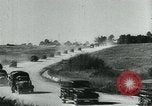
WW2 USA training film about protecting cryptographic messages
A United States military convoy on a road during WWII. Some footage dramatized. Aerial view of convoy from fighter plane. Smoke screen dispersed by plane next to military convoy. Fast moving tanks drive through smoke screen. A very fast tank takes air as it jumps over large mound and comes crashing to the ground. A tank blasted by howitzers loses its tread in explosion. Major Stewart Doyle talks to officers and notes that "it is the duty of every officer when capture is imminent to destroy all codes, documents, and cypher device settings...." In dramatization, a United States army officer transcribes a radio message onto a piece of paper and hands it to a soldier. The soldier, wearing goggles, gets onto a motorcycle and speeds away. View of German sniper shooting motorcycle messenger speeding down road. German soldier steals message bag. German cryptographic decipher team working. Close up of clock as time changes in montage. German radio officer receives message. Convoy on road. German pilots receive command in office. Allied convoy being attacked by fighter planes. Major Doyle reminds viewers to "know your rules on cryptographic security measures...."
Cotton Carnival parade in Memphis Tennessee, USA
Cotton Carnival in Memphis. A series of parties staged at Carnival. Current year's selected King, Queen and Royal Court of carnival. Presentations and parade by all cotton producing states. Decorated floats go by in a night time parade as crowd cheers. Floats have elaborate artwork and kings and queens. Flags of cotton producing states seen on many floats, including Georgia 1956 flag incorporating the Confederate battle flag on the Georgia float.
CRITICALPAST.COM: About Us | Contact Us | FAQs - How to Order | License Agreement | My Account | My Lightboxes | Shopping Cart | Advanced Search | Featured Collections | Website Terms & Conditions | Privacy Policy ©2026 CriticalPast LLC.
License Agreement |
Terms & Conditions |
Privacy Policy
©2026 CriticalPast LLC.