


 Francais
 Deutsch
 Italiano
Refine Your Search
Adak Alaska USA 1943 stock footage and images
- Showing 11863 to 11868 of 27381 results more
more Hide
Hide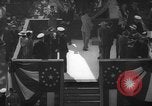
Launching ceremony of submarine USS Sealion (SS-195) from Groton, Connecticut early in World War 2 period
Views of the stage platform for dignitaries, decorated with patriotic bunting, at Electric Boat Company in Groton, Connecticut. Dignitaries including Mrs. Augusta K. Bloch, wife of Admiral Claude C. Bloch, being photographed and filmed. United States Navy submarine USS Sealion (SS-195) on skids just before launching. Flag on bow fluttering in wind. The submarine sliding down the ways into water.
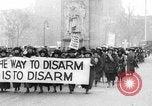
Women pacifists march in New York parade demanding complete disarmament, during anti-war movement of early 1920s
Scenes from a November 12, 1921 protest parade of anti-war women march to support disarmament and promote messages of peace and "No more war". The parade coincided with the start of the Washington Naval Conference, also called the Washington Disarmament Conference. Women march in New York City, under the Washington Square Arch, with a banner that reads "The way to disarm is to disarm." A banner for "Religious Society of Friends" (Quakers). People march holding placards demanding complete military disarmament. A placard reads "Thou shalt not kill" and another reads "War means death famine pestilence." Another sign reads, "Cooperation pays better than competition. Let's try it between nations." A banner reads "Mothers do you teach your sons to save life or to kill?". View changes to parade as it continues on 5th Avenue in Manhattan, New York City. Large banner includes "Immediate, Universal, complete disarmament". Scene changes to Washington DC, several months later, on July 29, 1922. A group of pacifist women in Washington DC in front of their "No more war' banner. Women hang "no more war" signs on a artillery piece that is on display in a public square. Group of women raise their banner for "No more war" in front of the Headquarters of the Council for Limitation of Armaments, located at the National League of Women Voters headquarters building, at 532 17th St., NW, Washington, DC. (The Friends Disarmament Council of the Society of Friends was involved in this group, which was predecessor of the National Council for Prevention of War in the United States.)
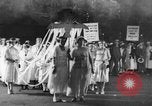
Pacifists, mostly women, march in a night time torchlight parade promoting Peace and Disarmament in the United States
A torchlight parade protesting war. Marchers are principally women. At start of film, a group of about 10 Women, all dressed in white, hold white streamers descending from a dove-like symbol of peace. The parade is conducted along a city street. Smoke rises all around from torches or bonfires beside the line of march. Some women carry a large banner reading: "Thou Shalt Not Kill." Other signs held by marchers appeal to Chemists and others who create tools of war, such as poison gas, to cease and desist such activities One sign reads: "Scientists Use Your Genius for Peace, Not War." A Bahai banner is carried by some marchers. Police officers monitor the march and marchers. Several women drape themselves in American flags. They are accompanied by a Civil War Union Army officer, carrying a sword. Many in the parade carry the same or similar signs and banners. Some are more legible when seen several times. Examples include: "Chemists, Help World Peace, Refuse to Make Poison Gas" and "Exploitation Leads to War, Abolish it." Other notable signs and slogans include: "Mothers pay the Heaviest War Tax;" "War is Not Inevitable. Human Nature does change;" "Immediate Universal Complete Disarmament;" and "We stand with Gandhi for World Peace." The last new one seen reads: " We will not give our children for another war."
Passengers board a Larsen JL-6 transport aircraft and men load cargo in an early model aircraft in the United States.
Aircraft are used for different purposes in the United States. Passengers climb the stairs and into an early model bi winged, twin engined passenger airliner. Passengers exit an early model touring car and get into a U.S. Navy Larsen JL-6 transport aircraft. A pilot gets into the cockpit of the passenger aircraft. The aircraft taxis and takes off. Passengers getting in and out of the cabin of an early model seaplane. An Aeromarine West Indies Airways U.S. and Cuban mail service amphibian, which is a converted U.S. Navy TN-1O airship, in flight over water. Passengers looking out of the windows of the converted TN-1O airship. Men load cargo into the cockpit of a United States Army Air Service Curtiss JN-6 aircraft.
Men load a stretcher patient in a U.S. Navy model of a DH-4 Amb-1 ambulance airplane in the United States.
Aircraft are used for different purposes in the United States. Ambulance aircraft offer fastest means of transporting the injured. A United States Army Air Service Cox-Klemin XA-1 ambulance aircraft taxis. Men put a stretcher patient into a U.S. Navy model of a DH-4 Amb-1 ambulance airplane. The ambulance aircraft takes off and in flight.
U.S. Army Air Service aircraft crop dust fields to kill insect pests in the United States.
Early model aircraft are used for different purposes in the United States. The Department of Agriculture and U.S. Army Air Service kill insect pests. A DH-4D aircraft crop dusts a field. The Department of Agriculture fights boll weevil with the help of U.S. Army Air Service. A DH-D Curtiss aircraft with a Wright engine crop dusts a field.
CRITICALPAST.COM: About Us | Contact Us | FAQs - How to Order | License Agreement | My Account | My Lightboxes | Shopping Cart | Advanced Search | Featured Collections | Website Terms & Conditions | Privacy Policy ©2026 CriticalPast LLC.
License Agreement |
Terms & Conditions |
Privacy Policy
©2026 CriticalPast LLC.