


 Francais
 Deutsch
 Italiano
Refine Your Search
Adak Alaska USA 1943 stock footage and images
- Showing 1315 to 1320 of 27381 results more
more Hide
Hide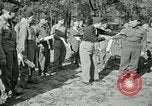
Chaplains attend a first aid class at Harvard University Chaplain school in Cambridge, Massachusetts (WW2)
Chaplains training at Harvard University in Cambridge, Massachusetts during World War 2. Chaplains at an outdoor first aid class. Chaplains learn to wrap a bandage around an arm. They learn to prepare a plaster in case of a fractured arm. The Chaplains look at a map and confer as one of them looks through a sighting instrument. An African American Harvard chaplain holding a sighting instrument.
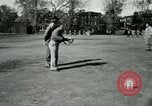
Chaplains undergo gas mask training at Harvard University Chaplain school in Cambridge, Massachusetts (WW2)
Harvard University chaplains undergo training outdoors in Cambridge, Massachusetts in World War 2. Chaplains lined up in a field with bags on their shoulder. They take out gas masks from the bags and wear them. Chaplains wearing gas masks walk towards a door. They enter and exit the door as smoke comes in through the doorway. White and African American chaplains lined up on the field. An officer inspects the Chaplains.
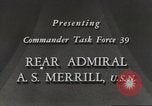
Rear Admiral A S Merrill states his observations on the Commander Task Force 39 at battle of Empress Augusta Bay
Rear Admiral A S Merrill states his observations on the Commander Task Force 39 during the Battle of Empress Augusta Bay. United States B-24 Bomber in flight. The Task Force should develop a tactical doctrine to attack the Japanese enemy. Radar shows the Northern Southern and center Japanese enemy groups in range. Division 45 pass an enemy target thinking it to be friendly. Cartoon animation of a sailor with NBC emblem on sleeve. (World War II period).
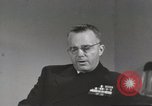
Admiral A S Merrill talks about target recognition of the Commander Task Force 39 during Battle of Empress Augusta Bay.
Rear Admiral A S Merrill talks about target illumination and recognition of Commander Task Force 39 during the Battle of Empress Augusta Bay. Enemy drop star shells. He talks about the speed ships should maintain, the accessibility of CIC to the Captain and planning a tactical plot. (World War II period).
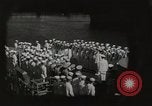
Shakedown cruise of Destroyer Escort, USS Frament (DE-677) during World War II
Destroyer Escort,USS Frament (DE 677) is commissioned during World War 2. Lieutenant Commander S. T. McAdam, Jr., in command, reads his orders to crew assembled on deck. Tug boats move the ship away from the pier. DE-677 underway in shakedown cruise.Officers review daily plans for shakedown cruise. General Quarters alarm is sounded and crew mans battle stations. Gun crews at 1.1 inch, 40mm, and 3 inch guns. Crew members positioned to launch depth charges ("ash cans") , torpedoes, and to fire "hedge hogs" (clusters of bombs). Navy aircraft tows a canvas sleeve target for crew to practice fire against. Antiaircraft gun crews shoot down target.
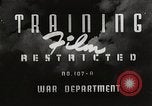
U.S. Army Air forces pilots learn about the Republic P-47 Thunderbolt airplane
From a U.S. Army Air Force Training film, "How to Fly the P-47. Pilot Familiarization." United States pilot seated on table writes a postcard to his mother, "Mrs D.Q. Hopkins. 1024 Clay Avenue, Pelham, New York" Board in the background with 'Daily Assignment of today' written on it. Scene shifts to forward view from cockpit of a Republic P-47 aircraft flying low over the flight line at an Air Base. Momentary glimpse of the pilot and his post card in the office. Back again, to forward view from cockpit of a P-47, but this time it is on final approach to the runway. Scene shifts to ground view of a P-47 landing. It taxis to the ramp and parks. The crew chief stands on the wing as the pilot completes and signs the aircraft's Form 1 (record of any problems). Five pilots walk past the flight line. The pilot, wearing a seat pack parachute, climbs down from the cockpit. The five pilots, seen earlier, approach, and one introduces them to the P-47 pilot (Captain Hopkins). They are Lieutenants assigned to his training flight. He greets them and shakes hands with all. The group ask questions about the P-47. Then they all go to the pilots room. As Captain Hopkins takes off his flight gear he tells them the P-47 is designed to operate at high altitude. He describes the P-47, referencing a large illustration of it on the wall. (World War II; WW II; World War 2; World War Two)
CRITICALPAST.COM: About Us | Contact Us | FAQs - How to Order | License Agreement | My Account | My Lightboxes | Shopping Cart | Advanced Search | Featured Collections | Website Terms & Conditions | Privacy Policy ©2026 CriticalPast LLC.
License Agreement |
Terms & Conditions |
Privacy Policy
©2026 CriticalPast LLC.