


 Francais
 Deutsch
 Italiano
Refine Your Search
Adak Alaska USA 1943 stock footage and images
- Showing 1597 to 1602 of 27381 results more
more Hide
Hide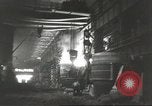
Steel produced at a mill in United States
Steel mill at production in United States. Molten steel poured from the furnace into Bessemer converters. Men shovel coal in the furnace. Molten steel on a conveyor.
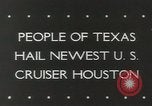
Houston volunteers join military; a new cruiser ship USS Houston (CL-81) launched at a ceremony in Newport News Virginia
Scenes in Houston Texas as 1000 Houston Volunteers enlist in the military in World War 2 to avenge the loss of the USS Houston (CA-30) to the Japanese. They attend a swearing in ceremony in front of the marquee of the Loews State theater. Scene change to Newport News, Virginia as people gather for the launching of the new U.S. Navy cruiser ship USS Houston (CL-81). New cruiser launched at a colorful ceremony. Dignitaries on stand include the sponsor, Mrs. C. B. Hamill, who is seen hitting a bottle of champagne against the ship hull, and then it slides down the ways at launching.
The Countess of Halifax launches USS Natoma Bay (CVE-62) escort carrier in Vancouver, Washington, United States.
A US Navy Escort Carrier carrier being launched from Kaiser Shipyard of Vancouver, Washington, in the United States during World War 2. The ship USS Natoma Bay (CVE–62), a Casablanca class escort carrier, is ready to be launched. Sponsor at the launch is Dorothy Evelyn Augusta Wood (née Onslow), Countess of Halifax, (Wife of 1st Earl of Halifax who was the United Kingdom's Ambassador to the United States; and she was daughter of 4th Earl of Onslow). The Countess of Halifax hits a bottle of champagne against the ship hull and it slides down the ways. The escort carrier gets underway at sea.

American soldiers take a ride in oscillating machines to get used to sea sickness at Camp Edwards in Falmouth, Massachusetts.
Soldiers go for a ride in an oscillating machine at Camp Edwards in Falmouth, Massachusetts. Two soldiers get into two separate oscillating machines. The machines oscillate to make the sea going soldiers used to sea sickness. Other soldiers look on as the machines oscillate. (World War II period).
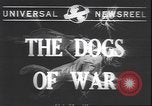
U.S. Coast Guards with trained dogs and horses on a beach in the United States as they run on the beach.
United States Coast Guards with trained dogs in the United States. A dog stands on a barrel. Sailors with the dogs. Coast guards with the dogs. Coast Guards ride horses. They walk and run with the trained dogs.
African American airmen being trained for World War II at the Tuskegee Institute in Alabama.
African American colleges in the United States during World War II. College curricula adjusts to war needs as they prepare students for various military and civilian occupations. A statue of Booker T. Washington. Tuskegee Institute campus in Alabama. African American United States Army Air Force pilots being trained at the institute (Tuskegee Airmen). An aircraft takes off. Airmen in a class. Students being trained for jobs in an aviation plant. Scientists and technicians in a laboratory as they conduct research on the science of nutrition. They work to get alcohol from agricultural products like potato. Women learn automotive maintenance skills to take up jobs during the war time.
CRITICALPAST.COM: About Us | Contact Us | FAQs - How to Order | License Agreement | My Account | My Lightboxes | Shopping Cart | Advanced Search | Featured Collections | Website Terms & Conditions | Privacy Policy ©2026 CriticalPast LLC.
License Agreement |
Terms & Conditions |
Privacy Policy
©2026 CriticalPast LLC.