


 Francais
 Deutsch
 Italiano
Refine Your Search
Adak Alaska USA 1943 stock footage and images
- Showing 17761 to 17766 of 27381 results more
more Hide
Hide
Italian scientists conducts a class, collaborate with American colleagues at the Massachusetts Institute of Technology (MIT)
Italian American physicist Bruno Rossi conducts a class at Massachusetts Institute of Technology (MIT). Professor Bruno Rossi demonstrates a spherical object to male students. An Italian doctor collaborates with American colleagues on cancer research. A doctor retrieves a radioactive vial from a Model LS-6 lead shield (made by Technical Associates of Glendale California). A team of doctors examines a female patient for cancer research.
Italian art found in famous Washington DC landmarks, museums and buildings
View of the Lincoln Memorial Reflecting Pool (2 Lincoln Memorial Cir NW, Washington, D.C., DC 20002, United States) in Washington DC. People entering the Lincoln Memorial (2 Lincoln Memorial Cir NW, Washington, D.C., DC 20002, United States). View of the National Mall, with the Washington Monument seen in the background. Aerial view of the National Mall in Washington DC. Aerial view of the U.S. Capitol park and the U.S. Capitol. View of the U.S. Capitol (First St SE, Washington, D.C., DC 20004, United States). The statue “Valor” by Leo Friedlander flanks the Arlington Memorial Bridge. Dedication under “Valor” reads “VALOR Leo Friedlander Sculptor CAST IN BRONZE MILAN 1950 A GIFT FROM THE PEOPLE OF ITALY TO THE PEOPLE OF THE UNITED STATES OF AMERICA”. Bronze statues “Sacrifice” and “Valor” flank the Arlington Memorial Bridge (2912 Independence Ave SW, Washington, D.C., DC 20418, United States). The Lincoln Memorial building is seen. Cars driving in Washington DC. View of the National Gallery of Art (Constitution Ave. NW, Washington, D.C., DC 20565, United States) in Washington DC. Sign reads ‘NATIONAL GALLERY OF ART”. “Madonna and Child” painting by Sandro Botticelli, on display at the National Gallery of Art. Ambassador Manlio Giovanni Brosio and an American official, Mr. Bunker, views the Alba Madonna by Raphael. View of the Alba Madonna painting. “Portrait of a Man” by Florentine painter Andrea del Castagno. A triptych from the Italian renaissance “The Crucifixion with the Virgin, Saint John, Saint Jerome, and Saint Mary Magdalene” by Pietro Perugino. “Saint George and the Dragon” by Raphael. Trees outside the White House. View of the White House (1600 Pennsylvania Avenue NW, Washington, D.C., DC 20500, United States) in Washington DC. Italian cameraman uses camera labeled “La Settimana Incom”. Italian journalist captures on film President Dwight Eisenhower going out of the White House with men. Italian journalist nods with satisfaction. Fountain in front of the White House. Aerial view of the South Lawn at the White House and surrounding areas.
A couple dines at a trattoria restaurant and plays a game of Morra
A couple dines at an Italian trattoria restaurant. A waiter, wearing folk attire, serves Fettucine Alfredo to the couple while musicians perform traditional Italian music. A young woman tosses a coin in a fountain inside the restaurant. A couple playing Morra- an Italian hand game similar to “Rock, Paper, Scissors”.
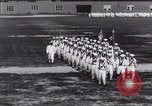
United States Navy recruits marching and performing calisthenics on drill field
U.S. Navy recruits (wearing white uniform) marching in drill field of the Naval Training Station in Norfolk, Virginia, before World War 2. Recruits marching with rifles and banners reading “Eighth Week” and “Training B Unit”. Recruits stand in place and a marching band plays music. Naval officers salute in front of recruits. United States flag in drill field. A wooden scale model of a battleship is seen near the field. A tent for guests to watch marching in drill field. Military band musicians play trumpets, flutes, and tuba (or sousaphone). Recruits and band standing in ranks. Recruits and military band march with the United States flag and banner across the drill field. Men standing in the middle of the drill field. Recruits perform calisthenics simultaneously.
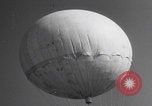
Parts of a Japanese Fu-Go paper balloon bomb (WW2)
A video explaining the components of a Japanese Fu-Go paper balloon bomb- a weapon launched by Japan to drop bombs on the United States during World War 2. A United States Navy personnel inspects the Fu-Go paper balloon on its ballast. Paper bags and sandbags tied to the ballast of the Fu-Go balloon bomb. Payload comprises of incendiaries and anti-personnel bombs. Inflated “Type B” Fu-Go balloon made of 5 ply “washi” rice paper. United States Navy personnel lets go of holding the ballast of balloon bomb. Man unfolds a piece of rice paper. Man ripping a piece of rice paper, demonstrating the durability of the material. Fu-Go bomb inflated with hydrogen gas. Man holding the escape valve of the Fu-Go balloon bomb. Escape valve is shown as made of pressed steel and has a rubber gasket. Pressure is exerted by the rubber ring the escape valve. Spider bracket of escape valve.
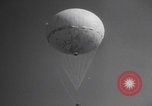
Parts of the so-called Brain Center of a Japanese Fu-Go paper balloon bomb (WW2)
A video explaining the components of the “Brain Center” of the Japanese Fu-Go paper balloon bomb- a weapon launched by Japan to drop bombs on the United States during World War 2. An inflated paper balloon bomb. A man with a pencil points to parts of the “Brain Center” of the balloon such as the electrical source (battery case), demolition block, barometer box, fused jacks, jack switches, blowout plugs, sandbags, and incendiary bombs. Man puts away his pencil. Man pulls back sandbags to show the central payload of the paper balloon bomb. Man demonstrates how ballast falls. Man demonstrates mechanism and release of the pay loads. A sandbag falls. Man attaches sandbag back to the ballast. Man shows a T-hook of the ballast. Man re-attaches a T-hook back in the ballast.
CRITICALPAST.COM: About Us | Contact Us | FAQs - How to Order | License Agreement | My Account | My Lightboxes | Shopping Cart | Advanced Search | Featured Collections | Website Terms & Conditions | Privacy Policy ©2026 CriticalPast LLC.
License Agreement |
Terms & Conditions |
Privacy Policy
©2026 CriticalPast LLC.