


 Francais
 Deutsch
 Italiano
Refine Your Search
Adak Alaska USA 1943 stock footage and images
- Showing 373 to 378 of 27381 results more
more Hide
Hide
Colonel Oveta Culp Hobby is the first commanding officer of Women's Army Corps in the United States.
Women's Army Corps in the United States. Women's Army Auxiliary Corps, created in 1942 is converted to WAC (Women's Army Corps) in 1943. A WAC carries a cake. 'WAAC' written on the cake. A WAC walks outside a building. Several men stand and talk. The WACs parade on a field. A United States flag. Duties performed by WACs. Women work as mechanics and handle complicated equipment. They take photographs through cameras. The U.S. Capitol building in view. U.S. Army General George Marshall and U.S. Secretary of State Henry Stimson. Colonel Oveta Culp Hobby is the first commanding officer of WAC. A dramatization depicts recruitment and induction of WAACs. A sign reads 'WAAC, information and recruiting'. A woman appears in an interview. The women undergo physical examination and are then recruited. WAACs undergo a training. They perform physical exercises and swim. Several WACs go to specialization classes. WACs cook food. A woman receives an award for her husband's bravery during World War II.
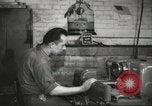
Manufacturing operations at Jack & Heintz Company war plant, Bedford Ohio, during World War II
Workers engaged inside the Jack and Heintz war plant in Bedford, Ohio, in 1943, during World War 2. The company designed and manufactured aircraft starters, automatic pilots, motors, and other aircraft parts and accessories for the U.S. Military. Film opens showing a machinist at his work station. Behind him is a bird cage, containing a facsimile of a turkey, a sign reading "Watch and Pray," and a picture of an American flag. Next, a row of other workers is seen. They stand att individual work stations working on small parts. A pinup picture of girl holding a bugle ia on the wall behind one worker. Closeup of the picture. Another worker has decorated his workplace with flowers. He pauses to smell them. He is smoking a cigar and responding rhythmically to music heard faintly in the background. View of employee chewing candy as he works. When another speaks to him, he shoves some of his candy into the other's mouth.. View of three girl pinup pictures on the wall. Another work station with picture of a pinup girl in a swing. Closeup of that picture.
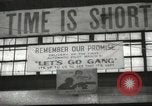
Views inside the Jack & Heintz Company war plant, Bedford Ohio, during World War II
The Jack and Heintz war plant in Bedford, Ohio, in 1943, during World War 2, where the company designed and manufactured various aircraft parts and accessories for the U.S. Military. First scene shows signs inside the factory reading : "Time is Short," and "Remember our promise, Delivery of the first automatic pilot March 31." And: "Let's Goo Gang, Its up to us to see that its kept." A picture of a war plant worker and a soldier with a machine gun is below the signs. Worker seen in a lab coat, smoking a pipe as he works at a machine. Behind him are two drawings of reclining pinup girls and a sign reading: "Quiet Please, War worker resting." Closeup of worker's hand machining a very small part.

The U.S. Army Quartermaster Corps store procured supplies and enlisted men are trained in quartermaster operations (WW2)
The United States Army Quartermaster Corps in the United States during World War II. A diagrammatic comparison of army manpower of 8,000,000 in December 1943 as against 1,750,000 in December 1941. A diagrammatic representation of huge increase in volume of obligated procurement in 1942 as against 1941. Men wheeling carts of supplies at a store. Men carrying supplies coming down a gangway from a ship onto a dock. Soldiers with guns standing on the dock. Soldiers moving through a wooded area. Men carrying the procured materials for storing. Officers watching the men. Two soldiers wearing their uniforms. People and vehicles moving on a city street. A signboard on a building reads 'Office of the Quartermaster General War Department'. The headquarters building in view. A map of the U.S. showing locations of different procuring offices across the nation. Men and women working in an office at the headquarters. Petroleum, Subsistence and Textile sections at the headquarters. Officers working in the headquarters. Men getting into a truck. Enlisted men being trained in various quartermaster operations at a training center.

U.S. recruits being classified for assignments and being informed about the progress of World War II and why they fight.
New U.S. army recruits seated at benches in the classification center, taking notes, as an instructor at a blackboard tells them how to fill out their classification questionnaires, during World War 2. View of machines processing the questionnaires. Hollerith 88 column punch cards being sorted by machine. Newspaper article about the Air Force efforts to improve classification and assignments of new airmen. A recruit being counseled. An Airmen in barracks, filling out a post card form to complain about his assignment. Servicemen working with sewing machines and at long cobbler's benches repairing shoes. U.S. soldiers in pith helmets, laying communications cable from a truck. A soldier recording information about a shipment of supplies. Soldiers filling 5-gallon "jerry cans" with fuel from a hose. Others serving at a communications center in woods. A soldier fastening a cable to a tank. Soldier standing on a truck. Large group of soldiers gathered to listen to a lecture about explosives. Army draftsmen at their work tables. Soldiers using information and training materials.(Narrator states these materials are often ignored.) An army newsmap for Monday, August 31, 1942 posted on an Army office wall. A sergeant points to July, 1943, on a current calendar next to it, illustrating that the newsmap is long out-of-date. View of another news map and narrator notes they are produced weekly. An officer speaking to an auditorium of soldiers. A soldier arranging his personal gear. Infantry on field maneuvers, firing rifles as they advance across a field. Soldiers firing a Browning water-cooled machine gun; a mortar; and a 105mm M101A1 howitzer. The sergeant using a newsmap to brief his staff about the progress of the war. Opening frames of a War Department Film Bulletin, and soldiers in a theater, watching the film. Opening frames of the film,"Why We Fight," that goes on to show animated map of the German advance across Europe in World War 2. Scenes of German forces on the move, towing artillery, riding on tanks, and entering towns as they invade countries of Europe. Women and children running in streets under bombardment, and civilians fleeing from their homes during aerial bombing. A Bombed out city and civilian corpses lying on the ground. Women in Poland, identifying their dead and grieving over them. German Heinkel He 111 aircraft dropping bombs. Norwegians evacuating the city in trucks, and other vehicles and on foot, during the German invasion. A squadron of German Messerschmitt Bf-109 aircraft in flight. German Ju-87, Stuka dive bombers diving on targets. Civilians rushing to a bomb shelter, and other refugees boarding a truck to evacuate. More He-111 bombers dropping bombs. A Ju-52 trimotor transport (type used to transport German paratroopers). Buildings ablaze in a town. Large formations of German aircraft of various types flying overhead. Building destroyed and burning from bombing. Ju-87s flying close past the camera.
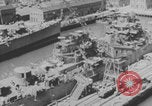
Naval guns and torpedoes manufactured, USS Wisconsin launched (WW2)
Steel used for ship building and war materiel manufacture in the United States during World War 2. Shipbuilding at a dock. Sign says “U.S. Naval Advance Base Depot”. A steam locomotive pulls a 16 inch naval gun from a war production factory. Men move newly made Navy torpedo via overhead conveyor. Men building torpedoes in a factory. A huge engine is being lifted by an overhead crane. War production workers on factory floor building items for U.S. Navy. A United States Naval officer speaks with a factory executive. Narrator mentions importance of scrap metal for use in ship building. The launching of the Iowa-class battleship, USS Wisconsin (BB-64), in the Philadelphia Navy Yard on December 7, 1943. Assisted by Rear Admiral Melo F. Draemel, Mrs. Margaret Roche-Goodland, wife of Wisconsin Governor Walter S. Goodland, successfully breaks a bottle of champagne over the ship's bow. The USS Wisconsin starts down the dry dock during launch.
CRITICALPAST.COM: About Us | Contact Us | FAQs - How to Order | License Agreement | My Account | My Lightboxes | Shopping Cart | Advanced Search | Featured Collections | Website Terms & Conditions | Privacy Policy ©2026 CriticalPast LLC.
License Agreement |
Terms & Conditions |
Privacy Policy
©2026 CriticalPast LLC.