


 Francais
 Deutsch
 Italiano
Refine Your Search
Alencon France 1944 stock footage and images
- Showing 535 to 540 of 9964 results more
more Hide
Hide
Battle of Saipan in the Pacific during World War II.
Animated map shows U.S. forces extending control in the Pacific to the Mariana Islands islands in the Pacific during World War 2. It shows chain of airfields linking island of Truk to homeland, Japan. Map focuses on island of Truk, in Micronesia, showing concentration of Japanese aircraft, ships, and troops there. Paths of U.S. air and naval attacks on Truk are shown. Map shows Japanese fleet withdrawing and U.S. forces by-passing Truk to concentrate on the Mariana islands. U.S. naval task force is seen off the island of Saipan on June 11, 1944. Two U.S. battleships are followed by two escort aircraft carriers/ Barrels of battleship triple guns firing at Saipan. Landing Craft Tank: Rocket LCT(R) firing salvos of rockets. Glimpse from aircraft, overhead, of landing craft leaving white wakes during amphibious assault. Closeups of U.S. troops in landing craft. View from shore of American troops storming ashore through surf, from landing craft, under heavy enemy fire. Closeup of soldier hunkered down in sand. Soldier dropping down from side of beached landing vehicle tracked (LVT). A dead U.S. soldier floating in the water. Troops firing from their LVTs. Shells striking on sandy shore. Marines running with stretcher over their shoulders Fletcher class destroyer firing her guns to port. Brooklyn class light cruiser firing guns to port. View from ships flying Japanese flags, of Japanese warships headed to engage U.S. fleet. Japanese aircraft carriers and Aichi Kokuki KK dive bomber (Val) taking off from a carrier. Aerial closeup of Japanese Val aircraft in flight, with pilot clearly visible before he banks his plane to the left. Formations of Japanese Val aircraft in flight. Formation of American Grumman TBF Avenger aircraft engaging the Japanese. Gun camera film showing Japanese aircraft being shot down. A Japanese aircraft crashing into the sea. Sailors of U.S. ship firing batteries of Bofors 40mm anti aircraft guns. and 20mm anti aircraft guns. Black flak clouds in the sky. A Japanese plane crashing into the sea. Aerial view of formation of Japanese Val aircraft in flight. Closeup of a Japanese Kawasaki Ki-61 (Hien) aircraft maneuvering to attack. More views of Japanese Val aircraft in formation. American dive bombers dropping bombs on, Japanese held, Orote airfield. View from the air of bombs striking and smoke clouds. Fires burning on the airfield. An American navy F6F hellcat plane diving. Gun camera film showing Japanese aircraft being downed. A plane director on deck of U.S. aircraft carrier. Two Grumman TBF aircraft taking off from a carrier. View toward tail of one taking off. U.S. aircraft in formation overhead, and then peeling off in trail formation to attack a target. Japanese ships being strafed. U.S. infantry continuing heavy fighting on Saipan.
U.S. Navy guns are fired at Japanese aircraft from U.S. battleships and USS Princeton catches fire in the Pacific Ocean.
American strike at Japanese forces in the Pacific Ocean during the Battle of Cape Engano of World War II (during Battle of Leyte Gulf) in October 1944. Animation depicts U.S. Task Force 38 in three groups and contact with enemy forces. Animation depicts Task Force 38.3 and Task Force 38.4 concentrating on Task Force 38.2. Task Force 38.1 diverted for battle and Japan's attack on Task Force 38.3. Japanese aircraft in flight. Naval guns fired from U.S. battleships. Japanese aircraft which are shot down plunge in water. USS Princeton (CVL-23 ) catches fire. U.S. soldiers spray water on the ship. USS Birmingham (CL-62) and USS Irwin (DD-794) attempt to extinguish the fire. The ship explodes. Animation depicts Task Force 38.3, Task Force 38.2 and a search airplane locating enemy carrier force. U.S. Navy Fleet Admiral William Halsey, Jr. who is the Commander of U.S. Third Fleet studies a map with others and makes an estimate of Japanese forces. Animation depicts the strength of Japanese forces. Animation depicts the strength of the Japanese Navy in the central region. Animation depicts U.S. plan of attack on Japanese forces.
U.S. Task Forces attack Japanese forces and commanders of U.S. fleets communicate with each other in the Pacific Ocean.
The Battle of Leyte Gulf in the Pacific Ocean during October 1944 in World War II. Aerial view of the Pacific Ocean. A U.S. aircraft takes off from a carrier. The aircraft in flight. Naval guns being fired from ships underway in the Pacific. Animation depicts lack of communication between American forces. Ships underway. Animation depicts the cause of surprise enemy attack on American forces. U.S. Navy officers and crew look at radar monitors tracking enemy forces. Japanese ships underway in the Pacific. U.S. 7th Fleet ships underway. Animation depicts positions of U.S. Task Forces. Commander of U.S. 7th Fleet Admiral Thomas Cassin Kinkaid receives a dispatch from Commander of U.S. 3rd Fleet. Battleships underway in the Pacific Ocean. Animation depicts organized Task Force 34 and Task Force 38 pushing on. Animation depicts the various possibilities of American Task Force attack over the Japanese forces.
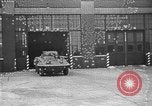
Ford military M8 armored cars are driven out of a Ford motor plant in the United States.
Ford military M8 light armored cars rolling off a Ford production line in the United States. Three armored cars driven out of a Ford motor plant. A man walks to the entrance of the plant as the trucks are driven out. Circa 1944.
U.S. 1st Marine Division invades the Palau Islands during World War II.
Film opens with animated map showing places in the Pacific near the island of Palau. A formation of U.S. B-24 Liberator bombers is seen in flight. Glimpse from the air of the Palau archipelago. Aerial view from a B-24 of its bombs exploding on the center of a Japanese airfield below. Aerial view of a U.S. Independence-class Aircraft carrier of Task Force 58. Officers and sailors on carrier island watch as a Grumman F4F Wildcat aircraft takes off .from the aircraft displays geometric marking on its tail, known as a "G-symbol." In this case it is a large white diamond containing the airplane number inside another diamond. (The United States Navy Pacific Fleet, assigned G-Symbols to the CV and CVL class carriers of Task Force 58. These were assigned to each carrier and appeared on all aircraft operating from it. ) A formation of Grumman TBF Avenger aircraft flying above clouds. Closeup of one with diamond G-symbol and number on its tail. Broad view from the air of TBF Avenger aircraft in flight and Navy warships maneuvering in waters below. Sea level views of some warships in the Third Fleet. One is a Portland-class Cruiser. Wide aerial view of ships in the task force. Cruisers and battleships bombarding Palau and nearby targets. Closeup of heavy cruiser USS Louisville (CA 28) firing her port side 5 inch 25 caliber guns and 40 mm A/A guns from the stern.. A TBF Avenger dive bombs a shore target. More views of warships with shells bursting in background. Shells bursting at the shoreline. Closeup glimpse of marines in landing craft U.S. Marine Corps LVT(A)4 Amphibious Tanks heading toward the beach on September 15, 1944. An LCI(L) Landing Craft Infantry (Large) firing close to shore. Shells striking shoreline installations. View from aircraft of landing craft speeding toward the beach and many more maneuvering offshore. Closeup of marines moving about on the shore of Palau with smoke rising and sounds of gunfire. A marine running through foliage at the shore. Marines manning a command post and communications center in the jungle. Marines firing rifles from a tree line. One firing a Browning M1919 machine gun and another throwing a hand grenade. Marines firing rifle grenades. Marines move forward and encounter a dead Japanese soldier lying next to his flame thrower. They reach the edge of the airfield, where two Japanese aircraft are just barely seen. They walk past dead Japanese at a machine gun emplacement. More views of Marines fighting at the edge of the airfield, and entering into the open area of the field, where fires are burning. .Wrecked Japanese aircraft are seen on the field. Marine infantry cross the field behind an M4 Sherman tank. Barges are seen carrying construction cranes and equipment to the island. A tracked crane drives onto the airfield. Bulldozers work on the edge of the airfield. A power shovel fills trucks with coral deposit material for resurfacing the airfield. Trucks dumping their contents at the field. Bulldozers and earth scrapers level the airfield surface. A TBF Avenger aircraft is the first to land on the unpaved airfield.
U.S. Army 1st Cavalry unit: reenactment battle against Indians at Little Big Horn; actual battle footage in World War 2 at Los Negros Islands, Pacific
A documentary titled 'Hell For Leather' shows combat activities of the U.S. 1st Cavalry Division during wars. Dramatization shows a 1st Cavalry soldier seated on a step and his son touches the insignia of the U.S. 1st Cavalry division on the uniform. Reenacted footage of Cavalry unit battling Native American Indians at the Battle of Little Big Horn. Next scene shows training of U.S. Army cavalry troops for World War 2, as they run an obstacle course and practice bayonet drills. The troops undergo combat training. They practice amphibious landings and crawling near razor wire. Animated map shows the amphibious attacks on Los Negros Island in 1944. A ship underway and soldiers on the deck of the ship. Ship guns are fired in Battle of Los Negros. The U.S. Army troops load a Landing Craft and it gets underway. They approach the shore and get off from the landing craft at the beach. The troops hold guns and advance in jungle region, firing rifles and machine guns, engaging enemy Japanese marines protecting the airfield. The U.S. Army troops firing and advancing against the Japanese. The wounded soldiers on a stretcher. The soldiers fire artillery and mortars. View of dead Japanese troops. The U.S. troops advance. U.S. General MacArthur praises a soldier. 'Bataan' written on the barrel of a gun.
CRITICALPAST.COM: About Us | Contact Us | FAQs - How to Order | License Agreement | My Account | My Lightboxes | Shopping Cart | Advanced Search | Featured Collections | Website Terms & Conditions | Privacy Policy ©2026 CriticalPast LLC.
License Agreement |
Terms & Conditions |
Privacy Policy
©2026 CriticalPast LLC.