


 Francais
 Deutsch
 Italiano
Refine Your Search
Australia 1942 stock footage and images
- Showing 121 to 126 of 2479 results more
more Hide
Hide
Women's Army Corps in Australia
Officials of Women's Army Corps debark from the ship. They march along the dock area and walk down gangway. A banner reads 'Welcome WACs'. Photographer on truck takes pictures of WAC officers. A group of WAC officers singing. WACs on parade, as they march away from dock area. One WAC faints and is helped to come back to her feet by soldiers and sailors. Views of WAC s on train and bus. (World War II period).
Scenes of Baghdad and environs, Iraq, circa 1942
Several cars drive past a traffic policeman, standing under a large umbrella in a circular post at the center of a road, in Baghdad, Iraq. He signals as cars pass. Workers construct new buildings in a housing development. Workers mix mortar that women carry in containers on their heads, to masons working on the buildings. A man drawing water from a river, by means of a "Sanya," a pulley arrangement using self-emptying leather bags (called dalw) hauled by donkeys walking up and down a small hill.
Streets with cars and pedestrians and a military truck in Honolulu, Hawaii, during World War II, 1942
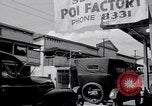
Streets with cars and pedestrians and a military truck in Honolulu, Hawaii, early in World War 2. A model 'T' Ford car drives on the road. Sign over a shop idenfifies "Poi Factory." Pedestrians walk on sidewalks. A military ambulance on the road. Houses and buildings on roadside.
German film describing Allied attack on Dieppe, August 19, 1942, during World War II.
Film opens showing a map of French and English coasts bordering the English Channel. Dieppe is the focus of attention. Narrator states that British, American, and Free French forces, totaling a Division strength, attempted a landing at Dieppe. Animated map illustrates hundreds of Allied landing craft off the coast, protected by Cruisers and Destroyers. A reserve of transport vessels is shown in the Channel and a strong supporting force of Allied bombers and fighter aircraft. Active scene shows German coastal guns firing from bunkers on the French coast and German soldiers deploying to defensive positions commanding the beaches They fire MG 42 machine guns and a 77mm field gun. Shells from British naval artillery explode near German soldiers at shoreline. Explosions at Dieppe harbor from British aircraft bombs. German anti-aircraft fire directed against them. View of Dieppe castle. German soldiers taking up defensive positions on a city street. More explosions from Allied bombers. German soldiers firing a 12.8 Cm Flak 40 anti aircraft gun and black Flak clouds seen in midst of attacking Allied aircraft. German soldiers firing a vehicle mounted 2 Cm Flak 38 gun and quad versions of the same. Allied aircraft struck and trailing white smoke as it falls toward the water offshore. Glimpse of German soldiers in center of town. Low flying Allied aircraft and explosions from their bombs. German Fw 190 fighter planes heading to engage the Allied aircraft. Contrails at altitude from dogfights between Allied and German fighter aircraft. An aircraft struck and falling. Closeup of a burning British aircraft on the ground. Camera pans across German soldiers and buildings damaged and destroyed by Allied bombing. British soldiers (mostly Canadian soldiers) being taken prisoner at the beachhead and later marched under guard in the town. A German General visits his troops at the beach front. Scenes of destruction after the battle. Dead bodies of Canadian and British Allied soldiers floating near the shore. Fire burning on a dock. Burning British Mark 8 Landing Craft Tank (LCT Mark VIII) with shell holes in it. More bodies of dead Canadian soldiers strewn on beach. Knocked out British Churchill tank displaying number 9. Several destroyed and damaged British LCT Mark 8s. Names: "Calgary" and "Beefy"on destroyed Canadian Churchill tanks of the 14th Canadian Tank Regiment. Destroyed British speed boat with sailor's body on it. Other destroyed invasion craft. Several crashed British aircraft at water edge. Closeup of bullet holes near British roundel on one. More destroyed British Churchill and other tanks. Beaches covered with fallen Allied soldiers. British soldier helmets caught in barbed wire.
Aftermath of the Allied raid on Dieppe in 1942 during World War II
Film opens showing a German soldier giving a canteen of water to an English soldier on a landing craft at Dieppe, after the ill-fated Allied raid there in World War 2. Numerous Allied prisoners (mostly Canadians) make their way across the sands of Dieppe. Some toss their helmets away. They carry a wounded on a litter. They proceed along a road with seaside Church of Notre-dame-de-bon-secours in the background. Some prisoners are barefoot. One is carried on a litter. Next a contingent of Canadian prisoners is seen marching in formation, three abreast, with arms raised. Destroyed and damaged buildings are behind them. Several carry wounded comrades, as they proceed into the center of town. Views of damage to buildings in Dieppe, from bombing and shelling. Canadian prisoners of war being escorted by German guards through town. View from high point overlooking Dieppe, showing the town, with smoke rising in places, and the beach with Allied boats and equipment strewn on it. German officers interview prisoners, including some wearing swim fins. Closeup of one with injured bloody face. Allied prisoners huddled together in a large group. Piles of weapons and equipment collected from the prisoners. Ambulatory prisoners being marched through Dieppe on their way to a prisoner of war camp. The prisoners marching on roads through rural areas. Closeups of some as they pass a camera. View of Dieppe harbor and environs from a high overlook. French residents walking on the streets of Dieppe, as life returns to normal. German soldiers manning a 2 Cm Flak 38 anti aircraft gun overlooking the beach, as a formation of German infantry marches past in the background. View of beach from bunker housing a German coastal gun. A formation of German Ju 88 bombers overhead, and viewed from one of the aircraft in the formation in flight. German gunboats racing through the water.

Scenes from the 1942 AAU championship championship track and field games in New York City
The AAU championships at Randall's Island. Hal Davis, fastest man in the world, wins 100 meters. Bill Cummins wins 110 meters hurdles from Joe Batiste. Al Blozis wins the Shot, and Cornelius Warmerdam wins the Pole Vault . The winners seen. Huge crowd gathered to watch the event.