


 Francais
 Deutsch
 Italiano
Refine Your Search
Australia 1942 stock footage and images
- Showing 313 to 318 of 2479 results more
more Hide
Hide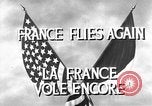
French Air Force in World War I. Germany Army occupies Paris in World War II
Opening scene shows French Nieuport biplanes in aerial combat with German airplanes in World War 1. Many are engaged in a massive dogfight. One aircraft is seen hit and falling toward the ground. Next, two French aircraft are seen returning to their base. They fly over a hangar where a crashed airplane sits with tail in the air. Near the hanger are several airplanes in various stages of maintenance. Mechanics are moving one. An airplane taxis in front of the hangar. Scene shifts to closeup of a Lafayette Escadrille Indian logo painted on a metal structure. Scene shifts to a formal award ceremony for some pilots and crews. Their squadron members are lined up behind them in front of a line of aircraft. The view is from behind a formation of French soldiers with rifles, rendering salutes. Next, French soldiers parade on the airdrome, led by a military band. At this point the scene phases out as a fireball is superimposed on a map of Europe, signifying World War 2. Adolf Hitler is seen in closeup near the Eiffel Tower, when he visits Paris, France following its occupation by German forces in 1940. Several views of German troops marching along the Avenue des Champs-Élysées and through the Arc de Triomphe. Closeups of some German soldiers in the ranks. Scene shifts to North Africa, in 1942, as American troops make an unopposed amphibious landing on the coast, in Operation Torch. Several landing craft are seen and troops ashore. A Dodge 3/4 ton WC-51 army truck, with half of its hood open, makes its way through the surf as it leaves a landing craft.
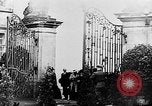
Adolf Hitler and other dignitaries attend the funeral of Gestapo official, Reinhard Heydrich, in Prague, Czechoslovakia
Funeral procession of Gestapo official Reinhard Heydrich in Prague. Dignitaries gather for the funeral at Prague Castle. They place flowers and wreaths. A large crowd of civilians and dignitaries attend the funeral procession which then proceeds back across a bridge over the Vltava River and into central Prague in a slow military parade. Civilians raising arms in Nazi salute as coffin passes. Coffin seen in railroad train as it begins trip back to Berlin for a second funeral service. View inside the new Reich Chancellery on 9 June, 1942. A torch in the background. Nazi German leaders Adolf Hitler, Hermann Goering, and Heinrich Himmler at the funeral. Hitler expresses condolences to Heydrich's two young sons, Klaus and Heider, at the State Funeral. Young boy Heider salutes Hitler.
U.S. soldiers decontaminate combat vehicles and tanks during training; also flashback WW1 mustard gas aftermath scenes
World War 2 training film teaching U.S. soldiers about decontamination of combat vehicles, at Aberdeen Proving Grounds in Maryland. Soldiers during a decontamination procedure with real mustard gas. The soldiers in armored vehicles. A group of soldiers prepares for the decontamination. An aircraft flying at low height. A stationary U.S. Army Pershing tank. Two soldiers in a jeep. Soldiers wearing gas masks decontaminate a vehicle. Flashback scenes to August 1918 in World War I in France, with many mustard gas attack victims being cared for at a field hospital (which narrator says is Field Hospital number 326). Medic washing eyes and face of a World War 1 gas attack victim. Next view is a soldier in 1942 with mustard gas burns on his hand, being treated by a medic. Next scene returns to World War 1 in 1918, showing mustard gas burns on arms, hands, legs, and feet of U.S. Army soldiers.
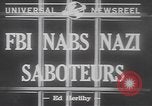
The FBI arrests eight Nazi German spies after they landed off the coast of the United States (WW2)
Nazi German spies attempting sabotage are caught in the United States during World War II. A sign on a building reads 'Federal Bureau of Investigation'. An official at a desk inside an office. A submarine underway at sea as a crew member looks through a periscope. Pictures of Nazi German would-be saboteurs caught by Coast Guard personnel and apprehended by the FBI after they landed near the coasts of Amagansett, Long Island and Ponte Vedra Beach, Florida. (This was Operation Pastorius which disrupted a Nazi German sabotage plot on U.S. soil in 1942.)
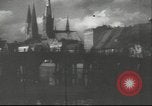
Cultural and religious monuments rubbled by British air raids in Lubeck, Germany.
Damaged and destroyed buildings in Lubeck, Germany during World War II, following British bombing with conventional bombs and incendiary bombs on March 28, 1942. A damaged bridge. Damaged cultural and religious monuments including Lübeck Cathedral, St. Peter's Church, the town hall and St. Mary's Church. Aerial view of the buildings. Damaged buildings along a water front. Bombed out buildings. Interiors of a bombed church with rubble everywhere. Ruins of the bombed and burned buildings.
World War II Japanese attack on troop convoy at Port Moresby New Guinea; also Battle of Midway scenes aboard USS Yorktown.
American and Australian troop convoy underway at sea, and then arriving at Port Moresby, New Guinea. A Hudson bomber of the Royal Australian Air Force flys by the troop ship escorting them into the harbor. U.S. and Australian troops unloading men and supplies at Port Moresby. Japanese planes attack the dock area and troop convoy. Elevated land-based views of the harbor with explosions and smoke during the bombing. Anti aircraft guns fired at enemy planes. Soldiers and sailors on ships at harbor open fire on the Japanese aircraft overhead. Planes drop bombs and explosions occur. Complete change of scene to the USS Yorktown (CV-5) during the Battle of Midway on June 4, 1942. United States Navy sailors fighting fires aboard the USS Yorktown. Japanese airplanes overhead during the Battle of Midway attacking the Yorktown. Patterns of tracer bullets seen fired from the Yorktown. Japanese torpedo bomber aircraft is hit by gunners on the USS Yorktown.