


 Francais
 Deutsch
 Italiano
Refine Your Search
Australia 1942 stock footage and images
- Showing 319 to 324 of 2479 results more
more Hide
Hide
Aftermath of Japanese air attacks on Dutch Harbor, Unalaska Island, Aleutian Islands, in World War II
The aftermath of the Japanese bombing of Dutch Harbor, June 3 & 4 1942, during World War 2. Scenes include the bombed ship, S.S. Northwestern, which was being used as housing for construction crews. The docked steamer was damaged by bombs from "Val" dive bombers launched by the Japanese aircraft carrier "Junyo". Smoke rises from an oil tank as it burns. Bombed & wrecked trucks at the island. Also shown are bomb damage and fires at Fort Mears, Dutch Harbor.
Mussolini and Hitler discuss Axis plans at the Berghof in Berchtesgaden, Germany during World War II.
German Chancellor Adolf Hitler with others at the Berghof in Berchtesgaden, Germany on 29 April, 1942. Italian Prime Minister Benito Mussolini and German Chancellor Adolf Hitler climb up the stairs of Hitler's residence Berghof. The two leaders confer inside a hall. Hitler and Mussolini confer with two other officers one of whom is General Albert Kesselring. The four of them and others at a large desk as they look at a map.
The Americans surrender in the Battle of Corregidor and General Homma takes over the Philippines during World War II.
An orientation film titled ' Westward is Bataan' about Japanese capture of the Philippines and the Americans surrender during World War II. Scenes of destruction from the Japanese attack on Pearl Harbor in Hawaii, United States on December 7, 1941. U.S. ships being strafed and explosions occur. Excerpts from Japanese newsreel showing surrender of U.S. forces at Corregidor. United States soldiers in Corregidor, Philippines. U.S. Army General Jonathan Wainwright meets Japanese officers to surrender during the Battle of Corregidor. Japanese soldiers near Heam Battery on May 6, 1942. Japanese soldiers remove the American flag from a pole to raise the Japanese flag after the surrender. People celebrate Japanese victory in Tokyo, Japan. In Manila people gather along the streets as they wave the Japanese flags to welcome Japanese General Masaharu Homma. General Homma enters a building. Japanese soldiers parade as they carry the remains of the soldiers who lost their lives during the Battle of Corregidor. The boxes carrying the remains of the dead Japanese soldiers being handed over to Japanese women at a ceremony.
U.S. B-17 crews of 8th Air Force are debriefed by intelligence officer upon return from a mission, during World War II.
U.S. 8th Air Force B-17 crew is debriefed by an intelligence officer immediately after returning from a bombing mission during World War 2. In response to his questions, the crew members describe being hit by enemy fire, damage to their aircraft, and attacks by German Fw-190 and Me-109 fighter aircraft. A gunner tells of shooting down a German plane that flew underneath their B-17. Narrator Richard Cordon seated at a desk speaks to camera in a public service announcement, and appeals to capable American mechanics and men under 50 who are handy with tools to volunteer for service with the Army Air Forces. He reads a notice of the U.S. Army Air Forces dated October 1, 1942, inviting civilian mechanics to service with the Army Air Force. Views of mechanics performing various maintenance duties on parked B-17 bomber aircraft. Mechanics work on a B-17 aircraft with name "Baby Doll" on it. A mechanic works on a propeller of B-17 aircraft with nose art and name "Birmingham Blitzkrieg." A mechanic evaluates a machine gun in side door of a B-17 aircraft named "Shoot, You're Faded." Close-up view of notice from the U.S. Army on its letterhead, appealing for mechanics up to 50 years of age.
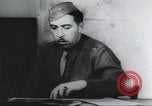
U.S. VIII Bomber Command, 97th Bomb Group, 342nd Bomb Squadron Commander is debriefed by a 97th Bomb Group Intelligence Officer (WW2)
Film opens showing a Captain, Intelligence officer with the U.S 8th Airforce 97th Bombardment Group, debriefing Captain William “Bill” Musselwhite, Commander of the 342nd Bombardment Squadron, about his unit's experience participating in the first Eighth Air Force heavy bomber mission in World War II, attacking the Rouen-Sotteville marshalling yards in France, on August 17, 1942. Referring to a map, he asks Captain Musselwhite where his Squadron dropped their bombs. Musselwhite points out the path of his units aircraft and that his first aircraft overshot the target, but those following dropped "on range," bracketing the target on left and right, with one "stick" of bombs going right down the middle. He mentions one ship straying over the town of Rouen, itself.
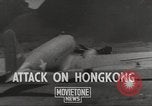
U.S. B-25s bomb Japanese headquarters in Hong Kong (WW2)
First of three American air attacks on Japanese positions in Hong Kong on 25 Oct 1942, during World War II. U.S. Army Air Forces North American B-25 Mitchell aircraft lined up at an airfield in China. General Claire L. Chennault, of Flying Tigers fame, discusses the missions with Colonel Caleb V. Haynes China Air Task Force (CATF) Bomber Section Commander and Colonel Robert T. Scott (CATF's 23rd Fighter Group Commander) 11th Bomb Squadron B-25 takes off from Ehr Tong Airfield at Kweilin (Guilin), China along with P-40 fighter escort. Formation of escorting Curtiss P-40 Warhawk fighters. B-25 bombers in flight over mountain ranges. Bombs being dropped over the Hong Kong headquarters of the Japanese. Bombs impact and smoke rises.