


 Francais
 Deutsch
 Italiano
Refine Your Search
Australia 1942 stock footage and images
- Showing 391 to 396 of 2479 results more
more Hide
Hide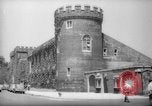
Dr. Enrico Fermi and assistants reenact experiments at site of the Chicago Pile-1 (CP-1) nuclear reactor, University of Chicago
Men walking towards the West Stands of Stagg Field, where the Institute for the Study of Metals, occupies the southern half of the abandoned stands. To the North, where the center of the building protrudes toward Ellis Avenue, is the squash court area in which the famous Chicago Pile number 1 was built, and achieved controlled, sustained nuclear fission, on December 2, 1942. Scene shifts to different area where a sign reads: "5655, Institute for the Study of Metals, Delivery Entrance." Scene shifts again, to Dr. Enrico Fermi and two assistants in front of a facsimile of the Chicago Pile 1. One assistant holds a simulated "control rod" that he "withdraws" from from the pile, while Dr. Fermi glances at a geiger counter and makes notes in a book. This is repeated for several takes, including one taken much closer. Dr.Fermi and his assistant smile as they take these actions. The second assistant, sits at a desk, where a slide rule is visible, and makes notes in a book. A large geiger counter is seen with lights flashing. Above the lights the counter is labeled "Interpolation," and the numbers: 1,2,4,16, and 32 appear above the lights, respectively. Dr. Fermi is then seen in another part of the lab, where he is making adjustments on some unseen device and annotating a book. Piping of various sizes is seen in background. He repeats these actions a number of times for the camera.

Unescorted B-17 Flying Fortress planes under heavy attack by German FW-190s during Schweinfurt raid in World War II.
Scenes of the first daylight strategic bombing by the United States Air Forces against targets in German-controlled Europe. A dozen B-17s execute the first mission against railroad marshaling yards in German-held Rouen, France, on August 17, 1942. A year later, large numbers of U.S. bombers attack Schweinfurt, Germany during World War II. U.S. B-17 Flying Fortress planes take off from U.S. Air Base in England. A formation of B-17s in flight. They head towards Germany. U.S. General Dwight D. Eisenhower and his aides confer. Unescorted B-17s over Schweinfurt under heavy attack by German FW-190 fighter planes. The B-17s drop bombs over the target area. Ruins of Schweinfurt after bombings. A FW-190 goes down after facing attack. Dead and wounded men unloaded from B-17s which return from the Schweinfurt raid. Panoramic views of ruined Schweinfurt on August 20, 1943.
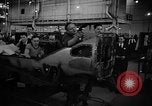
U.S. President Franklin Roosevelt visits Bell and Curtiss aircraft factories in Buffalo, New York
On November 2, 1940, U.S. President Franklin Roosevelt and party visit P-39 aircraft production line at the Bell Aircraft Company factory, 2050 Elmwood Avenue, Buffalo, New York, and P-40 production lines at the Curtiss Aeroplane factory, 2303 Kenmore Avenue, Buffalo, NY. Workers in the Bell plant pose around and inside fuselages taking shape along a production line for Bell P-39 Airacobra airplanes. In the Curtiss plant, view from rear, of Secret Service agent in coat and hat, standing on running board of an open Packard motor car carrying President Franklin D. Roosevelt, and his party as they drive slowly along an aisle in the factory, showing P-40 aircraft in various stages of completion. The President is barely visible in the back seat. (This is a 1939 Packard twelve, model 1708, special parade car, built for the President's use.) View from ahead of the President's car, as it proceeds along the Curtiss P-40 production line. (The President, in coat and hat, sits in the right rear seat.) As they progress along the production line, the aircraft seen are increasingly more complete. At the Bell plant, the motorocade passes a fully assembled P-39 on display. The President holds a desk model of the plane. The American flag and Presidential flag are displayed on the front of the car. The president is now seen without his hat. The car moves into a section of one of the factories that fabricates wing assemblies and other smaller parts. Closeup front view of the President and party as the car begins to exit the Bell factory on Elmwood Avenue. The building has "Bell Aircraft Corp." written on it. Employees are lined up outside the plant and applaud the President. [Note: There is a possibility that some scenes may be from other Buffalo-area aircraft factories that started production in 1942, including the Bell Plant in Wheatfield, NY (Niagara Falls) and the Curtiss Plant #2 at the Buffalo Airport.]
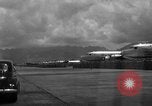
President Franklin D. Roosevelt at Hickam Field and at Alea Naval Hospital in Hawaii, during World War II
Rear view of a car in President Franklin Roosevelt's motorcade driving along the flight line at Hickam Field, Honolulu, Hawaii, during World War 2. Several C-54 aircraft are seen (Navy designation R5D). President's The President sits with Admiral Chester Nimitz, in the back seat of an open 1942 Packard convertible motorcar. (It displays private use "A" gas ration stamp, the most restrictive, on its windshield.) Medics carry a wounded soldier, on a litter,past the car, and the President shakes his hand. A new scene shows the President's VC-54C airplane (Sacred Cow) parked in front of the air base terminal building, which it topped by a sign reading: "Aloha Air Transport Command." Change of scene shows spectators filling the lower level and porch of a building at the U.S. Naval hospital, Alea Heights. Next the President's car is seen surrounded by hospital staff in formation to honor him. Nurses in white stand at attention on the ground, and a large formation of sailors stand at attention on a porch above.
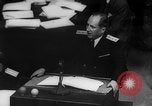
View of the Nazi Concentration Camps and its victims, and other atrocities committed by Nazi forces in World War 2.
Images and testimony related to the Nuremberg Trials held at the Palace of Justice in Nuremberg, Germany in October 1946. Flashbacks of a variety of Nazi crimes against humanity during the years of World War II. Reference to testimony of Kenaris and Hans Frank in describing Nazi policies and methods for exterminating Poles and others. Pictures recording the implementation and results of Nazi policies; atrocities and murder of victims in Ouradour Sur Glane in France, in Bande in Belgium, in the Catacombe of San Callisto in Italy and in Czechoslovakia. Nazi German soldiers seen leveling and destroying the town of Lidice in Czechoslovakia in 1942, after massacre of many residents, in retaliation for the assassination of SS Reich Protector Reinhard Heydrich. Corpses of the victims of the Nazi concentration camps, including Auschwitz, in 1945. Bones of humans in crematory ovens. Cramped starved women camp victims inside barracks. Stacks of luggage and suitcases of victims at a concentration camp, along with locks of hair, stacks of toothbrushes. Shaving cream brushes, shoes, clothing, and finally, piles of bones of camp victims. Testimony of Rudolf Franz Ferdinand Höss (sometimes spelled Höß or Hoess or Hess) describes concentration camps at Auschwitz in Poland. As scenes of victims in hospitals are shown, testimony of Rudolf Hoess is read, describing medical experiments include lowering the body temperature, injecting the body with poisons and infectious diseases and subjecting the body to high altitude pressure chambers. Shows pile of mutilated corpses.The "Arbeit Macht Frei" sign over the camp entrance of Auschwitz. Scenes of dead victims of Nazi brutality in the concentration camps.
Nuremberg Trials reveal the Nazi enslavement of people in occupied countries and atrocities against Jewish people during World War II.
Opening scene, in 1946, is the courtroom where Nazi officials are being tried for war crimes at the Palace of Justice in Nuremberg, Germany, where the procecutor has completed charges 3 and 4, concluding the indictment against them. Sitting in first row of the dock are Hermann Göring (or Goering) (hidden behind soldier), Rudolf Hess, Joachim Von Ribbentrop, and William Keitel. The camera focuses on Fritz Sauckel, as he is identified as the Nazi slave labor chief. Supporting documents are shown. Film footage scenes of slave workers being rounded up and working on shipping docks, emptying rail cars, repairing railroads, and digging in open pit mines, under Nazi military guard. Next are shown views of Hermann Goering walking in an occupied village in 1942, overseeing the confiscation of all of the livestock. German soldiers releasing and rounding-up cattle, sheep, and pigs that had belonged to citizens of an occupied village. Dr. Wilhelm Frick is shown. He is charged with eliminating elderly, insane, or uncurable sick Germans, considered "Useless Eaters" and subject to Nazi euthanasia programs. Several frail and sick or mentally disabled persons are shown. Crosses are shown marking burial places of these persons outside the institutions in which they died. Next, several German Jewish men in civilian clothes are seen rushing to a work site where they are put to work as slave labor digging with shovels under direction of a Nazi military officer. Scene shifts to Nazi Storm Troopers (Sturmabteilung) harrassing German Jewish shopkeepers, writing anti Jewish messages on the windows, encouraging boycott, and preventing their businesses from operating. More views of Nazi Storm Troopers causing trouble in the streets. Next scene is Hermann Goering reading some dictates as Hitler and Hess, along with other Nazi officials, sit in attendance. The so called "blood purity" rules or blood purity laws of the Nuremberg Laws define German citizens narrowly and prohibit marriage between "German Citizens" and Jews. An unseen audience roars its approval. Jewish people are next seen being rounded up and beaten, mistreated, harassed, and evicted from home. Back at the trial, the prosecutor speaks of Nazi SS Brigadier General Jürgen Stroop cleaning out the Warsaw Ghetto, in Warsaw, Poland, in utter ruthlessness in 1943. Scenes of Polish Jews people being driven and dragged out by SS and Gestapo forces, many unclothed, and the entire place being dynamited afterward. View of a detonation system, and then a huge explosion and walls of the Warsaw ghetto in Poland area are seen crumbling to the ground. Buildings burning and people leaving with injured on a stretcher. Scenes of Nazi agents, Gestapo, and Wehrmacht Army chasing Jews from sewers using tear gas and driving them from buildings using light tanks and armored vehicles. Jews are rounded up, beaten with clubs, and dragged by Nazi German SS and Gestapo authorities who capture them. Back in the courtroom, Rudolf Hess is seen describing how Nazi doctors would screen arrested Jews as they entered concentration camps. Views of crowds of Jews entering a concentration camp near a railroad train depot. A large group of Jewish children at a camp. Children hold up their arms and the boys and girls reveal tattoo numbers on their arms. More views of women and children moving through outside paths of a concentration camp, surrounded in barbed wire and fencing. Views of so-called camp shower baths in which prisoners were killed by poison gas. Clothing of prisoners hanging outside the gas chambers, which the prisoners were told were delousing chambers. Views of the gas chamber shower heads and gas output vents. Views of naked prisoners, some seated and some laying down, inside a gas chamber. View of dead, naked prisoner bodies stacked up in a room. View of bags filled with gold from rings and teeth of the dead. Canvas bags and chests containing the teeth and gold jewelry, held in the Reichs Bank. Closeup of corpses. Bodies being loaded and unloaded from flatbed trucks and being dragged by camp inmates and German soldiers, and thrown into mass graves.