


 Francais
 Deutsch
 Italiano
Refine Your Search
Australia 1942 stock footage and images
- Showing 385 to 390 of 2479 results more
more Hide
Hide
Pilots discuss participation in Doolittle Raid bombing of Tokyo; scenes from start of raid in World War II.
Car pulls up to curb with Lincoln Memorial in the background, in Washington DC. Captain Ted W. Lawson and Captain Dean Davenport ascend the steps of the Lincoln Memorial, with one of them using a cane to assist, as they talk. They talk about home life and then they recall their flight as pilot and co-pilot on B-25 aircraft in the Tokyo raid in World War 2, one year earlier. Scene changes to open sea and view of the USS Hornet aircraft carrier (CV-8) underway at sea. Aircraft on the flight deck of USS Hornet ready for the operation 'The Doolittle Raid'. Airmen soldiers watch as Lt. Colonel Doolittle ties a Japanese medal onto a bomb. Closeup view of the medal on the bomb. The B-25 aircraft on flight deck ready for the attack on Tokyo. Lawson and Davenport talk about how they suffered engine failure on the return from Tokyo. The crew aboard the ship exercise, running in a group on an open part of the flight deck. Crews starting aircraft on April 18, 1942. The B-25 aircraft of Lt. Colonel Doolittle taking off first from the flight deck. Other B-25 Mitchell bombers taking off from the short flight deck. Planes in flight. Large image of United States flag waving. Still images of pilots captured by the Japanese during the raid. General Henry Arnold ("Hap" Arnold) seated at a desk and speaking, denounces the execution by the Japanese of U.S. pilots and calls on the forces of the US. Army Air Forces to continue their efforts until the enemy are destroyed.
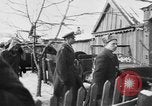
German 6th Army surrenders to Soviet forces at battle of Stalingrad in World War II
German Field Marshal Friedrich Paulus, enters a wooden building near Stalingrad where he surrenders the German 6th Army. He, and Arthur Schmidt, General-lieutenant, Chief of the 6th Army Staff; take seats,surrounded by Soviet Army officers. Scene shifts to the twenty two Divisions (300 thousand men) of the 6th Army trudging through the snow as they surrender. Most of them are seen in open fields near Stalingrad, Russia. Closeups of some make their way along a street in the city. Many wear makeshift shoes and other contrived clothing. They are clearly suffering from their lack of any cold weather equipment. Aerial view of a long line of surrendering German soldiers making their way on snow-covered street in Leningrad. Closeups of some of the German soldiers. One soldier walking slowly, alone, across a stretch of snow. He wears woven homemade coverings over his feet.He heads, alone, toward an open stretch of barren snowy land. Camera focuses on ice strewn Volga River. A dead German soldier lies on its bank. View of Russian countryside, the following Spring. An animated map depicts the extent of the Soviet advance in the previous winter with the occupation of 185 thousand square miles of territory (more than previously occupied by the German forces). Film shows weapons captured during the 6th Army surrender, including German aircraft, tanks, heavy artillery guns, light machine guns, rifles, artillery shells and small arms ammunition. Glimpse of dead German soldiers in the snow. Aerial view of rail cars containing captured German military supplies. Lines of surrendering German soldiers making their way in the snow. Numerous dead German soldiers in body bags, in the snow. Animated film reviews the German operation Barbarossa and subsequent events in the German invasion of Soviet Russian in 1941, 1942, and 1943. Glimpses of Russian troops dressed in white and British troops advancing. Film concludes with artistic representation of United Nations flags and troops marching to victory.
Role of the Jeep in U.S. military operations during World War II.
A U.S. Army Air Forces (USAAF) Waco CG-4A-WO glider is seen descending and landing in a grass field. Upon touchdown, its front pops open and and an army jeep drives out. USAAF C-47 aircraft are seen next, offloading jeeps pulling small artillery pieces, and infantry who move rapidly from the parked aircraft. Jeeps traversing a high hump in a dirt road. A jeep towing an M-3 Antitank Gun 37mm, and others driving through underbrush and bouncing over rough road while towing 37mm guns and trailers. Soldiers stepping from jeeps to set up machine guns. American soldiers playing a game of horse and rider, during a break in duties. Soldiers setting up mortars. Jeeps driving through bodies of water. Two M4A1 (76)W Sherman tanks, with cast steel hulls, drive into a stream. Troops setting up several 37mm guns on a river bank. Two soldiers in a communications jeep. Army officers perusing a map laid out on the hood of a jeep. U.S. field artillerymen using periscopic binoculars on tripods, to spot and direct gunfire. Military vehicles, including jeeps, moving across desert terrain. Artillery crews firing M59 (M2 Long Tom) 155mm guns. A Douglas A-26 Invader aircraft flying overhead. Jeeps in various roles, bouncing along in the desert and laying smoke screens. Jeeps equipped with M3 anti-aircraft guns and others with stretchers for wounded affixed to their sides. U.S. Army Ford GPA "Seep" amphibious jeeps plunging into water and continuing on as boats. A jeep production and assembly line in a U.S. factory showing stages of assembly and finished jeeps driving out of the plant into yards containing hundreds of them. A convoy of jeeps driving over a bridge, and others carrying a U.S. military brass band in a parade in England. A Hollywood actress (Gloria Swanson?) being lifted into a jeep by several men. Glimpse of an unidentified actress with an American soldier, in a jeep. Hollywood stars, Stan Laurel and Oliver Hardy clowning in the front seat of a jeep with Desi Arnaz and two women riding in the back. Several jeeps carrying these and other Hollywood personalities during a war bond parade in Washington DC. The Capitol looming in the background as the jeeps move away from it toward the camera. Jeeps being prepared for transport to overseas destinations. Jeeps being partially disassembled and loaded into wooden crates and placed on rail cars for transport. Jeeps being hauled by cranes and placed aboard ships. Landing crafts mechanized (LCMs) transporting infantry and vehicles, including jeeps. An M4A1 Sherman tank driving out of a landing craft into surf. A jeep being driven onto beach at Adak,in the Aleutians,from a landing craft of the USS J.Franklin Bell (AP-34), in 1942. In 1943, this transport ship was reclassified as APA-16.) American troops with jeep on a South Pacific island in World War 2. A soldier on motorcycle, skids in mud on road in North Africa, and jeeps drive past him. American soldiers ride camels and some drive in a jeep near the Great pyramid and Sphinx in Egypt. Jeeps seen in China, with Generals Joseph Stilwell and Claire Chennault. One parked next to a Flying Tiger P-40 airplane. Soldiers in a jeep in Alaska, next to a tent and sign pointing to "Tokyo." Local tribesmen literally carrying a jeep, on long poles, across a river in Timor. General Douglas MacArthur, accompanied by staff officers, being driven in a jeep along a jungle road in New Guinea, past a line of local tribesmen. Wendell Wilkie, serving as Ambassador-at-large, during the war, speaks to U.S. officers in a jeep. Britain's King George VI in a jeep followed by another carrying Queen Elizabeth. President Franklin D. Roosevelt riding in a jeep to review troops. He removes his hat as they pass the American flag. Sign on a building in North Africa reads "Bizerte." General George S. Patton, standing in a jeep during a victory parade in North Africa. Soldiers at an outdoor religious service during the war with the hood of a jeep serving as a make shift altar.Various views of jeeps driving with soldiers in them.
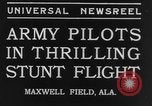
U..S. Army Air Corps flight demonstration team known as "Men on the Flying Trapeze," put on air show at Maxwell field in Alabama, United States
Army pilots in thrilling stunt flight, Maxwell field in Alabama, United States. Four pilots known as "Men on the Flying Trapeze," an Army flight demonstration team, pose in front of a U.S. Army Air Corps P-l2. From the left they are Sgt. William C. McDonald; an unidentified pilot; Captain Claire Chennault and Sgt. John H. Williamson. (Claire Chennault went on to lead the famous "Flying Tigers," The First American Volunteer Group (AVG) of the Chinese Air Force in 1941–1942.) Next, three P-12's are seen taking off together. When airborne, they start an inside loop, then execute other aerobatics in formation Three P-l2's executing a 360 degree roll. Three P-l2's in formation flight.
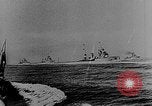
The siege of Malta and the North Africa campaign during World War II.
Italian warships maneuvering in the Mediterranean during World War 2. Destroyers pass a Corazzata-class Italian battleship. Italian IMAM Ro.43 reconnaissance planes are launched from a battleship. Two Corazzata-class Italian battleships underway. Change of scene shows the island of Malta, viewed from a low flying airplane. A formation of Italian CANT Z.508 seaplane bombers flying overhead to attack Malta. View from ground on Malta of anti-aircraft flak burst clouds in the air above. Smoke rising from bomb bursts. Glimpse of a large British warship slowly easing out of its dock. Single engine aircraft overhead moving through heavy flak clouds. More bomb explosions. Local civilian people and refugees, including many children, seeking safety from bombing. People perusing destroyed buildings. A formation of British Bristol Blenheim light bombers in flight over North Africa. British forces firing artillery in Libya. War materiel abandoned by retreating Italian forces in Eritrea and Somaliland. British troops and a contingent of Ethiopian troops march into Addis Ababa, escorting Emperor Haile Selassie as he is restored to his throne in May, 1942. Next, German armor in North Africa is seen burning. A knocked out German tank viewed through window of a British armored vehicle. More burning German armor. German aircraft destroyed on the ground at an airbase. Bombs lined up on the ground. Huge number of Italian prisoners of war marching across the desert in Libya.
Soviet Russia mobilizes to defend against German offensive (Operation Barbarossa) in World War II.
Film opens showing Adolf Hitler, in World War 2, with Field Marshal Walther von Brauchitsch, Army Commander-in-Chief, and other top military members, planning for Operation Barbarossa (Attack to the East toward the Soviet Union). As he walks away from the table, he speaks briefly to Grand Admiral Erich Raeder, head of the Kriegsmarine (German Navy). Next Hitler and Marshall Hermann Goering are seen strolling and conversing at the Eastern Front headquarters, "the wolf's lair," (Wolfschanze) near Rastenburg, East Prussia (now Poland). Scene shifts to the Soviet Union, where Joseph Stalin is seen speaking at a podium. A large outdoor audience, including some soldiers, is gathered to listen. Images showing the Soviet people responding to defend against the German Nazi invasion. Closeup of Soviet soldiers with shouldered weapons. The nearest is holding a PPSh-41 submachine gun. Closeups of Soviet women and men in military uniforms. Soviet citizens heading to enlist in the military. Soldiers marching loosely n a city street. Patriotic singing is heard in background. A formation of Soviet women marching. Some carry furled banners. Soviet women carrying simple farm implements, marching in a rural part of Russia and joining others who are working to prepare anti-tank ditches and barriers in the countryside. Views of hundreds of people working on this project. Weapons being provided to rural Soviet guerrillas who will operate behind enemy lines. Anti-aircraft guns being set up overlooking a harbor. Closeup of Soviet soldiers manipulating controls on a camouflaged anti-aircraft gun and others maneuvering a four-barreled anti-aircraft machine gun. Local farm family members on makeshift towers keeping watch over huge fields of wheat. Soviet farmers harvesting the wheat with scythes. An armed farmer shielding his eyes as he searches the skies for German airplanes. Closeup of a man cutting wheat with a scythe as women gather the sheaves behind him. Motorized harvesters at work in a field of wheat. Closeup of a woman operating one. Tractors used in harvesting. Women and children gleaning what remains behind in the harvested fields. Farmers driving their cattle East (away from advancing Germans). Evacuating Soviet people employ a scorched earth policy, burning their homes, barns, and anything that might be of value to advancing German forces. Views of burning houses. Soviet industrial enterprises working around the clock producing war materiel. Seen are petroleum facilities; a large plant expelling coke; coal pouring into a barge; men at work at a steel furnace; ribbons of hot steel moving out of rollers; a huge manufacturing plant in operation. Next, a Soviet Kliment Voroshilov (KV) tank is seen moving across a field. Soviet Russian Polikarpov I-16 fighter planes in flight. A large formation of German Dornier DO 17 bombers in flight high overhead. Soviet forces retreating. Views of fallen German soldiers, fires burning, and remnants of a downed German bomber. German prisoners of war marching under guard and others surrendering with hands in the air. Closeups of some German prisoners. A Russian Petlyakov Pe-2 aircraft parked in snow with engines running. Fallen German soldiers lying in the snow along a roadway, in Winter of 1941-42. A Russian Kliment Voroshilov (KV) tank maneuvering in the snow. Russian Bt-7 Light Cavalry Tanks proceeding toward the front in Springtime, 1942.