


 Francais
 Deutsch
 Italiano

Refine Your Search
B-24-Burma stock footage and images
- Showing 913 to 918 of 3692 results more
 Hide
Color Sound

Charles Lindbergh takes off from Roosevelt Field for his famous solo flight from New York to Paris.
People gathered early on a misty morning at Roosevelt Field, Long Island, New York, to watch as Charles Lindbergh attempts to make a solo flight across the Atlantic Ocean in his airplane, The Spirit of St. Louis. The plane starts its takeoff role between groups of spectators, raising dust. The spectators move to get a better view as the plane continues, out of sight in the fog and mist. It is not clear where the plane is, although engine sound has changed. Spectators strain to see it through the mist. Then, some cheers are raised when the crowd realizes that Lindbergh has successfully taken off in his heavily laden airplane. The opening caption refers to Curtiss Field, where the Spirit of St. Louis was test flown and reportedly maintained in Hanger 16. there, from May 12th through the 20th. However, for the Paris flight, the plane was towed a mile to Roosevelt Field where, heavily loaded with fuel, it could take advantage of the longer runway for takeoff. (Note: Both fields were originally part of the old Hempstead Plains Field renamed Hazlehurst Field when taken over by the U.S. Army in 1917. U.S. Geological survey maps of 1918 show three areas named, respectively, Hazelhurst Aviation Field No. 1; Aviation Field No. 2; and Camp Albert L. Mills, abutting it. Field No. 2 was renamed Mitchel Field on July 16, 1918. The eastern part of Field No. 1 was dedicated as Roosevelt Field, on September 24, 1918. After the war, the western part of Field No. 1 became known as Curtiss Field, associated, as it was, with the Curtiss Aeroplane & Motor Company located there.)
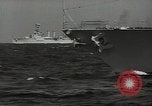
USS West Virginia and USS Idaho underway in Hampton Roads, United States.
U.S. battleships underway in Hampton Roads, United States. USS West Virginia (BB-48) and USS Idaho (BB-24) behind it, underway in the Atlantic ocean. Pan of the USS West Virginia. Crew working on the deck of the battleship. Several Curtiss SOC Seagull scout observation seaplanes seen carried aboard the ship.

U.S. 16th Armored Dividion in Pilsen, Czechoslovakia, at end of World War II. Firing at snipers
Czech civilians pose with some U.S. soldiers of the 16th Armored Division, in Pilsen, Czechoslovakia, at end of World War 2, in Europe. They are standing on top and in front of an abandoned German tank. They completely cover the tank, and wave enthusiastically for the camera. Scene shifts to the rear of an M24 Chaffee light tank, with some civilians gathered around it, as it prepares to move out, behind an M3A1 halftrack pulling an M10 ammunition trailer. Views of other halftracks loaded with U.S. troops and equipment. Several American infantrymen gathered at a fence, one pointing out sniper location, while another takes aim with his rifle. American soldier in a 105 mm Howitzer Motor Carriage M7 (aka, 105 mm Self Propelled Gun, Priest, by the British Army). He is firing its M2 .50 caliber air-cooled machine gun in its raised cupola. Brief glimpse of a Czech soldier aiming his rifle behind a tracked vehicle.
Tourists visit the Bunker Hill Monument, the Old State House and the State Capitol Building in Boston, Massachusetts.
Tourists visit Charlestown in Boston, Massachusetts. View of the Bunker Hill Monument (Monument Sq, Charlestown, MA 02129, United States) with buildings in the background. People walk outside the Old State House located at the intersection of Washington and State Streets in Boston. The State Capitol Building (24 Beacon St, Boston, MA 02133, USA) with pedestrians walking by. View of the Custom House and Boston Harbor behind it.
The battle of Saipan during World War II in the Pacific.
U.S. forces battle against the enemy on Saipan, Mariana Islands during World War II. The 4th Marine Division advances on the eastern side of Saipan. Marines fire rifles. The 2nd Marine Division fires at enemy snipers. The 8th Marine Regiment advances amidst heavy firing. A Marine M3 Stuart (M3A1) light tank equipped with flamethrower (Satan flame tank) is seen in action. Marines moving slowly behind a tank. Two marines running, under fire, carrying a wounded on a stretcher. Others run for cover before a huge explosion. The 8th Marines capturing Mount Tapochau. The 4th Division moving M16 rocket launchers into position for deployment. barrages of rockets striking distant targets in the Bluff Point area. Closeup of rockets being fired from launcher on back of a truck. Map showing Saipan and the disposition of the various Marine units as of 24 June, 1944. American P-47 aircraft parked at Aslito airfield. One has the name "Rosemary" painted across its engine cowling. P-47s taking off on 26 June, to strike at Tinian. A Grumman TBF Avenger is seen taking off at the same time. Another status map shows improved U.S. positions.
The Alaskan Flight crew visits a gold mine in operation near Fairbanks, Alaska.
(Soon after passage of the Gold Reserve Act in the United States, establishing a much higher price for gold): Alaskan scenes photographed by cameraman with the U.S. Army Air Corps' 1934 Alaska Flight. Placer mining for gold, near Fairbanks, Alaska. Heavy stream of water directed at edge if a stream, to wash away loose dirt and expose more stable layers of gravel, where gold may be found. Views of channels cut from the high pressure hose. A giant dredge that operates 24 hours a day, digging up riverbed to depth of 30 feet, sifting out heavier material (gold) and discharging the tailings behind, as it moves along. Closeup of the dredge. Steel buckets connected to a conveyer, being raised in the process. A pet black bear cub playing in a tub of water and later, in a tree. Two Bear cubs playing in a tree.
CRITICALPAST.COM: About Us | Contact Us | FAQs - How to Order | License Agreement | My Account | My Lightboxes | Shopping Cart | Advanced Search | Featured Collections | Website Terms & Conditions | Privacy Policy ©2026 CriticalPast LLC.
License Agreement |
Terms & Conditions |
Privacy Policy
©2026 CriticalPast LLC.