


 Francais
 Deutsch
 Italiano

Refine Your Search
B-24-Burma stock footage and images
- Showing 1507 to 1512 of 3692 results more
 Hide
Color Sound
A USAAF officer instructs a new B-17 pilot about ground inspection and safety precautions prior to take off.
A U.S. Army Air Forces (USAAF) training film titled 'How to fly the B-17. Part I. Ground Operations.' about inspections and safety precautions by a pilot prior to take off. A USAAF officer trains a new pilot beginning his career as a USAAF B-17 Flying Fortress pilot. A B-17 parked nearby. The recruit confirms possession of weather codes and radio charts. A Sergeant (engineer) gets down the hatch in the aircraft belly and joins the other two. External Inspection: The three airmen inspect various aircraft parts. Tire inspection for slippage marks, outboard brake line for oil leakage, tire tread for cuts or damage, brake line on the in board side. Inspection of the right oleo for the load, whip antenna. Similar inspection of the left hand gear, oleo, and tire. The officer performs checks for: turbo wheel on the engine, check for cracks at welded joints, wheel for clearance, missing bucks, mechanical linkage on the wastegate, skin covering access doors. Check: nicks, dents, cracks on the propeller number 2, anti ice boots, stones between the boot and blade. Inspection of the three blades, propeller governor, engine for proper cooling, engine and propeller number 1. Checks: DI support on one side under the wing, all access and inspection doors, aileron fabric, aileron trim tab for play, antennas present and accounted for. Inspection of the ball turret door, guns horizontal and pointed to the rear, trailing antenna anchored, marker beacon antenna on, breaks, stabilizer, elevator covering and trim tab play. Inspection of the rudder covering and trim, damaged skin parts, elevator down spring through the tail gunner's hatch. The officer instructs the new pilot to repeat the same inspections on the right wing and engines 3 and 4.
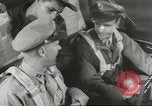
A USAAF officer trains a new B-17 pilot in cockpit check, including seat and controls check in the United States
A U.S. Army Air Forces (USAAF) training film titled 'How to fly the B-17. Part I. Ground Operations.' about inspections and safety precautions by a pilot prior to take off. A USAAF officer trains a new pilot beginning his career as a USAAF B-17 Flying Fortress pilot. The instructing officer, trainee pilot and aircraft engineer inspect a USAAF B-17 Flying Fortress. Cockpit check including seat and controls check: Seat check: seat belts, seat adjustment, rudder pedals. Control check: rudders and elevator controls unlocked, lock down and latched, aileron lock. Trim tab indicators inspection: rudder tab control, elevator tab control, aileron tab control. Check for: fuel transfer valves and switches, inter-coolers, JAIROS, fuel shut off switches, landing gear switch, cowl flaps, turbos, waste gate open, idle cut offs, throttles, RPM, auto pilot, de-ice and anti-ices, wing and propellers, cabin heat controllers, generators. Engine start check: The officer instructs the pilot to check for the fire guard with a fire extinguisher standing by near each engine. The pilot warns the ground crew for propeller clearance. (World War II period).

303rd Bomb Group airmen work on a parked B-17 at Dow Field, Bangor, Maine while in transit to England
The United States Army Air Force (USAAF) 303rd Bombardment Group (Heavy) 'Hell's Angels' at Dow Field, Bangor, Maine, while en route with their B-17s to their operating base at (RAF) Station Molesworth in England during World War II. Airmen work on a parked Boeing B-17 Flying Fortress. Names and artwork on the B-17s: 'Zombie - Dopey', 'Rim Fire Renner', 'Jerry Jinx', 'Lost and Found Department', 'Hostess wanted' , 'Nancy' , 'Sky Wolf,' 'Thumper', 'Idaho Potato Peeler'. Pilots look skyward. Note: From Brian O’Neill’s “303rd Bombardment Group” here is reported fate of some of the named planes: “Zombie” 41-24566, pilot: O.S. Witt, fate: MIA 20 Dec 42 “Jerry Jinx” 41-24607, pilot: E.H. Reber, fate: MIA 23 Jan 43 “Sky Wolf” 41-24562, pilot: C.H. Morales, fate: MIA 11 Jan 44 “Thumper” 41-24579, pilot: J.E. Castle, fate: crash landed UK 23 Jan 43 “Idaho Potato Peeler” 41-24565, pilot: R.C. Bales, fate: MIA 5 Nov 43

303rd Bomb Group B-17s in flight over the English Channel coast during World War Ii.
The United States Army Air Force (USAAF) 303rd Bombardment Group (Heavy) 'Hell's Angels' based at the Royal Air Force (RAF) Station Molesworth in England during World War II. USAAF Boeing B-17 Flying Fortresses in flight through clouds. The aircraft propellers and wing span. The B-17s in flight over the English Channel coast. The aircraft in flight over land and water. The B-17s in flight over an air base. Hangars and other buildings at the air base.

U.S. Army Air Force airmen work on B-17s before they take off from Molesworth Airfield in England during World War II.
The United States Army Air Force (USAAF) 303rd Bombardment Group (Heavy) 'Hell's Angels' based at the Royal Air Force (RAF) Station Molesworth in England during World War II. A windsock flies with the wind. U.S. Army Air Force airmen work on the engine of a Boeing B-17 Flying Fortress. Several B-17s parked at the Airfield. Military jeeps around the aircraft. Two B-17s taxi along. They pass several other parked Flying Fortresses. The aircraft take off.

303rd Bomb Group B-17s and A-20Cs in flight over the Molesworth Airfield in England during World War II.
The United States Army Air Force (USAAF) 303rd Bombardment Group (Heavy) 'Hell's Angels' at the Royal Air Force (RAF) Station Molesworth in England during World War II. USAAF Douglas A-20C Boston IIIAs taxi past parked B-17 Flying Fortresses. The aircraft take off. Several B-17s take off. The aircraft in flight. Aerial view of the Airfield. The landscape around the Airfield. The B-17s in flight over fields and buildings in rural England.
CRITICALPAST.COM: About Us | Contact Us | FAQs - How to Order | License Agreement | My Account | My Lightboxes | Shopping Cart | Advanced Search | Featured Collections | Website Terms & Conditions | Privacy Policy ©2026 CriticalPast LLC.
License Agreement |
Terms & Conditions |
Privacy Policy
©2026 CriticalPast LLC.