


 Francais
 Deutsch
 Italiano
Refine Your Search
B-24-Burma stock footage and images
- Showing 1657 to 1662 of 3678 results more
more Hide
Hide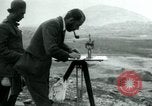
British geologist George B. Reynolds and workers drilling for oil and striking oil in Masjed Soleyman, Iran, Persia.
Activities of George B. Reynolds and his team operating an oil drilling mechanism in Masjed Soleyman, Iran. Reynolds, representing the Anglo-Persian Oil Company or APOC, (which later became British Petroleum in 1954, or BP), studies maps while smoking a pipe. An oil rig set up in the desert at the location Masjid-i-Sulaiman. Workers and mechanics working at the rig. Close views of the diary records of George B. Reynolds. Men work on oil rigs under intense sun. The oil rig working and striking oil; a cloud of smoke and fire from the ground. Close views of a binder holding letter from Lewis Mallet to the British foreign office announcing the successful oil discovery. A seemingly unrelated two-second view of 1908-era motor cars on a street follows.
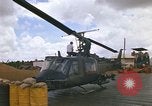
Mechanics work on engine and rotor and check machine guns of UH-1B helicopters at a post of United States Military in Vietnam.
Post of the United States Military in Vietnam during Vietnam War. Tow mechanics work on top of a UH-1B helicopter around the rotor. Two men work on main rotor of another UH-1B. Mechanic greases various areas around the rotor. A crewman works with machine gun M-60 on port side of the helicopter. Another crewman carries two other machine guns. They check the machine gun and rocket pod on the port side. Mechanics work on exposed engine and rotor. Mechanics work on after part around the rotor.
Peruvian men assist in loading a D6B Cat machine in a C-130A cargo plane of U.S. Air Force during Andes Airlift at Chiloya, Peru.
C-130A cargo airplanes of the United States Air Force transport road construction equipment during Andes Airlift, from Chiloya to Bella Vista village, in Peru. A Peruvian man instructs a U.S. Air Force captain how to operate a D6B Cat machine. Peruvian labor shore lumber in C-130A and place them crosswise in aircraft. The air force captain backs the D6B Cat machine to rear of aircraft and then Peruvian man backs it inside the cargo aircraft.
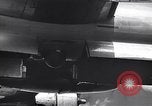
Bombing of Hiroshima, Japan, during World War II. B-29 in flight, bomb doors open, explosion on ground and devastation scenes
Bomb bay of United States Army Air Force B-29 aircraft opens. Interior view of aircraft shows bombardier in nose as he looks through bomb sight. Actual atomic bomb detonation over Nagasaki Japan as seen from B-29 aircraft on August 9, 1945. View of mushroom cloud rising rapidly from an atomic blast (a different blast; not Nagasaki or Hiroshima). Ground views of devastated city of Hiroshima following atomic bombing in World War 2.
Nike missile destroys a B-17 drone aircraft during tests in the United States
A B-17 bomber (drone) is seen flying at altitude, when it is struck by a Nike missile that explodes and causes a fire. Next, the B-17 is seen rolling over and falling out of control. Its tail falls off as it descends. It strikes the ground and explodes in a fireball.
British royal family visits Allied air force bases in England during World War 2; Princess Elizabeth christens B-17 aircraft
King George VI of England, accompanied by his wife, Queen Elizabeth Bowes-Lyon, and daughter, Princess Elizabeth (future Queen Elizabeth II), arrives at an Allied air base in England during World War II. King George VI awards medals of honor to officers of Allied Air Force. British Royal family looks at an Avro Lancaster aircraft of Royal Air Force (RAF). British Royal family being greeted by United States Army General Doolittle at Thurleigh Royal Air Force Base outside Bedford, England, base for the 306th Bombardment Group, 367th Bombardment Squadron of the U.S. Eighth Army Air Force. A Boeing B-17 Flying Fortress aircraft with nose art "Four of a Kind" is seen parked in the background. King George VI speaks to American flight crew. Using a bottle of cider, Princess Elizabeth christens B-17G bomber as "Rose of York" (formerly it was named "Princess Elizabeth" and "The Princess." Those names were ordered removed by command of the 8th Air Force). 306th commanding officer, Colonel Claude Putnam, is by her side for the christening. Princess Elizabeth holds a bouquet of white roses and stands with officers of United States 8th Air Force.
CRITICALPAST.COM: About Us | Contact Us | FAQs - How to Order | License Agreement | My Account | My Lightboxes | Shopping Cart | Advanced Search | Featured Collections | Website Terms & Conditions | Privacy Policy ©2026 CriticalPast LLC.
License Agreement |
Terms & Conditions |
Privacy Policy
©2026 CriticalPast LLC.