


 Francais
 Deutsch
 Italiano
Refine Your Search
B-24-Burma stock footage and images
- Showing 13 to 18 of 3692 results more
more Hide
Hide
Problem of getting U.S. supplies to China during Japanese aggression in China during World War II.
A film titled 'Coming Kunming' based on the problem of getting supplies to China and the activities of U.S. Troop Carrier Command during World War II. Japanese troops march into a Chinese town during Sino-Japanese war. They advance during an invasion. A map highlights the Burma Road linking Burma with China and Kunming, Yunnan and Lashio as its terminals. A Chinese woman works on the road. Trucks move along the road. The Ledo Road as an alternative to the Burma Road which had been cut by the Japanese Army. U.S. Army Air Force B-24 Liberator bombers in flight over the Himalayan Mountains. Inadequate dock facilities in Calcutta, India. A map details transportation problem. Native labor is used for the construction of a U.S. air base in India. Building of rail road lines. Chinese laborers work in China. Cargo ships underway at sea.
Allied planning for the final invasion of Japan in World War II
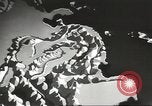
Scene opens with a map illustrating one possible Allied path for invasion of Japan. It proceeds from India and Burma to China and thence to Japan. A U.S. B-24 bomber is seen landing at a Far East Air field. Next, the Supreme Allied Commander of South-East Command (SEAC) Admiral Lord Mountbatten, is seen posing with Chinese General Li Zongren (AKA Li Tsung-jen) and other high ranking Chinese officers, and then walking with them. Next are views of U.S. General Joseph Stillwell working with staff as they consult maps. Then, Chinese laborers are seen engaged in construction of a bridge over a riverbed, that is to be part of the "Ledo Road,"traversing Burma and providing a highway from India to Chunking, China. Trucks moving over the already completed segments of the road, carry men and war materiel. One truck passes a local native drawing water from a well using a long counterbalanced pole. At the frontier of the roadbuilding, Chinese soldiers chop their way through dense jungles and battle Japanese forces firing at them. A fallen soldier. Allied soldiers shouting as run into a village engaging Japanese forces. Structures in the village burning and spreading in the area. Scene shifts abruptly to an animated map illustrating what are believed to be the Japanese plan for its last desparate defense. It shows them falling back to highly defensible boundaries encompassing sources of supplies needed to sustain their defense. Aerial views of Manchurian landscape. Japanese officials are seen at their administrative offices in Manchuria. Large numbers of Manchurian workers are seen headed to work near a factory. Others are engaged in open pit mining, where explosives are used to expose and ready ores for extraction. Views inside a Manchurian steel plant supporting the Japanese war effort. Japanese military forces are shown moving by horseback in the area, ostensibly to push further into China and add more protection against potential Allied offensives. Likewise, Japanese warships are shown at sea maneuvering to defensive locations. This is all summed up in a map showing the expected disposition and status of military defensives for Japan's final defense (Fortress Japan). Street traffic on a city street in Japan. A large group of Japanese women in traditional dress, carry banners and quietly bow. View of the Japanese Diet Building (Parliament) and political and Military leaders inside, including Prime Minister Tojo, Hideki.

Testing of AZON or VB1 smart bombs by United States
AZON one of the first smart bombs developed by United States, for destroying narrow railway bridges in Burma, being tested. An AZON marked 62 is dropped much above the surface by United States B -24 Liberator aircraft. The bomb drops and strikes an isolated area and an explosion occurs. AZON is officially designated as VB-1 i.e. vertical bomb which is a guided weapon to maximize damage to target and minimize civilian destruction. Various dimensions of VB-1 being explained like, battery ,gyro stabilizer,radio receiver and antenna. Bomb releases and explosion occurs. (World War II period).
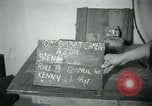
Demonstration on assembling and directing Azon Bombs by the 7th Bombardment Group U.S. Army Air Force at a laboratory in Burma.
China-Burma-India Theater during World War II. A United States Army Air Force technician checks the working of control systems of an Azon Bomb at a laboratory in Burma. He fills in the 24volts battery, tests gyro, tests tuning receiver. He puts radio receiver, gyro and battery in the fin assembly. He measures the movement of the rudders on a scale.
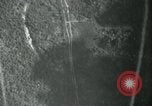
Array of smoke trails left by bombs dropped by the United States Army Air Force in China-Burma-India Theater in World War II.
U.S. Army Air Force attacks enemy railroads and bridges in China-Burma-India Theater during the World War II. Bombs dropped by the -24 bombers of the U.S. Air Force leave a smoke trail behind. An array of straight smoke trails left by the dropping bombs.
United State helicopter pilot examines a crashed B-25 in Burma during World War II
American pilot, examining a crashed B-25, in Burma, during World War 2. He places instruments, he's removed from the aircraft, on its wing. The aircraft is a B-25J serial 43-3951 "Cornhusker" of the 83rd Bomb Squadron, 12th Bombardment Group. He gets down from the wing carrying the instruments and moves towards his Sikorsky YR-4B helicopter. He gets into the helicopter and starts the engine. The Helicopter lifts off and hovers low over the crashed B-25.
CRITICALPAST.COM: About Us | Contact Us | FAQs - How to Order | License Agreement | My Account | My Lightboxes | Shopping Cart | Advanced Search | Featured Collections | Website Terms & Conditions | Privacy Policy ©2026 CriticalPast LLC.
License Agreement |
Terms & Conditions |
Privacy Policy
©2026 CriticalPast LLC.