


 Francais
 Deutsch
 Italiano
Refine Your Search
B-24-Burma stock footage and images
- Showing 1909 to 1914 of 3678 results more
more Hide
Hide
Field Marshall Bernard L Montgomery visits Major General Matthew B Ridgway at 18th Airborne Corps near Harde in Belgium.
Field Marshall Bernard L Montgomery arrives near Harde in Belgium. He visits Major General Matthew B Ridgway at 18th Airborne Corps. House in the background. Other soldiers walk along with the Field Marshall and the Major General. A car arrives. Men talk amongst themselves. The car comes out of the house. Jeeps parked outside a building. (World War II period).
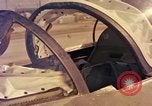
Pilot in the cockpit of B-47 fastens his chute and seat belt, United States.
Pilot climbs into the cockpit of B-47 in United States. He fastens his chute and seat belt. He puts on his helmet and face mask. Canopy is open.
Strategic Air Command (SAC) B-47 Reflex Action Alert crew responds at Loring AFB in Maine, USA
Strategic Air Command (SAC) Reflex Action Alert flight crew members, responding to on alert, run across icy ramp to man their B-47 aircraft at the Loring Air Force Base in Maine, United States. Crew is seen preparing to board and launch. Heater hoses are attached to the aircraft. Pilot talks to crew chief, who then attends to ground auxiliary power unit and communicates with aircrew using mike and headset. Sun is setting.Snow plowed from alert area and runway. Three responding crew members slip and slide as they run over ice. A flight line guard, carrying a carbine and wearing fur lined parka, checks their passes and lets them continue. Aircraft in flight seen in background.
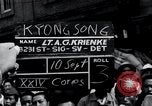
United States soldiers of 7th Division, 184th Infantry Regiment, Company-B, march past civilians in Kyongsong (Seoul) South Korea, at end of World War II.
American soldiers of 7th Division, 184th Infantry Regiment, Company-B, march past civilians standing on curbs of streets inf Kyongsong (Seoul) in South Korea, at the end of World War 2. Japanese policemen herd civilians onto curb.where they wait to view the parade. Two men hoist Korean National Flag on top of a building.American and Korean flags flutter on masts atop a tower. (World War II period).
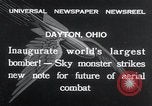
World's largest bomber (Boeing Y1B-9) is demonstrated for public at Wright Field, Dayton, Ohio
World's largest bomber (of its day) on first public demonstration flight at airfield in Dayton,Ohio. A Boeing Y1B-9 bomber taxis on ramp at Wright Field. The all-metal aircraft has open cockpits. Pilot in center of aircraft and crew member visible in nose gunner position. Change of scene shows a man standing behind the empennage of the parked bomber and moving its huge metal rudder slightly. The bomber taking off towards the camera over a grassy field, and later, in flight, .being observed and photographed from accompanying airplanes (partially visible).
President Lyndon B. Johnson signs the Civil Rights Act at the White House in Washington DC.
United States Congress passes the Civil Rights Bill. After the House votes on the measure, President Lyndon B. Johnson signs the Civil Rights Act of 1964 into law before an audience of Legislators and Civil Rights Leaders at the White House in Washington DC. He calls it 'a turning point in history' and uses one hundred pens to affix his signature. Many civil rights and government leaders seen behind the President, including Everett Dirksen and Hubert Humphrey, Marting Luther King Jr., and J. Edgar Hoover, all of who receive signing pens. President Johnson hands several signing pens to Attorney General Robert Kennedy, for members of the Kennedy family.
CRITICALPAST.COM: About Us | Contact Us | FAQs - How to Order | License Agreement | My Account | My Lightboxes | Shopping Cart | Advanced Search | Featured Collections | Website Terms & Conditions | Privacy Policy ©2026 CriticalPast LLC.
License Agreement |
Terms & Conditions |
Privacy Policy
©2026 CriticalPast LLC.