


 Francais
 Deutsch
 Italiano
Refine Your Search
B-24-Burma stock footage and images
- Showing 2065 to 2070 of 3678 results more
more Hide
Hide
Crash of U.S. Air Force B-52 bomber after takeoff from March Air Base in California. Five of six crew killed.
Film opens showing closeup of a smashed aircraft landing gear at a crash site. A large group of men stand near the burned remains of U.S. Air Force B-52D Stratofortress, 56-0594, of the 22d Bomb Wing, that crashed at 0730 hours, shortly after takeoff from March Air Base in California. An armed airman stands in the foreground. A fire truck is parked near the wreckage. Scene shifts to recovery workers combing through smoldering debris. Medics carry covered remains from the area, on a stretcher, past an Air Force cinematographer filming the scene. Closeup of a medic in white red cross helmet wearing a breathing mask, standing near workers placing charred remains in a plastic bag and tagging it. An Air Force Lieutenant Colonel and a Captain, standing with civilians at the site. View of the plane tail and part of fuselage silhouetted against gray sky. Remains of a farm animal. Airman shoveling ashes over smoldering debris. An aircraft circling over the crash site. A fire truck parked next to wreckage. Camera pans over remains of aircraft tail section. Closeup of landing gear wheels with tires and fire fighters moving hose through through smoldering debris in background. Firefighters at their truck. (Note: the crash site is a plowed farm field at Sunnymead, approximately 2.5 miles SE of March AFB.)
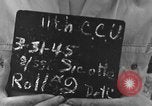
Remains of a United States Army Air Forces B-29 Super fortress that crashed on Tinian in the Northern Mariana Islands., during World War II
Remains of USAAF B-29 number 42-65283 from the 9th Bomb Group, 99th Bomb Squadron, that crashed, 30 March 1945, in World War 2, on Tinian, Northern Mariana Islands. All crew members were immediately killed in the crash, except tail gunner, Sgt. Joseph C. Trullo, Jr., who initially survived but died of his injuries, five days later, and the sole survivor, Radio Operator, Sgt. James Langraf who was injured but eventually recovered. Air Force personnel inspect debris that is scattered across the crash site in sand dunes close to the ocean in the background.
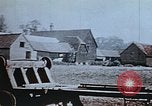
B-17s of the U.S. 91st Bomb Group take off from Bassingbourn Airfield, England on a mission.
Views of the area around RAF Bassingbourn airfield, as B-17s of the U.S. 8th Air Force, 91st Bomb Group, line up for takeoff on a mission to bomb German-held port of Wilhelmshaven, during World War Two. among the named aircraft seen taking off are: "Dame Satan," "Hitler's Gremlin," "Helno-gal," "Royal Flush," "Der Fuehrer's Face," "Old Bill," "Peggy, my little Waaf," and "Desperate Journey."
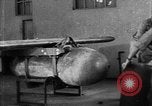
Dropping of a heat seeker missile, GB-6 from a B-17 flying fortress in the United States.
A review of research and development in guided missiles by the United States Air Force from 1919 to 1948. GB-6, a heat seeker missile, is assembled in a work laboratory. Men attach the homing device to the heat seeker unit then attach the same to the nose section of the GB-6 airframe. They test the heat seeker missile by holding a match flame in front of the same. Activating section of the heat seeker missile. A B-17 flying fortress in flight launches the GB-6 missile. The missile descends.
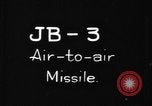
A JB-3, air-to-air missile attached to the wing of a B-26 Invader in the United States.
A review of research and development in guided missiles by the United States Air Force from 1919 to 1948. A JB-3, air-to-air missile. The missile is attached to the wing of a B-26 Invader. A still photograph of a partially assembled JB-3 missile in an assembly building.
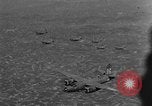
U.S. Army Air Forces B-26s, on interdiction mission over Germany, drop bombs on lines of communication.
American B-26 bombers attack waterways and interdict other lines of communication in Germany during final phases of World War II in Europe.
CRITICALPAST.COM: About Us | Contact Us | FAQs - How to Order | License Agreement | My Account | My Lightboxes | Shopping Cart | Advanced Search | Featured Collections | Website Terms & Conditions | Privacy Policy ©2026 CriticalPast LLC.
License Agreement |
Terms & Conditions |
Privacy Policy
©2026 CriticalPast LLC.