


 Francais
 Deutsch
 Italiano
Refine Your Search
B-24-Burma stock footage and images
- Showing 2167 to 2172 of 3678 results more
more Hide
Hide
U.S. 13th Air Forces B-17 Flying Fortress bomb Japanese airfield on Munda Point, New Georgia during World War II.
A film titled 'Air Aspects of the Campaign against Munda' based on USAAF (United States Army Air Force) activities on New Georgia group of Islands, Solomon Islands during World War II. USAAF P-38 Lightning in flight over the Solomon Islands. An animated map highlights Munda Point in New Georgia. A USAAF officer takes a look at aerial reconnaissance photographs. The officer talks over a phone at his desk. An animated map highlights Vila in Kolombangara. An animated map connects Vila and Munda Point with Henderson Airfield on Guadalcanal. U.S. 13th Air Forces B-17 Flying Fortress bombers take off from an airfield and bomb Japanese airfield at Munda Point.
U.S. 13th Air Force B-17 Flying Fortress bombers drop bombs over Japanese installations in Rekata Island during World War II.
U.S. Army Air Force aircraft attack enemy installations on Rekata Island, Solomon Islands during World War II. U.S. 13th Air Force B-17 Flying Fortress bombers drop bombs over Japanese installations on Rekata Island. Smoke billows up from the explosions.
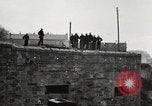
Vice Admiral Henry B Wilson visits a fortress on the coast of France, with members of his staff, at the end of World War I
Vice Admiral Henry B Wilson, Commander of U.S. Naval Forces in France, and about 20 members of his staff, visit a coastal fortress. American sailors walk along a an area overlooking the site's high walls. Camera pans to the left toward a group of Naval Officers climbing a tall berm that runs below the higher wall. The head of the group is Vice Admiral Wilson. A Navy Captain, in lighter color uniform, is acting as a tour guide. He pauses as the remainder of the visiting party catch up. The group poses. The fort wall and tops of buildings appear in the background. Admiral Wilson is flanked by the Captain tour guide and a Captain from his staff, in blues. All members of the party seem amused at being photographed by a cinematographer.
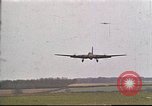
B-17 Flying Fortress bombers of U.S. 8th Army landing in succession on an airfield in England during World War 2.
B-17Fs of the 8th Bomber Command, 1st Bomb Division, 305th Bomb Group, 366th Bomb Squadron, landing at their base, RAF Chelveston, in Northamptonshire, England, during World War II. The first to land displays a dozen yellow bombs, for missions, painted under the pilot's cockpit window, and Squadron code KY, and L, on its fuselage. Its tail number is 42-5053. The second plane to land displays KY and D, on fuselage, and tail number 42-29553. The third, shows the squadron's KY, but other markings are not readable. The fourth to land displays some mission bombs below its cockpit window, the Squadron KY, and J on the fuselage. Its tail number is 41-21624. Bomb Group tail codes and nose art are not seen on any of the aircraft. But, researchers have identified names of three of them: Bloody Tangier Show (42-5053), Arkie II (42-29553),and Madame Betterfly (41-24624), and estimate the film to have been shot between 3/1/1943 and 5/19/1943.
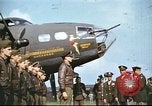
U.S. Army Lt. General Jacob Devers personally congratulates crew of the B-17 bomber, "Memphis Belle."
Commander of U.S. Army Forces in Europe, Lieutenant General Jacob Devers, personally congratulates the pilot, Captain Robert K. Morgan, and each crew member of the 8th Air Force B-17 bomber, "Memphis Belle." Commander of U.S. 8th Air Force, Major General Ira Eaker, is present during the ceremony, which is extensively covered by photographers, cinematographers, newsmen and broadcasters. (BBC microphone can be seen.) Some actions are repeated at the request of the military film director on the scene. The name and artwork on the nose of the aircraft is clearly seen as well as the 25 bombs (for missions) and 8 swastikas (for downed German airplanes) painted on the "Memphis Belle" fuselage. (World War II period).
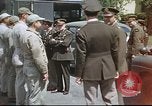
Generals visit U.S. 8th Air Force B-17 Flying Fortress bomber crew in England during World War II.
U.S. Army Lieutenant General Jacob L. Devers, Commander of U.S. Army Forces in Europe, and 8th Air Force Commander, Major General Ira Eaker, visit crewmen (in fatigues). A captain (pilot ) in class A uniform (possibly Captain Robert K. Morgan, pilot of the "Memphis Belle") escorts General Devers as he walks around a parked B-17. Views of briefing officer and aircrew members during a mission briefing.
CRITICALPAST.COM: About Us | Contact Us | FAQs - How to Order | License Agreement | My Account | My Lightboxes | Shopping Cart | Advanced Search | Featured Collections | Website Terms & Conditions | Privacy Policy ©2026 CriticalPast LLC.
License Agreement |
Terms & Conditions |
Privacy Policy
©2026 CriticalPast LLC.