


 Francais
 Deutsch
 Italiano
Refine Your Search
B-24-Burma stock footage and images
- Showing 2371 to 2376 of 3678 results more
more Hide
Hide
Various military aircraft fly in nuclear test zone in Nevada
A documentary detailing the effects of atomic weapons on Boeing B-50 bomber Superfortress airplanes, via Project 5.2 for the measurement of the effects of atomic weapons. Animated drawings of aircraft identified as WADC B-50 D, SAC B-50D, Navy AD-2, and T-33. and flying over a map, including aircraft shockwaves nearby. A B-50 bomber Superfortress aircraft codenamed “Clay Pigeon No.3” in flight formation on target run. B-50 bomber code named “Clay Pigeon No. 2” flies over a mountainous terrain. A Douglas AD-2 of the United States Navy code named “Duckbill” in flight formation on target run. Seven Lockheed TAC T-33 Shooting Star (with code name Leap Frog) approaching target after a bomb’s release. A target circle in ground as seen above. Aerial view shows the detonation of an atomic bomb, showing the expansion of super-heated circle cloud. Aerial view of cloud formation from atomic bomb detonation. A B-50 Superfortress in flight experiences sudden violent vibration from detonation nearby. A view of a mushroom cloud formation. A Douglas AD-2 flies near a mushroom cloud.
General Eisenhower inspects a Ninth Air Force Base in England; Allied bombers attack German infrastructure in France (WWII)
Supreme Allied Commander in Europe General Dwight D. Eisenhower inspects a Ninth Air Force Base in England during World War II. General Eisenhower salutes to men. United States soldiers look outside from a window to watch General Eisenhower’s arrival. Brick layers stop working on a wall to salute to General Eisenhower. General Eisenhower speaks with the M-26 Marauder crewmen. General Eisenhower laughing. General Eisenhower sits on in the cockpit of a fighter plane and fires its machine guns. Crowds of crewmen watch Eisenhower inspecting aircraft. An the airfield control tower, General Eisenhower and other officials watch the take-off of B-26 Marauders for a combat mission. B-26 Marauder bombers take off from the airfield. B-26 Marauder bombers form a formation in flight. B-26 Marauder bombers dodge anti-aircraft fire. Bomber with broken windshield window due to anti-aircraft fire damage. Bombs are dropped above a Nazi aerodrome in France. Aerial view of the Nazi aerodrome, railway switch yard bombings in Normandy. B-26 Marauder bombers heading back to England after bombing important military infrastructure in Normandy. A B-26 bomber lands on the runway. British Royal Air Force (RAF) Avro Lancaster bombers take-off from the Ninth Air Force Base at night. Lancaster bombersdrop bombs over German ammunitions dump and stores depot in France at night. Nighttime view of explosions on the ground.
First powered flight of an X-15 Rocket Plane. Also scenes of several other X-15 powered flights.
X-15 first powered flight on Thursday, 17 September, 1959. (X-15 No. 2, tail number: 56-6671 with LR-11 engines. Scott Crossfield flew this mission at mach 2.11 and altitude 52,341 feet.) Scenes of several other X-15 powered flights are also shown. View of the water tower at Edwards Air Force Base, california. Overhead, NASA NB-52A, No. 003 and an F-100D chase plane, are seen at high altitude, with contrails behind them. The X-15, cradled under the B-52's right wing, drops clear, starts its rocket engines and begins its first independent powered flight, climbing rapidly away from the B-52. NASA camera tracks it, appearing as a moving white dot against the sky. The next sequences show later powered flights. View of NASA B-52 and three chase planes leaving contrails overhead. X-15 drops, its engines are running and falls behind the B-52, before accelerating rapidly, passing to its right, and continuing upward. Another scene shows brief glimpse of NASA B-52 overhead (no contrails). In final scene, X-15 is seen moving rapidly, leaving a long contrail behind it. Cloud then obscures the image somewhat.
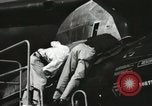
A man adjust hoist unit for final adjustment of X-15 while mating to pylon at Edwards Air Force Base in United States.
Mating of rocket powered aircraft X-15 with B-52 Stratofortress. Support crew work on X-15 under wing. A man adjust hoist unit for final adjustment of X-15 while mating to pylon. Three men on work stand. Men work on X-15 and pylon. Hoist holds X-15 in place while men work on both sides of X-15 making adjustments. A man with headphones on walks in. Air Force officer discusses about control box with civilian. Air Force officer stands beside civilian with control box. A man makes adjustment on the nose gear of X-15. Man watches other men on work and makes adjustments on X-15. A man stands on ground with headphones on. Two men work on pylon. View of center and tail section of B-52. Insignia of United States. A man stands by a camera that is mounted on rear side. Two men stand and work on pylon. Two men work on camera on rare side of B-52. Two men stand and work on camera mounted on. Right front side of B-52. X-15 held in place on B-52 by hoist support. Two men check hoist.
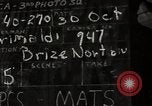
A bombardment group in a briefing room at Brize Norton Air Force Base in Oxfordshire, England.
A training mission of the United States Air Force 305th Bombardment Wing on aircraft B-47 Stratojet at Brize Norton Air Force Base in Oxfordshire, England. The crew members stand near the plane prior to the engine starting. One member talks to the crew in the plane over a radio phone. Power cables are attached to the underside of the plane's external power receptacles. A view of a hand pulling power cables from the receptacles. A ground crewman removes an engine warm up equipment. He removes a C-26 type electrical equipment auxiliary power unit from near the B-47 Stratojet. Another B-47 Stratojet stationary in the background as seen from beneath the wing of another B-47 Stratojet. Another B-47 Stratojet taxis. Interiors of a briefing room. The bombardment group sitting. The gate entrance to Brize Norton Air Force Base. Activity at the gate as civilians drive cars. They enter and leave the base. An ambulance pulls up at the gate. A sign reads ' Brize Norton RAF Station 3920th Air Base Group Welcomes You. Col. W. N. Van Sickle Command'.
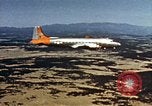
Testing effect of Atomic explosion on aircraft parked at different angles in Nevada, United States
Continental atomic tests Nevada, United States. Air Force C-54 aircraft in flight. Air Force Flight Surgeons wear masks and observe the atomic bomb explosion from an aircraft to test its effect on a pilot's vision. They immediately test their vision, while aboard the airplane, following the atomic blast. A truck drags a P-47 airplane. B-17s, P-47s, and newer aircraft are stationed at different angles. Atomic explosion tesst the effect of this explosion on the aircraft. High-speed cameras record effects of atomic blast. Elevator on tail of a B-17 in flames. Afterwards, technicians examine the damage on the various aircraft. Views of damaged aircraft after explosion on ground. USAF B-57B aircraft in flight. B-47 takes off with JATO. Smoke trails from the boosters.
CRITICALPAST.COM: About Us | Contact Us | FAQs - How to Order | License Agreement | My Account | My Lightboxes | Shopping Cart | Advanced Search | Featured Collections | Website Terms & Conditions | Privacy Policy ©2026 CriticalPast LLC.
License Agreement |
Terms & Conditions |
Privacy Policy
©2026 CriticalPast LLC.