


 Francais
 Deutsch
 Italiano
Refine Your Search
B-24-Burma stock footage and images
- Showing 2407 to 2412 of 3678 results more
more Hide
Hide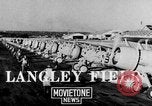
Fatal airplane crash mars 20th anniversary air show at Langley Field, Virginia.
People gather to watch air show commemorating 20th anniversary of Langley field, Virginia. Long line of P-12s parked with engines running on the air base ready for flight. Crew members rush towards the planes. Y1B-17 bombers, from 2nd Bombardment Group, move slowly along taxi strip toward the runway. One of the B-17B takes off. Nine B-17Bs in flight in echelon formation. PT-6 lays a smoke screen. P3-2As and PB-2As, of the 8th Pursuit Group, fly low over the field. Suddenly, one PB-2A dives and crashes into the ground, and burns. Smoke arises from the crashed plane. (Major Alfred J. Waller is killed in the crash and his observer, Sergeant John Johnston is injured.)
U.S. Air Force film report about the Strategic Air Command (made in January 1960.)
Film opens with still portrait of U.S. Strategic Air (SAC) Commander in Chief, General Thomas S. Power., who is heard saying "Peace is Our Profession." Signs outside SAC headquarters, bearing the same message. Glimpse of entry gate to the headquarters. View of Atlas missile displayed on the headquarters grounds. Closeups of the missile, at top and bottom. Air Force personnel manning phones in SAC Control Center, underground,at Offutt Air Force Base, Nebraska. Others are seen walking near extremely large wall displays. View of the main Control Center with officers at their respective stations. View of person entering past guards into the underground facility. A briefing officer climbs onto a moving platform that elevates him so he can brief the center personnel, while referring to one of the large wall displays. View of teletype machines receiving messages in the Center. Digital clocks show times in places like Guam and Alaska. The famous "Red Telephone" from which it is possible to launch the entire SAC strike force, all over the world, within seconds after warning of an enemy attack has been received at SAC Headquarters. B-47 bombers taxiing on a base. Closeups of some taxiing. A B-47 bomber taking off and flying high above the camera. Extreme closeup from outside of crew members in cockpit of B-47 in flight. Flight of three B-47s flying in formation.
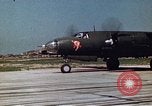
P-26 Marauder bomber aircraft in flight over Germany.
B-26 Marauder aircraft in Germany. B-26 taxiing on a runway. B-26 in flight. B-26's starboard prop slowing, milling, being feathered, then restarting. Landing gear of plane is lowered.
Allied aircraft lay mines in Pacific Theater during World War II.
'Aerial mine laying blockades Japanese shipping' depicts Allied preparations and Operations of the 21st Bomber Command, for aerial dropping of mines in the Pacific ocean to thwart Japanese shipping in World War 2. . Rows of stacked bombs are shown in a munitions dump at Tinian Air Base in the Mariana Islands. Camera focuses on a 2000 pound MK25 mine. Men demonstrate hydrostatic safety devices on the mine, including an extender that holds the detonator away from the booster charge until sufficiently immersed, and a clock delay mechanism. MK 25 transported to B-29 aircraft named Flak Alley Sally. (This is B-29 Number 42-24878 of the 40th Bomb Squadron, 6th Bomb Group, 313th Bomb Wing.) Airmen attach a parachute to the end of the mine. Another inserts the detonator and its extender plus the timer device into the side of the mine. Soluble washers are then placed in arming device ports. Scene shifts to Army and Navy planners working with maps, dividers, and a Weems plotter to mark the target location and mine laying pattern. 313th Bombardment Wing Group Commanders are seen being briefed in a war room. Next, engines are seen starting on a B-29, that then takes off and is seen in flight.(Narrator notes that missions are flown at night, but this one is photographed in the day to show how it is done. View of B-29 cruising above clouds. View from inside the aircraft, of bomb bay slowly opening. View of the target area below. The parachute of a mine opens by a static line as it falls from the bomb bay. Scene shifts to water level closeup of a mine striking the water. ('Presumably a demonstration inserted here.) Final scene shows a Navy Grumman TBF/TBM Avenger torpedo bomber dropping a parachute equipped mine. in the same location.
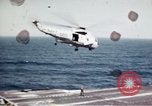
Several aircraft being launched from the flight deck of USS Ranger underway in the South China Sea.
USS Ranger underway in the South China Sea during the Vietnam War. A U.S. Navy SH-3D Sea King helicopter in flight off the side of USS Ranger. The helicopter lifts off. A U.S. Navy KA-3B Skywarrior aircraft being launched. A U.S. Navy A-7B Corsair II being launched from the angle deck and becomes airborne. An F-4J Phantom II aircraft taxis on the deck of USS Ranger, turning completely around. The A-7B seen airborne in the background after being launched from the angled deck. U.S. Navy A-6A Intruder aircraft taxiing on the deck. Two A-6As on the angle deck being prepared for a launch. One A-6A is launched. The second A-6A on launch. U.S. Navy C-1A Trader aircraft taxiing slowly on the deck. The F-4J aircraft in flight. The A- 7B in flight with its wheels down.
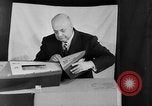
Assembly of liberty ships at Kaiser Shipyards, assembly of airplanes at aircraft factories in America during World War II
Opening scene shows U.S. Industrialist Henry J. Kaiser, demonstrating, on a scale model, how prefabricated parts are assembled into a Liberty Ship, in World war 2. Closeup shows each section of ship labeled by number and name, such as, “Transverse Bulkhead, number 44.” Scene shifts to Permanente Metals Corporation No. 2 shipyard in Richmond, California, where Liberty ships are seen in various stages of construction. Views of keels being laid, superstructures being raised into position, View from interior as skeleton of a ship is being completed. Sign atop the Liberty Ship, Robert E. Peary, as it is being launched, announces that it was completed from keel laying, to launch, in 4 days, 15 hours and 29 minutes. (This was a record for shortest time.) Camera view of the Robert E. Peary, from across the yard area where she was built. A brief view of shipyard activity at night, followed by camera panning over shipyard in daytime. Change of scene to an aircraft factory where B-17 bomber aircraft are being built. Women are seen riveting inside a plane’s fuselage. Other women work on a vertical stabilizer and still others work inside airplane structural members Men assemble an aircraft engine. Women fasten parts of engines together. Engines move through the plant on overhead cranes. An engine and propeller being placed into position on a wing with use of a crane. A right wing with two engines installed is moved into position for installation on a B-17 aircraft. Scene shifts to other aircraft factories building Martin Marauder B-26 aircraft; P-47 fighter aircraft;Navy Catalina aircraft; Douglas A-20 fighter bomber aircraft; and more B-17 bomber aircraft.
CRITICALPAST.COM: About Us | Contact Us | FAQs - How to Order | License Agreement | My Account | My Lightboxes | Shopping Cart | Advanced Search | Featured Collections | Website Terms & Conditions | Privacy Policy ©2026 CriticalPast LLC.
License Agreement |
Terms & Conditions |
Privacy Policy
©2026 CriticalPast LLC.