


 Francais
 Deutsch
 Italiano
Refine Your Search
B-24-Burma stock footage and images
- Showing 2533 to 2538 of 3678 results more
more Hide
Hide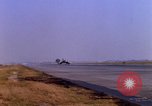
Various U.S. fighter aircraft (RF-4 Phantom, F-8E Crusader and A-6 Intruder) in Vietnam.
A U.S. Marine Corps RF-4B Phantom on ground roll, towing its open drag chute after landing. Another RF-4B Phantom takes off. An F-8E Crusader lands. Another F-8E lands and rolls out to end of runway. An A-6A Intruder on long ground roll after landing. Two F-8E Crusaders take off in succession. (Vietnam War period).
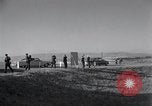
Inspection of SAC and ABC by President John F Kennedy,US
Motor caravan moving along road. Inspection of SAC and ABC facilities, flight line and hangar exhibits, conducted for President John F Kennedy by General Thomas S Power. Wall of 576B block house shows SAC insignia and 16 Atlas missiles representing launches. President Kennedy and official party arrives at 576B Control Center where he greets members of 389th Strategic Missile Wing launch crew outside emplacement. President Kennedy gets out of bubble limousine. President Kennedy shakes hand followed by Secretary of Defense Robert McNamara. Strategic Missile wing Launch crew outside emplacement. Major Clifford W Simonson, commander of missile combat launch crew presents official missile badge to President Kennedy. Party leaves area by car. Events of project Sky Rocket. 23 March 1962.
Four U.S. security policemen pack supply package and leave for Hill 151 by U.S. military helicopter,Vietnam
Four U.S. security policemen pack and place supply package. U.S. military jeep in background. Four U.S. personnel board a HH-43B helicopter. Supply package dropped by a U.S. military helicopter HH-43B 'Huskie' at a observation post on Hill 151 overlooking Phu Cat Air Base. SP looks through binoculars toward valley.
French Navy hydro-aeroplanes (flying boats and float planes) in World War I
During World War 1, a French naval aviator climbs into the hull of a Franco-British Aviation Type H flying boat, marked F.B.A. #8. Another crew member is already aboard and the engine is running. They taxi out in the water and take off in the aircraft. As they taxi for takeoff, a Breguet 14H float plane lands in background. Aerial views from the airborne F.B.A. Type H, showing boats in the water below. Next are seen two voisin 3 float planes taxiing slowly in water. A Viosin 3 float plane taxis rapidly up onto a wooden ramp. (WWI. WW1)

Devastation from atomic bomb dropped on Hiroshima Japan in World War II
U.S. War Department film showing devastation from atomic bomb dropped on Hiroshima, Japan, during World War 2. Opening scene is darkness of predawn in Alamogordo, New Mexico, on 16, July, 1945, at 5:29:45 AM. Suddenly, a huge explosion lights up the sky. A fireball and mushroom shaped cloud form. Closer view of the explosion from another camera. Following the initial explosion, the ensuing sound is a continuous roar. Another view is shown, from a third camera location. It highlights the boiling fire and smoke of the explosion. These scenes document the first successful test of a nuclear weapon, code named "Trinity". Change of scene shows glimpse of the Manhattan Project B Reactor site at Hanford, Washington, as viewed from a car driving past. Closeup of the facility, from right up against a boundary fence. Glimpses of other Manhattan Project facilities in New Mexico, Oak Ridge, Tennessee, and another view of the Hanford, Washington facility. Next, a rough topographical map of Japan is shown. Closeup of elevated railroad train traveling in Hiroshima, Japan. Imperial Japanese Army motorized vehicles are shown on parade, including fully tracked open personnel carriers with soldiers aboard and Type 94 Tankettes being driven by individual soldiers. Japanese infantry marching in full field gear including shouldered rifles with fixed bayonets. Closeup of a Japanese Army officer. Glimpse of Japanese support troops, such as quartermaster elements, in black uniforms. Japanese technicians in white lab coats at a wartime facility. Japanese Navy Warships being launched from Hiroshima ship yards. A lone B-29 bomber seen in flight over clouds. Its tail number, 42-63735 is clearly seen. It displays a large "05" on it upper tail. (This is not the "Enola Gay" whose tail number was 44-86292.) Closeup of one of the aircraft's engines with propeller turning. Glimpse upward from interior of the aircraft. Scene shifts to aerial photograph of Hiroshima with overlay depicting the bomb strike zone. Animated map showing explosion and precise point ot detonation above the junction of the Motoyasu and Ota Rivers. A view at the ground of destruction from the atomic explosion. An American soldier stands in the midst of the destruction. Slabs of heavy concrete are destroyed. View looking East from ground zero, past a burned tree trunk in the foreground, where the shells of several stronger buildings still stand amidst a sea of rubble. To the South, hardly anything is left standing. Looking West, everything is essentially leveled.
Air operations on Japanese aircraft carrier Zuikaku, during World War II.
View from deck of a Japanese battleship looking back at three Japanese aircraft carriers underway. during World War 2. Interior view of compartment in Japanese aircraft carrier Zuikaku Ship's intercom loudspeaker calls pilots to a mission. Airplanes with engines running on the flight deck of the carrier. The planes ready for take off. Pilot prays at shinto shrine below decks, before mission briefing. Japanese flight commander briefs the pilots before take off. Pilots in cockpits. Nakajima B6n1 torpedo planes take off carrying torpedoes underneath (these B6N aircraft were called "Jill" by the Allies). Japanese Imperial Navy sailors watch the planes.
CRITICALPAST.COM: About Us | Contact Us | FAQs - How to Order | License Agreement | My Account | My Lightboxes | Shopping Cart | Advanced Search | Featured Collections | Website Terms & Conditions | Privacy Policy ©2026 CriticalPast LLC.
License Agreement |
Terms & Conditions |
Privacy Policy
©2026 CriticalPast LLC.