


 Francais
 Deutsch
 Italiano
Refine Your Search
B-24-Burma stock footage and images
- Showing 2599 to 2604 of 3678 results more
more Hide
Hide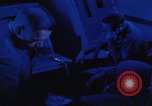
North American Aerospace Defense Command officials seated in control room, United States.
Animation: NORAD (North American Aerospace Defense Command) using SAGE (Semi-Automatic Ground Environment) directed Bomarc IM-99B missiles to repel an attack by hostile aircraft. General Laurence Kuter and other officials in the NORAD control room. They look at screens and speak over phone. Four F-102A aircraft in flight. NORAD official operates controls and speaks over mouth piece. General Laurence Kuter speaks with other officials. Bomarc IM-99B at launch pad.

Montage of scenes depicting U.S. military weapons in the Korean War era.
Segment of U.S. Army public information television program called, "The Big Picture." Army cameraman records firing of a Nike missile. Atomic cannon fires shell creating atomic explosion and classic mushroom cloud. Army troops exit Sikorsky YH-19 helicopters. Infantrymen climb a hill while firing rifles in unison. Animated rotating world globe. Sergeant Stuart Queen emphasizes that, in spite of new weapon systems, the individual soldier is the essential element of the Army. Technicians in missile launch control blockhouse observe launch of a missile from steel tower. View from inside the structure of missile rising, and then of smoke as it heads skyward. Radar units and cameras tracking the missile. Views from a missile, of the ground below, as it accelerates upwards. More tracking cameras. A Matador missile being launched. A Viking missile being launched. Test of anti-aircraft missile launched horizontally, striking nearby target with explosion. A thermonuclear weapon test explosion. A Corporal missile being launched. Sophisticated electronic tracking equipment employed at desert test site. Convair experimental XFY Pogo seen in vertical takeoff during trials. Anti-aircraft missile, fired from Navy ship, strikes drone target aircraft, which falls in flames. Technician stands before a virtual wall of electronic equipment. Army Signal Corps television cameraman captures field maneuvers of Landing Vehicles Tracked (LVTs) and an M4 Sherman tank. A High-flying warplane fires an air-to-air missile destroying a drone aircraft target that falls in flames. Aerial view of the Pentagon, Arlington, Virginia. America's top military leaders sit around a table. At the head, is Chairman of the Joint Chiefs of Staff, Admiral Arthur William Radford. To his right are: General Nathan F. Twining, USAF, and Admiral Robert B. Carney, Chief of Naval Operations (back to camera). To Radford's left are General Lyman Lemnitzer, Army chief of Staff, and General Lemuel C. Shepherd, Jr. Commandant of the Marine Corps. Views of U.S. Navy warships firing heavy guns. A South Dakota Class Battleship firing her 16-inch guns. Navy aircraft being catapulted from the USS Ranger (CV-61). Gun camera view from aircraft firing guns. A USAF B-52 bomber in flight. Bombs falling from open bomb bay of bomber in flight and carpeting the ground with explosions. Low flying USAF aircraft demonstrating ground-support bombing techniques, dropping napalm and explosive bombs.
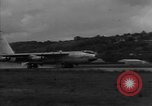
Combined operations of: U.S. Army, Air Force, and Navy, during Inchon Landing, in the Korean War
A B-52 strategic bomber aircraft takes off. A flight of B-52s in formation. Higgins boat landing craft motoring toward shore in the amphibious assault and landing at Inchon, during the Korean War (also spelled Incheon). A U.S. Landing Craft Tank (Rocket), LCT(R), firing rockets at shore during the assault. Wider view of the assault with rockets being fired and smoke obscuring much of scene. General of the Army Douglas MacArthur, Commander-in-Chief, Far East Command, is seen seated aboard the USS Mount McKinley (AGC-7) during the Inchon Korea landings, September 15,1950. Behind him is Rear Admiral James H. Doyle, U.S. Navy, Commander of Task Force 90 and Major General Edward M. Almond, U.S. Army, Commander, Tenth Corps (looking through binoculars). More scenes of the amphibious landing including view of Landing vehicle Tracked (LVT) in the surf. Infantrymen clambering ashore. An M4 Sherman tank in action. Smoke and fire. North Korean soldiers surrendering with white flags and taken captive as prisoners of war. American tanks passing through captured North Korean town.
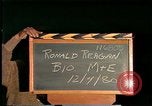
A film sketch about U.S. President Ronald Reagan and tracing his personal history and career leading to the Presidency in the 1980 election.
Opening scene shows U.S. President Ronald Reagan holding a little girl, and then standing with officials and Secret Service agents, as he prepares to enter a car. Closeup of him smiling. Closeup of President Reagan signing his autograph for spectators in a crowd. Next, Reagan and his wife Nancy are seen on November 4, 1980 waving to supporters at the Century Plaza Hotel, celebrating his election victory as the 40th U.S. President. The President elect says a few words of thanks to them. Views of the crowd cheering. Adopted son, Michael Reagan holds his son Cameron as he and his wife, Colleen Reagan, join Ronald and Nancy Reagan on the stage, followed by daughter Patricia Reagan and son Ron Reagan. The crowd cheers the President elect and his family. At this point the film begins showing images about Ronald Regan's life, starting with baby pictures; his parents; Tampico, Illinois, where he was born; Dixon, where he is seen in a school picture and with boyhood friends. A photograph of "Dutch" Reagan President of his High School Class. Reagan in photo with other members of the Eureka College football team, in Eureka, Illinois. The seal of the college. Pictures of Reagan with college classmates and teammates. Reagan posing in bathing suit when he was swimming team coach. Young Reagan, after graduation, as a sports announcer, sitting at a microphone labeled: "WHO" in Davenport, Iowa. The broadcasting tower of that radio station. A Track and field event taking place. Reagan posing with a pipe in his mouth, at the WHO radio station in Des Moines, Iowa. A baseball game in progress before a full stadium of spectators. In 1937, a Chicago baseball team is seen boarding a ship to a Spring training camp in California. (Narrator states Reagan accompanied them.) Aerial view of buildings at the First National Studios (home of Warner Brothers) in Hollywood. Ronald and Nancy Reagan, circa 1952, being applauded at a gathering when he was President of the Screen Actors Guild. Views of Reagan in U.S. Army uniform. A U.S. Army C-47 aircraft taking off from a field under attack, with fires burning and smoke rising (possibly during Japanese December 7, 1941 attack on installations in Pearl Harbor, Hawaii). U.S. Airmen standing on a ramp next to a Douglas C-47B-1-DL transport aircraft (tail number: 43-16145). What appears to be a ViP version of a B-50 aircraft parked on a ramp with an honor guard at the stairway. Ronald Reagan, in uniform, signing up for active duty. Later, Captain Reagan, U.S. Army Air Forces, is seen with other uniformed men at a gathering in Warner Brothers studios. The entrance of Paramount Pictures studios in Hollywood. A large group of studio employees walking between buildings. Reagan speaking, as President, of the Screen Actors Guild, at an outdoor gathering. Actor Robert Young and film industry executives stand nearby. Reagan, as Chairman of the Motion Picture Industry Council, addresses a dinner gathering of that organization. He is also seen testifying before he House Committee on Un-American activities Committee (HUAC) on October 23, 1947.
General Dwight D Eisenhower inspects 9th Air Force base in England (WW2)
Air war in England during World War II. General Dwight D Eisenhower inspects 9th Air Force base in England. General Eisenhower inspects the plane and its readiness, shown by Air force personnel. General Eisenhower seated in cockpit fires mounted machine guns for testing. B-26C's take off and bombard over target. Aerial view of targets and explosions over target. B-26C's land and British Hudsons take off. Planes fire, smoke arises from explosions.
The story of U.S. Navy Seabees on Guadalcanal during World War II.
Activities of the Seabees on Guadalcanal, Solomon Islands, during World War II. Seabees seen salvaging ships damaged and sunk during the Japanese December 7, 1941 attack on Pearl Harbor.Seabees seen on the deck of the USS California (BB-44). U.S. warship fires guns at Guadalcanal. U.S. Marines land on Guadalcanal and advance in long line across the island. Marines firing heavy field artillery. Seabees begin rebuilding Henderson Field, surrounded by fire and smoke of battle. Ground and aerial views of Henderson field, with destroyed U.S. fighter bombers seen. From the air, many small airplanes and several B-17s can be seen. Seabees filling shell and bomb craters on the field. U.S. Marines firing firing antiaircraft weapons against attacking Japanese airplanes. Two Japanese airplanes plunging in flames. An empty life vest floating in the water. The Seabees continue rebuilding and expanding Henderson Field using Marston matting (pierced steel planking). A Navy Douglas SBD Dauntless dive bomber lands at the newly repaired field. U.S. Air Force B-17s take off from Henderson Field. and
CRITICALPAST.COM: About Us | Contact Us | FAQs - How to Order | License Agreement | My Account | My Lightboxes | Shopping Cart | Advanced Search | Featured Collections | Website Terms & Conditions | Privacy Policy ©2026 CriticalPast LLC.
License Agreement |
Terms & Conditions |
Privacy Policy
©2026 CriticalPast LLC.