


 Francais
 Deutsch
 Italiano
Refine Your Search
B-24-Burma stock footage and images
- Showing 2617 to 2622 of 3678 results more
more Hide
Hide
U.S. Operation Teapot High Altitude test of an air-to-air missile nuclear warhead at Nevada test site in Nye County, Nevada.
One of the Operation Teapot atomic tests at the Nevada test site in Nye County, Nevada. B-36H Aircraft in flight at almost 37 thousand feet. Several contrails in sky. Aerial blast goes off high in sky forming a white fireball, it darkens quickly. It looks like a doughnut with a large hole in its center. It closes up fast and produce an odd-shaped circular smoke cloud. It has a appearance of a doughnut with a shallow area in the center. (Note: Because of the extreme high altitude of this air-drop test , the device was retarded, by parachute, to allow the B-36 time to travel a safe distance before detonation.)
U.S. President Lyndon Baines Johnson visits Anderson Air Force Base in Guam, during the Vietnam War.
President Lyndon B. Johnson arrives in a motorcade at Anderson Air Force Base, Guam, on March 20, 1967, during the Vietnam War. As a rain shower begins, a man, holding an umbrella, opens the door of the President's car, and Major General William Joseph Crumm, Commander of the 3rd Air Division, helps him step out. Closeup of some of the military families gathered to greet the President. Children hold small American flags. Next, the President is seen presenting Air Medals to 12 crew members of Strategic Air Command (SAC) B-52 bombers and KC-135 aerial refueling aircraft of the 3rd Air Division in the Western Pacific. View of friends and families and other spectators watching the proceedings. General Crumm is seen officially greeting President Johnson, and then presenting him with a plaque identifying him as a member of the "Top Three Club." The President makes a few remarks praising the Air medal recipients for their sacrifices and deeds in the air over Vietnam.
Silver iodide cartridges being loaded in bomb racks of planes during operation Storm fury at Roosevelt Roads in Puerto Rico
Project Storm fury at Roosevelt Roads Naval air station in Ceiba, Puerto Rico. Three RA-3B planes lined up at Roosevelt Roads Naval air station. A CPO (Chief Petty Officer) removes silver iodide cartridges from a wooden box and places them in small racks. CPO loads iodide cartridges into small bomb racks as a civilian engineer talks to him. Bomb bay of the plane open. Engineer hands cartridges to the CPO as he loads them into the bomb rack. Men hand over racks of cartridges to a man inside the bomb bay in the plane. Nose of RA-3B plane with overcast sky in the background.
Various Aircraft tow gliders during World War II.
Preparations for Allied invasion of Normandy, France during World War II. During Glider development programs, gliders come in for landing towards stake to which white flag is tied. B-25 takes off as it tows a CG-4A glider. P-38, PBY-5A, B-17 and C-54 aircraft take off as they tow gliders. C-54 takes off as it tows three gliders (a "triple tow") and aircraft in flight.
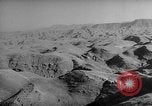
British Engineers and Geologists strike oil at Maydan-i-Naftun in Khuzestan, Iran, in 1908.
After years of exploration, British engineers and geologists strike oil while working in Khuzestan,Iran,under the D'Arcy Concession, signed in 1901 between William Knox D'Arcy and Mozzafar al-Din Shah of Persia. After unsuccessful drilling at Mamatain and Shardin, they concentrate their final efforts, at Maydan-i-Naftun, in 1907. Views, from a mountainside, of rugged topography in foothills of the Zagros Mountains. Men and horses move up a slope. The Karun River flows at the foot of the hills. Men and pack animals appear ready to ford the river. Scene shifts to the hands of British Chief Engineer, George B. Reynolds, holding open his hand-written journal with a photograph of himself inserted between the pages. View shifts back to the rugged landscape, where a small waterfall is emptying into a pool in the river below. More views of the terrain and of camels being herded by men, moving past grazing sheep being tended by a shepherd. George B. Reynolds, is seen on horseback. In the background workers are busy setting up camp at Maydan-i-Naftun. (The overall project camp was at Masjid-i-Suleiman AKA Masjed Soleyman.) A woman draws water from an overflowing pool on a hillside,and pours it into a large desert water bag. Men dig up earth to prepare for oil drilling at Maydan-i-Naftun. Men assembling an oil derrick and commencing to drill for oil. View of the successful well being pumped at Maydan-i-Naftun. Well-dressed man checks drill before it is lowered into hole. Men and mules move up a slope and rugged hills.
Montage of scenes from the day before the invasion of Normandy in World War II
D-day minus 1 (June 5, 1944) during World War 2. U.S. soldiers eat a meal while seated on the deck of a Large Landing Craft Infantry LCI(L) number 88, docked in Weymouth, England. (This ship would be the first LCI(L) to carry troops to the Easy Red landing zone during the second wave of landings at Omaha beach, on D-Day. Among troops landing there would be the 16th Regiment, 1st Infantry Division, with support from 7th Field Artillery Battalion;1st Engineer Combat Battalion; 1st Medical Battalion; 741st Tank Battalion (DD); 62d Armored Field Artillery Battalion; and 20th Engineer Combat Battalion.) A Captain and a field grade officer sit next to each other on the ship's deck. One soldier looks through his binoculars at an English woman standing outside her back door, looking back at him through her binoculars. Wash is drying on her line. The soldier tries to call out to her, but stops, realizing it is futile. Several of his buddies are amused by the whole event. Scene shifts to U.S. Army Air Forces B-26 bombers flying in formation, and then to aerial views from an aircraft, of bombs exploding on the ground in a city below. Next, a formation of B-17 bombers is seen, escorted by P-47 fighters. Scene shifts back to Weymouth harbor again, where American troops attend a Roman Catholic mass on the pier, adminstered by a military chaplain, wearing traditional clerical garb. LCL(L)s number 89 and 93 are seen tied up in the background. Coast Guardsmen gather around one of their ship's officers who briefs them on the operation.
CRITICALPAST.COM: About Us | Contact Us | FAQs - How to Order | License Agreement | My Account | My Lightboxes | Shopping Cart | Advanced Search | Featured Collections | Website Terms & Conditions | Privacy Policy ©2026 CriticalPast LLC.
License Agreement |
Terms & Conditions |
Privacy Policy
©2026 CriticalPast LLC.