


 Francais
 Deutsch
 Italiano
Refine Your Search
B-24-Burma stock footage and images
- Showing 2641 to 2646 of 3678 results more
more Hide
Hide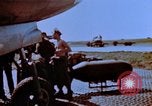
Aircrews of USAAF 323rd Bomb Group prepare to depart on mission to bomb German targets during World War II
Opening scene shows ground crew loading bombs on a Martin B-26 Marauder aircraft of the USAAF 323rd Bombardment Group at Denain-Prouvy Airdrome, France (A-83) in World War 2. The aircraft is parked on pierced steel planking (Marsden Matting). Glimpse of aircrew members, carrying their parachutes, as they climb into the back of an open truck. Next, ground crewman steadies a bomb as another man operates controls to lower it from an M6 bomb service truck. Ground crewman screws fins on the bomb. View shifts to inside the truck carrying aircrew members, as more climb aboard it. Several crew members climb down from the truck, as it arrives at their aircraft. Others are seen already at their respective aircraft parked nearby. Rough slate identifies the airfield as A-83, and day as 22 April. An officer, bombardier, is seen strapping himself into the nose of a B-26. Bombardier makes adjustments to his bomb sight. Pilot and copilot close their respective canopies. Name: "Wild-Bill" seen painted below copilot's window.
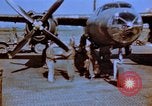
Aircrew of USAAF 323rd Bomb Group returns to base in France after bombing mission over Germany in World War II
USAAF Crew members, of the 323rd Bombardment Group, climb out of their Martin B-26 Marauder aircraft after returning to Denain-Prouvy Airdrome, France (A-83) from a mission over Germany, in World War 2. The aircraft commander (pilot) fills out the Form 1 for the crew chief and then he and the crew climb aboard a waiting crew transport truck. Several of them light cigarettes and begin to discuss the mission in animated ways. As the truck drives away, hangars and several parked B-26s can be seen in the background.
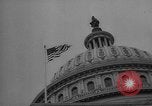
U.S. President Lyndon Johnson signs Civil Rights Act and shakes hands with Martin Luther King at U.S. Capitol in Washington DC.
Civil Rights Bill passed in the U.S. Congress signed by President Lyndon B. Johnson at the U.S. Capitol, Washington DC, United States. The U.S. Capitol and national flag on it. A woman with two children visits the Lincoln Memorial (2 Lincoln Memorial Cir NW, Washington, DC 20002). The U.S. President Lindon B Johnson along with other U.S. Congressmen during the signing of the Civil Rights Act of 1964. President Johnson signs the bill and shakes hands with Martin Luther King.

A group of scientists aboard an airplane performs secret tests on atomic bomb effects in Nevada, United States.
Secret atomic bomb research and tests by United States Atomic Energy Commission, in Nevada, during the Cold War. A group of scientists aboard an aircraft performs secret research about atomic bomb explosions. The scientists put on gas masks and goggles for eye protection, and work with analysis and measurement equipment aboard the airplane. An atomic bomb explosion is seen below and the plane passes above near the atomic mushroom as volunteers test their eye protection. On the ground, cameras in the blast wave record damage incurred to parked airplanes on the ground by the force of the explosion blast wave. An airplane tail section burns while it traverses the explosion cloud. A giant Boeing B-50 Superfortress bomber codenamed Rosebud is seen on an atomic bombing run in an actual atomic test. The pilot and bombardier are shown in the plane, the target sight is seen on the ground, and the atomic blast is seen from the B-50 flying overhead. Massive explosion and mushroom cloud seen forming. The atomic cloud rises up in sky.
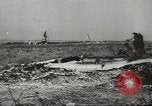
German citizens evacuate from cities and towns being bombed by Allied forces during World War II
Film begins, showing remains of a Boeing B-17F from the U.S. 100th Bombardment Group (BG) with home base at RAF Station Thorpe Abbotts, England, during World War 2. Camera pans over a field of debris containing two of the aircraft's engines and the wreckage of the fuselage and tail. The tail displays the Square D symbol of the 100th BG, plus the letter "T" and some of its tail number: "2303." Camera pans interior wreckage including crew seats and oxygen tanks. It then shows broken wings along with bodies of several crew members wearing parachute harnesses. A different side of the fuselage and tail shows the tail number "230311." This fully identifies it as B-17, number 42-23011. A field grade German officer and another officer examine the wreckage. Views of aircraft wreckage, in a forest, including a Browning M2 .50 caliber machine gun and another aircraft engine. Scene shifts to nearby town, where German women in white are serving meals at an outdoor food kitchen, for local people who are preparing to evacuate. A camper van loaded with family belongings is seen moving in the background. Several women, carrying plates of their food, walk toward tables. Some sit and eat at a table with a German soldier. Women make themselves sandwiches with foods laid out on a butcher block table. Closeup of a large drum of drinking water. local people fill containers from it. German children are seen aboard a bus waving goodbye to their mothers during evacuation for their safety. German children are placed aboard open boats at a port, for transport to safety out of war zone. German women and children board a train during evacuation to safety. Huge piles of their luggage is stacked on the train platform. View of a substantial private home in a residential area. Inside view shows it has been converted into nursery for infants, who are seen in many small cribs. Women sit on the lawn behind a substantial country home, as some small children run toward them from the house.
An M-76 amphibious cargo carrier is driven and casualties are placed aboard helicopters in Khe Sanh, South Vietnam.
The Battle of Khe Sanh in Khe Sanh, South Vietnam during the Vietnam War. An M-76 amphibious cargo carrier is driven. Casualties on stretchers being placed aboard United States Marine Corps UH-1H Iroquois and CH-46B Sea Knight helicopters. Men remove long crates from a CH-46B helicopter.
CRITICALPAST.COM: About Us | Contact Us | FAQs - How to Order | License Agreement | My Account | My Lightboxes | Shopping Cart | Advanced Search | Featured Collections | Website Terms & Conditions | Privacy Policy ©2026 CriticalPast LLC.
License Agreement |
Terms & Conditions |
Privacy Policy
©2026 CriticalPast LLC.