


 Francais
 Deutsch
 Italiano
Refine Your Search
B-24-Burma stock footage and images
- Showing 2677 to 2682 of 3678 results more
more Hide
Hide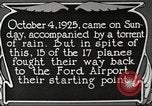
Henry Ford and Edsel Ford at the Ford Airport when the aircraft returned after the Airplane Reliability Tour in Dearborn.
Commercial Airplane Reliability Tour for the Edsel B Ford Trophy, at the Ford Airport in Dearborn, Michigan, United States. A large crowd on the wet airfield at the Ford Airport to receive the aircraft returning to the starting point, the Ford Airport, during the Commercial Airplane Reliability Tour for the Edsel B Ford Trophy. The aircraft which came in first on the airfield after the trip. Several people beside the aircraft. Henry Ford, the founder of the Ford Motor Company, and Edsel Ford, President of the company and a few men on the airfield. The aircraft in flight which came in second. The aircraft in flight over the airfield and comes in for landing. The Ford aircraft lands on the airfield. Number '30' and 'Ford' written on the aircraft. Several men beside the aircraft. The pilot gets out of the cockpit of the aircraft and walks through the crowd beside the aircraft. The pilot Eddie Hamilton and the mechanic James Phelps shakes hands with Edsel Ford, Henry Ford and other men. The pilot and the mechanic talking to the men on the airfield. A search light beam from a building at the airport. Henry Ford with a man on the airfield. A few men behind them. Men seated at tables at a dinner hosted in honor of the pilots at the Ford Airport.
Air Operations at Tan Son Nhut Airbase, Saigon, Vietnam, during Operation Market Time, in the Vietnam War.
Views of aircraft operating at Tan Son Nhut Airbase, Saigon, in the period of Operation Market Time. A yellow Follow-Me vehicle is moving along a taxiway. Parked behind it are three U.S. Air Force EC-121D "Big Eye Task Force" aircraft from the 552nd Airborne Early Warning and Control Wing. (Aircraft from that unit rotated on 90-day temporary duty assignments, from their home base at McClelland AFB, California.) A number of C-123s and C-47s can be seen parked on the flight line in the background. A USAF B-57B aircraft taxis along the taxiway (where the Follow-Me vehicle had led). Next, a C-123 taxis on that taxiway, in the opposite direction. An O-1E Bird Dog observation plane taxis past the noses of the EC-121Ds as a U.S. Army UH-1E Iroquois helicopter flies overhead and lands behind them. U.S. Navy A-1H Skyraider with Tail Code Z, taxis past the camera, followed by another with Tail Code V. In background, another UH-1E helicopter lands and an ambulance takes wounded away. It is followed by yet another one, also met by ambulance. A U.S. Navy Lockheed SP-2H aircraft of Patrol Squadron Four (Tail Code YD) taxis fairly close to the camera.
Dwight Eisenhower, Robert Carney and Matthias Gardner with sailors and marines on USS Des Moines in the Pacific Theater.
U.S.General Dwight D. Eisenhower, Supreme Commander Allied Powers Europe, aboard USS Des Moines (CA-134) with the 6th Fleet in the Mediterranean Sea. General Eisenhower takes photographs of United States Navy Admiral Robert Bostwick Carney and Vice Admiral Matthias B. Gardner with his stereo camera. Sailors and marines in formation on the deck. Dwight David Eisenhower, Robert Bostwick Carney and Matthias B. Gardner talk. A Sikorsky H-5 helicopter rises from the deck and flies off. USS Franklin D. Roosevelt (CVB-42) at sea. The rails of USS Des Moines (CA-134) in the foreground. Several carrier-based aircraft put on a demonstration, strafing and firing rockets into the water.
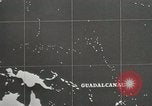
The Guadalcanal campaign in the Pacific during World War II.
Animated map shows Guadalcanal, where Japanese were building up a base to interdict Allied supply routes to Australia, in World War 2. U.S. marines in full battle gear board a troop transport ship. Convoy of transport ships headed to Guadalcanal. A Benham class destroyer bombarding the island from close range. On 8 August, 1942, the day after the amphibious assault on Guadalcanal, U.S. marines of the 3rd Defense Battalion, are seen descending rope net from the Transport ship USS Zeilin (AP-9, later designated APA-3) to enter landing craft headed ashore to reinforce marines fighting Japanese defenders on Tulagi, Gavutu, and Tanambogo, in the Solomon Islands. U.S. ship firing its guns. U.S. marines wading ashore, relatively unapposed at Guadalcanal, on 7 August, 1942. U.S. Douglas SBD Dauntless dive bomber taking off from Henderson Field on Guadalcanal. Two officers with large binoculars are seen aboard a Japanese warship flying her Naval ensign. A Japanese Nakajima B5N torpedo bomber (Kate) taking off from carrier. A formation of Japanese Nakajima Ki-43 Hayabusa (Oscar) or Ki-44 Shōki (Tojo) aircraft in flight. Closeup of two overhead in silhouette. Glimpse of U.S. carrier (USS Wasp?) taking evasive action. Sky filled with puffs of black Flak at low altitude and contrails from dogfights at high altitude. Closeup of a Japanese Mitsubishi B5M Type 97 Carrier Attack Bomber (Mabel) with others in formation in background. Bombs falling. View from carrier island of sailors running across deck of U.S. Carrier with smoke rising at site of bomb strike. Smoke obscuring the deck and beginning to clear. View from different U.S. carrier deck, past parked aircraft, to a camouflaged U.S. destroyer approaching astern. Carrier deck with Douglas SBD Dauntless dive bombers parked at its end, and black flak clouds overhead. Several night naval gun battle scenes followed by view of burning Japanese ship. Closeup of the wreck of the Japanese transport ship, Kinugawa Maru and views of other Japanese ships burning. U.S. army troops are seen marching along the sides of a road as they arrive in December, 1942, to relieve the marines on Guadalcanal. View of the embarkation operation on the shore as marines prepare to depart. Marines getting aboard Higgins boats (landing craft) for transport out to their transport ship, the USS Neville (AP-16, later redesignated APA-9).

The Apollo Moon craft makes a rugged landing when dropped from a rig while testing in Houston, Texas.
Apollo Moon craft during rugged landing tests at the Lyndon B. Johnson Space Center, the NASA manned space flight center, in Houston, Texas. The Apollo Moon craft on a stand at the Lyndon B. Johnson Space Center. The Moon craft makes a rugged landing when dropped from a rig while testing. (This shows impact tests of the Apollo space capsule, not the Lunar Exursion Module or LM or LEM.)
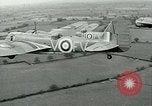
British and American aircraft in flight early in World War II, and RAF recruits being trained in Great Britain.
The Royal Air Force ( RAF ) in Great Britain during World War II. Aircraft in flight. Workers work for the production of aircraft. Officers greet in front of a line of stationed aircraft. A Royal Air Force Lockheed Hudson light bomber taxis and takes off. The Lockheed Hudson in flight. Narrator acknowledging America and its workers for the contribution of the Hudson and the B-17. A RAF B-17 Flying Fortress aircraft takes off. Trainees march. The trainees work on equipment learning use of guns and bomb dropping mechanisms on the planes. A link trainer in operation. Classroom instructions given to the trainees. Airmen at controls in mock bomber trainers. An officer at a desk talks to a bomber crew as one of the crewman makes a report on the results of their bombing run, on behalf of the bomber crew. Another officer makes a report for fighter pilots. A fighter pilot picks up a telephone. The fighter pilots run to their aircraft. The aircraft taxi and take off, participating in the Battle of Britain.
CRITICALPAST.COM: About Us | Contact Us | FAQs - How to Order | License Agreement | My Account | My Lightboxes | Shopping Cart | Advanced Search | Featured Collections | Website Terms & Conditions | Privacy Policy ©2026 CriticalPast LLC.
License Agreement |
Terms & Conditions |
Privacy Policy
©2026 CriticalPast LLC.