


 Francais
 Deutsch
 Italiano

Refine Your Search
B-24-Burma stock footage and images
- Showing 2881 to 2886 of 3692 results more
 Hide
Color Sound

Highlights of the Allied New Guinea campaign and other Pacific battles against the Japanese in World War II
The Allied campaign across New Guinea and onward to the Philippines during World War 2. U.S. warships firing their guns at night. Flashes illuminate the blackness. Bombs dropping from an aircraft bomb bay. Bombs exploding on stretch of jungle near water. A U.S. Army Air Forces B-26 bomber in flight View rearward from very low flying USAAF bomber as it bombs it drops explode behind. U.S. troops making amphibious assault on New Guinea. Map showing path of Allied attacks from Australia, across New Guinea from Port Moresby to Buna and on to the Admiralty Islands, cutting off Japanese-held Rabaul, New Britain. Map shows Allied forces moving towards Japanese strongholds at Wewak and along the North shore of New Guinea and bypassing Wewak to strike at Hollandia. General Douglas MacArthur is seen aboard a U.S. warship conferring with American and Philippine officers. Annimated map shows Allied assaults on Japanese positions along the coast from Hollandia, to Warde, Biak, and beyond, stepping along towards the Philippines. Views of numerous fallen Japanese soldiers numbering more than 150 thousand dead. Crosses in battlefield cemetery at graves of some of the more than 13 thousand Allied military who lost their lives during the campaign. A soldier paying respects at one of the gravesites. Admiral Chester Nimitz with members of his staff at his headquarters in Hawaii. U.S. Navy F4F aircraft launching from an American aircraft carrier. American aircraft bombing Japanese positions on an atoll. U.S. warships bombarding Japanese positions with their heavy guns. Admiral Nimitz standing with Admiral William Halsey. More Navy gunfire and amphibious assault scenes. Map showing places where Allied forces had to battle the Japanese, including, Tarawa in the Gilbert Islands, Kwajalein, in the Marshals, Saipan, and Guam in the Marianas, and Palau to complete the "bridging" of the Pacific to the doorstep of the Philippines.
U.S. prisoners of war rescued in the Philippines and returning home to the United States at end of World War 2
Families at harbor waiting for the troop transport ships. United States soldiers and liberated prisoners of war on ship. San Francisco's Golden Gate Bridge and harbor in background with Coit Tower atop Telegraph Hill. Troop ships arrive and crowd cheers. Japanese soldiers bonzai cheer and Japanese forces bomb and take control of Corregidor. Japanese planes bombing. Ambulance carries wounded. United States soldier loses his arm during a Japanese aerial attack on Corregidor in 1942. Japanese soldiers guard American prisoner of war soldiers and escort them into prison camp in Manila (soldier narrating says it was Bilibid jail). General Wainwright surrendering in Corregidor in May 1942. United States flag lowered by Japanese soldiers and Japanese flag is hoisted. Wreckage of bombed U.S. facilities in Philippines. Japanese propaganda film showing care for wounded American soldiers on hospital beds. U.S. Army prisoners fo war eat food. Wounded American soldiers walk with crutches on the grounds of the prison camp. Bataan Death March of the emaciated prisoners. American military prisoners at Cabanatuan labor and sleep on open air bunks. Scene of U.S. Army training early in World War 2 with troops in a field setting a machine gun emplacement to fire at rolling trucks relabeled as "Tank". Japanese propaganda newsreels showing Japanese military success in Philippines and Japanese forces in the Aleutian Islands. Aerial view formation of U.S. Army Air Force B-25 bombers in the sky. Aerial side view of American bomber aircraft and bombs away view. Navy bombing from ships. General MacArthur returns to Philippines and wades ashore. Philippine guerrillas and U.S. troops in battle to retake Philippines. U.S. prisoners of war liberated and freed and at 92nd Evacuation Hospital Cebu. Released prisoners on ships to America. WAC women hand out mail. Soldiers write telegram wires announcing arrival. Ship docks in San Francisco. Prisoners reunite with happy families and crowds on streets cheer their arrival. Soldiers and civilians walk on Market Street in San Francisco. Welcome home parade for San Francisco soldiers during WWII. Soldiers waving from buses in parade. Soldier in front of Marina Junior High School, 3500 Fillmore Street. One armed, disabled soldier with parents views photo album.
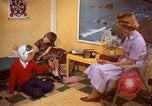
A woman with a boy and a girl in a family fallout shelter and a boy and a girl play in United States.
1960's Cold War fallout shelter for nuclear bomb or atomic bomb attack: A woman wearing a dress sits with a boy and a girl in a living room of a family fallout shelter in United States. Boy plays with the model of B-66 airplane. He wears a plastic helmet serving as a pretend pilot's helmet. Woman reads a book. The girl, also wearing a dress, plays with toys. They listen to the radio. A dart board on the wall. The girl plays with a doll. A purse on the floor. They get up and leave.

President Richard Nixon issues statement to the press on the death of John Edgar Hoover, Director of FBI; various FBI scenes.
Side entrance to the White House, in Washington, DC. Flag on roof at half mast. Members of the White House press corps gather and President Richard M Nixon addresses them regarding the death of J. Edgar Hoover, Director of the FBI. He speaks about Hoover's greatness and gives a tribute to him. He leaves the podium. Scenes reflecting activities of the FBI during Hoover's time in office are shown, including: lowering of flag to half mast at Department of Justice building; construction of the F.B.I. building; J. Edgar Hoover's house, with doormats carrying initials "JEH."; clips of FBI agents apprehending gangsters; FBI agents firing pistols at a training range, and Hoover at work in the Bureau.
Soldiers of the 1st Infantry Division in England and during the invasion of Normandy and subsequent campaigns toward Germany (WW2)
Soldiers of the 1st Infantry Division training in England under General Clarence R Huebner, in preparation for the D-Day Normandy invasion in World War II. U.S. Navy ships underway at sea. Heavy naval guns bombard the coast of France on D-Day. U.S. Army soldiers seen during assault on Omaha beach with heavy losses on D-Day. U.S. soldiers and tanks encounter heavy German resistance in the "hedge rows." American soldiers digging trenches with shovels and picks and treating wounded comrade. Dead German soldier lying in street as Americans enter the town of Caumont (Caumont l'Eventé). Frenchman civilian pours wine for American soldier after they liberated Caumont l'Eventé from the entrenched German forces. An American helps a French civilian woman to reach a safe place crossing rubble. Damaged French houses along the sides of street. During rest, a soldier gives another a haircut, and another writes a letter. U.S. Air Force B-17s fly overhead and bomb near St. Lo, France on July 25, 1944. Other U.S. Army artillery units, the 4th and 9th Divisions, and General Patton's tanks provided support so the 1st Infantry (First Infantry or Big Red One) could occupy the area. Army combat engineers dig up mines and use construction equipment to clear debris. Wrecked houses and rubble. U.S. soldiers keep advancing through towns and eat and rest as they can. Road sign reads: "Coutances." First Infantry goes through Mortain, Etampes, Meaux, Soissons and across the Belgian border. German prisoners of war walk with their hands raised. German soldier digging out of fox hole. Siegfried Line and dragons teeth. Strong German resistance encountered at Aachen. Tanks fire in the field. House to house fighting in Aachen. Surrender of Aachen. A German flag laying in the street is run over by a U.S. military vehicle. German resistance is heavy during battle scenes in Battle of Hürtgen Forest. German and American artillery are seen in Hurtgen Forest. U.S. wounded treated. The 1st Division is pulled out for rest at the rear, in Belgium.
American women work in factories and the United States Army WAAC (WW2)
The United States flag on flagpole in the middle of a jungle during World War II. United States soldiers marching. U.S. Navy sailors on battleships at sea. German leader Adolf Hitler with other officers in a hall. Lines of United States Army soldiers marching; United States Army Air Force crew members gathered at an airfield with many soldiers in front of and on top of a Boeing B-17 Flying Fortress bomber aircraft. U.S. Navy sailors doing jumping jacks for calisthenic exercises on the deck of a ship at sea. View of factories and manufacturing facilities with smoke pollution pouring out of smokestacks. American women war workers entering or leaving a factory, and then wearing uniforms and working in various war materiel factories. A man explains the work to female workers. Nazi German officers in their office discuss that the American women can only be playgirls, they cannot work for the nation with the army. German flags in the office. American women work as technicians in factories and welders welding military equipment. They weld airplane parts and naval landing barges. They install wiring in planes and inspect armament shells and radio tubes. Views of uniformed women in the armed forces of the United States, including groups of women army soldiers (WAAC or WACS), a group of women in the Navy, and female Marines marching. A group of nurses at a field hospital poses and smiles.
CRITICALPAST.COM: About Us | Contact Us | FAQs - How to Order | License Agreement | My Account | My Lightboxes | Shopping Cart | Advanced Search | Featured Collections | Website Terms & Conditions | Privacy Policy ©2026 CriticalPast LLC.
License Agreement |
Terms & Conditions |
Privacy Policy
©2026 CriticalPast LLC.