


 Francais
 Deutsch
 Italiano
Refine Your Search
B-24-Burma stock footage and images
- Showing 2965 to 2970 of 3678 results more
more Hide
Hide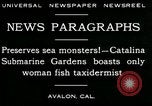
Woman taxidemist, Emily Parker, shows sea life specimens at Catalina Submarine Gardens in Avalon, on Catalina Island, California
Woman taxidermist, Emily Parker, interviewed at Catalina Submarine Gardens, in Avalon, on Catalina Island, California. Numerous preserved species of sea life are mounted on the wall behind her. She is working on a specimen of hammerhead shark. Next, Ms.Parker displays a preserved Tuna and several other species including a pair of so-called Flying Fish. she touches- up a billfish specimen and inspects a shark. (Note: Ms. Parker's husband, C.B. Parker, was a Taxidermist in Catalina. After he passed away in 1926, Ms.Parker continued his business. She was considered to be one of the first women taxidermists.)
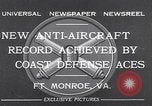
Coast Artillery anti-aircraft guns fire at targets towed by aircraft over Fort Monroe, Virginia.
Opening slate reads: "New Anti-Aircraft Record Achieved by Coast Defense Aces, Ft Monroe, VA." A Curtiss O-1B two place bi-wing airplane is seen in flight. Aerial view of the Fort Monroe, Virginia, waterfront. Gun emplacements are seen. Air- to-air view of the Army airplane in flight over Fort Monroe. But this time, a target can be seen towed behind the aircraft. View of U.S. Secretary of War, Patrick J. Hurley, looking skyward, in the company of three Army officers, including Major General John W. Gulick, chief of the Coast Artillery and commander of Fort Monroe, who is standing next to the Secretary, to his right. View of gunners in a battery of 6-inch anti-aircraft guns. Batteries firing and puffs of white smoke seen aloft. Tracer bullets seen all around a towed target. Soldiers looking through an artillery range finder. A towed target floating in the air with black clouds from exploding anti-aircraft rounds nearby. Gunners firing at high rates of speed.
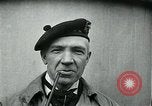
Harry Lauder smokes a pipe and speaks to a crowd in a park in the United States.
Harry Lauder smokes a pipe in United States. Band plays bagpipers. An insignia reads "B F Keiths" and "Red Cross". Large crowd gathers around the stand in which the Harry Lauder with other dignitaries stand.
Captain J M O'Brien and crew members aboard USS Midway.
Commanding Officer seated in his chair on bridge. A-3B Aircraft lands aboard USS Midway. Men work on plotting boards in CIC. Helmsman turns the wheel. Captain J M O'Brien seated in chair receives a message of strike.
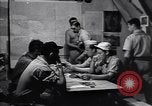
U.S. Navy PBY Catalina (Black Cat) night mission against Japanese shipping during World War II in the Pacific
U.S. Navy Aircraft Seventh Fleet PBY Catalina operations in Southwest Pacific during World War 2. Pilots and navigators of six PBY Catalina crews are seen planning the night's operations at a table in a flight planning hut. (These Catalinas are called "Black Cats" because they were painted black for night operations.) The Black Cat mission is to interdict Japanese supply ships at sea. Intelligence officer is seen briefing about locations of Japanese convoys and cautions that Japanese night fighters are stationed only 60 miles away.The pilots look at pictures of the type of warships that might accompany the Japanese convoys.They are briefed on Japanese antiaircraft batteries near harbor where convoy ships might anchor.And they are briefed on the weather. Ground crew pass a large box of foods to a PBY crewman.The aircraft taxis into the water. The weather is getting stormy.Ground crew remove landing gear. The PBY takes off. Views from inside the aircraft as it leaves the water and becomes airborne. Views from inside a PBY as lightning strikes outside in a storm. Crew members in their positions.Approaching the harbor where Japanese vessels may be anchored. Navigator plots position with dividers and calculates course using E-6B computer. Waist gunners ready at their stations. Crew member is posted as a lookout at an open bay in the PBY nose. There are no Japanese ships seen in the harbor. But the PBY is sighted by Japanese antiaircraft batteries that begin firing. They are also being hunted by Japanese night fighters. The pilot dives low towards the water to hide. Japanese fighter plane passes overhead. They resume search for convoy and lookout spots it. Radio operator informs other Black Cats via CW signal. As the Catalinas converge on the convoy, Japanese warships open fire on them.The "Cats" attack and hit a Japanese Cruiser, 2 freighters, and a tanker. One of the Catalinas is destroyed during its bomb run.
Man works underneath a RA-5C plane aboard USS Constellation in North Vietnam.
Two men repair a parachute pack on flight deck next to an aircraft aboard USS Constellation in North Vietnam. Man's hands tying a small piece of thread on side of a parachute pack. A man in green shirt works over the parachute pack and underneath a RA-5C plane. Man lowers a panel underneath the aircraft. He is using a rag to clean after camera mount on RA-5C. Two men in green shirts work underneath the RA-5C and close the little panel to camera mount area. Words read "USS Constellation" and "Navy VAH-12" on a RA-5C. A man in purple shirt up alongside the RA-5C refuels the aircraft and attaches the Fuel hose to side of RA-5C. Two men in purple shirt up along the starboard side of RA-5C as plane is refueled. A-4C plane taxis over flight deck. Man in blue shirt holding onto a tow bar walks along in front of aircraft during spotting. Blast fence is up in the background aft of second catapult. F-4B plane taxis over deck off to right. A-4C plane.
CRITICALPAST.COM: About Us | Contact Us | FAQs - How to Order | License Agreement | My Account | My Lightboxes | Shopping Cart | Advanced Search | Featured Collections | Website Terms & Conditions | Privacy Policy ©2026 CriticalPast LLC.
License Agreement |
Terms & Conditions |
Privacy Policy
©2026 CriticalPast LLC.