


 Francais
 Deutsch
 Italiano
Refine Your Search
B-24-Burma stock footage and images
- Showing 3241 to 3246 of 3678 results more
more Hide
Hide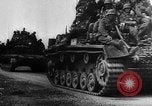
Montage of World War II images,covering Eastern Front, Pacific, and European theaters of operation
German troops advance on the Eastern Front during World War 2. Russians employ scorched earth policy . Oil tanks ablaze and dams and structures blown up. Germans lay siege to Stalingrad. A Soviet troops in urban combat in Stalingrad. A German soldier is shot and falls. Views of awful destruction. Animated map showing Leningrad and the Gulf of Finland and Lake Ladoga on either side. Views of Leningrad in snow. Citizens bundled against the cold, walk near historic structures. Food being distributed. Soviet troops in defensive positions. Animated map shows outbreak of Soviet forces in pincer movement that surrounds the German 6th Army. Two Soviet armies meet as they close the pincer. German Field Marshal Friedrich Paulus surrendering to Soviet forces on 31 January 1943. Troops of the German 6th Army make their way through the snow as they surrender. Battlefield cemetery, with markers of German soldier's graves. Numerous Soviet citizens, victims of the fighting, seen lying in the snow, as relatives grieve. Scene shifts to the Pacific theater with view of Japanese bombers flying over an installation flying the Rising Sun flag. Scenes of the Pearl Harbor attack. American workers fill yard near a war plant during shift change. Defense industry workers in the plants. Liberty ships being launched. American forces in amphibious assaults. U.S. forces engaged in North Africa and on Pacific islands. American soldiers at battlefield gravesite. General Dwight D. Eisenhower with General Omar Bradley and Allied military leaders, look over a map of Europe, following the June 6th invasion in Normandy. Fields filled with Sherman tanks and other war materiel, in England. The wing of an American airplane in D-day stripes as it takes off. Views from cockpit of an American bomber striking targets on D-day. B-17 bombers in formation at high altitude, leaving condensation trails in the sky. Pilots in cockpit of an American bomber, as they drop bombs. Allied fighters in D-day stripes peeling off to attack. Gun camera views of fighters strafing German targets. Explosions and fires.
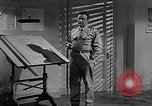
Effects of conventional bombs compared to incendiary bombs in tests against wooden structures, at Eglin Field in World War II
Tests to compare effects of conventional bombs to those of incendiaries,on wooden structures. Test conducted at Eglin Field, Florida, during World War 2. Actor Lee J. Cobb, portrays an Air Force Captain, seated at Project Officer's desk. He shows photographs of a wooden test house constructed similar to houses in Japan. View of wooden structure being ignited from within. The resultant fire is put out promptly. B-17 airplane in flight over the test area, drops conventional bombs, which destroy some of the test village houses. A second bombing using incendiary bombs that break apart and ignite many fires, produces greater destruction across the test village.
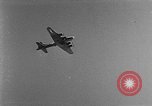
Bombing tests using conventional and incendiary bombs against wooden structures, at Eglin Field, Florida, in World War II.
Tests by the U.S. Army Air Forces to assess the effectiveness of incendiary bombs against wooden structures (typical of Japanese homes) during World War 2. Tests conducted at Eglin Field, Florida. B-17 bomber drops conventional bombs on test village, producing considerable damage where they strike. In contrast, bombing with incendiaries produces fire and smoke engulfing the entire complex, and greater destruction and confusion on the ground.
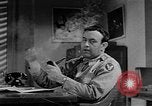
Testing various types of bombs against Japanese-style wood construction, at Eglin Field, during World War II
U.S. Army Air Forces tests of conventional and incendiary bombing of Japanese-style wooden structures, at Eglin Field, Florida, during World War 2. An Army Air Forces Captain (portrayed by actor, Lee J. Cobb) discusses bombing tests conducted at Eglin Field. He holds a pipe in his hand. B-17 bomber takes off over the camera. The plane in flight over the test area. Clusters of small incendiary bombs fall on the test village, causing it to be engulfed in flames. Immediately, thereafter, conventional bombs are dropped on the smoking test village, causing large explosions. The Air Force Captain (Cobb) discusses the results.
Beginnings of successful powered heavier-than-air flight. Wright Brothers flights in U.S. and Europe. General Hap Arnold
History of aviation. A balloon in flight. Historic glider such as that which interested U.S. War Department as early as 1898. In 1903, a crew of men moving a Wright Flyer into position. Two men turn over propellers on a Wright Flyer, and the engine starts. View of the Wright-designed water-cooled engine. View of Orville Wright. The famous first powered flight, at Kitty Hawk, North Carolina, with Orville Wright at controls. Animation shows that 120 foot flight juxtaposed against a B-36 wing. Wilbur Wright in Europe, in 1908, gesturing as he converses with interested parties. A gallery of spectators including the President of France, King of England, King of Spain, and King of Italy. Wilbur Wright places a wheel under the right wing of a Wright Flyer and lashes it to the strut. A team of horses pulls the plane across the field. Men maneuver the plane onto a monorail on the ground. Men pull on a heavy rope to raise a weight in a tower, for a catapult. Two men spin the propellers and the Wright Brothers airplane motor starts. Wilbur Wright and his passenger, a French journalist, board the plane. The catapult weight drops, launching the aircraft which flies low over the field. U.S. President Theodore Roosevelt speaking (He is seen on a podium campaigning for the Bull Moose Party nomination at the Kansas State Fair in Hutchinson, Kansas on September 22, 1912.) War department issues specifications for a heavier-than-air craft. Reenactment of a Wright brother signing a bid contract. A Wright Flyer airborne at Fort Myer, Virginia, as the Wrights meet the Army specifications and sell, U.S. Army airplane number 1, to the War Department, in 1908. Gold Aviator wings being pinned on the uniform of a U.S. Army pilot. Photograph of Army Air Forces Chief, General Henry (Hap) Arnold, wearing his original aviator wings on his service uniform. A Glenn Curtis training airplane starting up and taking off. View of a DH-4 airplane and a Wright Flyer taking off together.
Allied forces hold air superiority in battle of Saint Mihiel during World War I.
This film shows numerous types and models of World War One aircraft in operation. It opens showing Allied airplanes preparing for a maximum air campaign in the battle of Saint Mihiel. View from inside a hanger as its flap opens and men push a Sopwith Camel airplane out onto airfield. Map of St Mihiel. American planes warm up on flight line in predawn, with flares burning at wingtips. Huge numbers of allied airplanes are marshaled on airfields throughout the theater of operations and begin taking off. Among them is a French Morane-Saulnier low wing monoplane. German fliers are seen loading small hand held bombs into the cockpit of their Albatross aircraft. Soldiers in combat on ground in "no man's land" during the battle of St. Mihiel. They take refuge in large shell and bomb craters and try to advance running between them.. Germans fliers dropping bombs, by hand, from airplane. Numerous Allied and German airplanes in aerial dogfights. American planes over clouds. American Observation balloon attacked in sky. Balloon in flames, and trailing black smoke as it falls to the ground. French flag flies at an airfield, where a nosed-over airplane sits, by a hangar, as airplanes fly overhead. Aircraft taxiing about in close quarters at airfield. Large formations of American airplanes flying overhead in a grand formation, following the Armistice, November 11, 1918 Then the film shifts dramatically from World War One to the post-WWII year of 1947. It illustrates the dramatic advances in warplanes since WWI by showing U.S. B-36 bombers and straight-wing F-84 Thunderjet fighters is formation.
CRITICALPAST.COM: About Us | Contact Us | FAQs - How to Order | License Agreement | My Account | My Lightboxes | Shopping Cart | Advanced Search | Featured Collections | Website Terms & Conditions | Privacy Policy ©2026 CriticalPast LLC.
License Agreement |
Terms & Conditions |
Privacy Policy
©2026 CriticalPast LLC.