


 Francais
 Deutsch
 Italiano

Refine Your Search
B-24-Burma stock footage and images
- Showing 3271 to 3276 of 3692 results more
 Hide
Color Sound
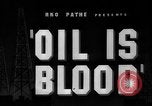
Production of petroleum at oil refineries and its transportation in United States, before and during World War II
Documentary titled, ' Oil Is Blood ' on production and transportation of petroleum and its by products in United States. Crude oil in a pit. Man takes samples from the pit. View of derricks at an oil drilling site. Derricks at sea. Exteriors of a building near the derricks. Service station attendants, pumping gas and cleaning the windshield, on a 1942 Lincoln Continental convertible, at a "Tydol Flying A" gas station. Scenes of busy highways and plenty of fuel give way to empty roads, closed gas stations, and restricted hours for obtaining fuel, as it is rationed during World War 2. Views of persons obtaining ration stamps and books. Various gasoline ration books including the "A" books (allowing the smallest amounts) and "B", "C", and other books allowing larger rations to more essential users. Oil rig "roughnecks" inserting new sections of pipe and proceeding to drill. Closeup of a "gusher" before it is capped. Men filling railroad tank cars with petroleum products. A long train of tank cars pulled by a steam locomotive. Animated map illustrates the ocean shipping lanes that formally served as means to transport fuel and oil, before the German U-Boat threat made them too dangerous for general use. Drums of fuel and oil being loaded aboard a ship to supply the Allies during the war. A convoy of ships heading to the war zone of North Africa.
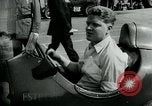
Japanese and French confer in Hanoi; war materiel supplies to China cutoff at Yunnan and Canton; British forces departing Shanhai
Clip opens with unrelated brief two second view of Frank Griswold, winner of 1940 New York World's Fair road race, waving from behind the wheel of his 1934 Alfa Romeo Tipo B after the race. Scene changes to views through the fertile countryside of French Indochina on a trip to Hanoi early in World War II. Narrator notes Hanoi is a principal supply hub for war materiel destined for General Chiang Kai-shek; supplies which the French have now interrupted at the request of Japanese authorities. A train arrives at station in Hanoi. People at the station. Views of downtown buildings of Hanoi and a market place. Street vendors selling foods and goods. A woman carrying a basket on her head. Rickshaw pullers at work behind several people seated at a street-side outdoor cafe. Narrator notes views are proceeding toward the central park where the residence of the head of the new government is located. Views of a couple in formal suit and dress strolling in the park. Major General Nishihara, head of the Japanese mission, is seen exiting a building following talks with the French Governor-General. Scene changes to Lao-Kai (or Lai Cai), a border station between French Indochina and China, where narrator says supply inspectors from Japan have traveled to examine the situation. View of the Yunnan railway with railroad tracks cut off by the French authorities, and guarded by local indigenous soldiers with conical hats (nón lá). Scene changes to the harbor at Canton China. Large ships anchored in harbor. Barrels or drums on the ground near docks, as narrator notes that large quantities of war supplies no lie idle and unusable on the port docks. Scene changes to Shanghai. A procession of forces from Great Britain on parade at a racecourse or stadium, and in the streets of the city, including uniformed bagpipers. Narrator notes it marks the end of British supremacy in China, with the first contingent of British troops departing Shanghai.
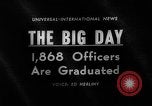
President Kennedy awards graduation certificates to graduates at the U.S. Air Force Academy in Colorado Springs, U.S.
Graduation ceremony for Air Force and Naval graduates in the United States. Spectators look as cadets are graduated at the United States Air Force Academy in Colorado Springs. Colorado. U.S. President John F. Kennedy addresses the graduates and the spectators from a dais. 493 cadets graduate. The graduates come up on the dais and shake hands with the President. The cadets fly their hats in the air. A board in Annapolis reads 'United States Naval Academy'. 871 graduates are seated during the graduation ceremony. They walk up on a stage and are presented graduation certificates by U.S. Vice President Lyndon B. Johnson. The anchorman, who is the last one to get the certificate, is cheered by his fellows.

President Kennedy is greeted by Chancellor Adenauer and Vice Chancellor Erhard on his visit to West Germany.
United States President John F. Kennedy visits West Germany. Men rolling out the red carpet in Cologne Bonn Airport (Kennedystraße, 51147 Köln, Germany). President Kennedy disembarks from the Air Force One aircraft (VC-137C SAM 26000, Boeing 707-353B). German Chancellor Konrad Adenauer welcomes President Kennedy. Kennedy and Adenauer review the honor guard. Vice Chancellor Ludwig Erhard greets Kennedy. They board in a car. People on the sides of streets in Cologne as the President's motorcade passes. A large crowd cheers and waves U.S. flags. President Kennedy attends a Catholic mass at Cologne Cathedral (Domkloster 4, 50667 Köln, Germany). Police try to control the people. German men and women running to meet President Kennedy. A banner read ' Welcome President Kennedy'. Another one reads 'common struggle for peace and freedom'. President Kennedy addresses people in front of Bonn City Hall (Markt 2, 53111 Bonn, Germany). People wave small United States flags.

U.S. Army Air Forces P-47s in live fire training at Hammond Bombing and Gunnery Range during World War II
Views from the adjacent Hammond Army Air Field, as U.S. Army Air Forces P-47 aircraft fly very low and engage in live fire training over the Hammond Bombing and Gunnery Range. Antiaircraft gunners of the 55th Brigade AAA practice sighting and tracking these aircraft as part of their own training. Gun sight view from a 40 mm Bofors gun tracking incoming aircraft. Formation of U.S. Army Air Forces B-26 Marauder aircraft high above the training area (probably engaged in bombing training)..
Japanese General discusses first American air raid on Tokyo, Japan, in World War II. Captured American fliers in custody
Several blindfolded American fliers are seen being taken from an airplane. They are crew of the 16th B-25 comprising the famous "Doolittle"s Raiders." (Their aircraft was serial number: 40-2268, nicknamed: "Bat Out of Hell." Low on fuel, they were captured after bailing out near Japanese occupied Nangchang City, China, on April 18, 1942.) Captured American pilot, Lieutenant William .G. Farrow, is seen smoking a cigarette, while being escorted by Japanese soldiers, out of a building. With him are members of his crew: co-pilot, Lieutenant Robert L. Hite; Navigator, Lieutenant George Barr; Bombardier, Staff Sergeant, Jacob DeShazer; and Engineer Gunner, Sergeant Harold A. Spatz They pose for a group photograph on the steps, with the officer crew members on the top step and the two enlisted crew members a step below. (Lieutenant Farrow and Sergeant Spatz were executed by the Japanese on Oct. 15, 1942, at Kiangwan Cemetery, Shanghai, China.)
CRITICALPAST.COM: About Us | Contact Us | FAQs - How to Order | License Agreement | My Account | My Lightboxes | Shopping Cart | Advanced Search | Featured Collections | Website Terms & Conditions | Privacy Policy ©2026 CriticalPast LLC.
License Agreement |
Terms & Conditions |
Privacy Policy
©2026 CriticalPast LLC.