


 Francais
 Deutsch
 Italiano
Refine Your Search
B-24-Burma stock footage and images
- Showing 3403 to 3408 of 3692 results more
more Hide
Hide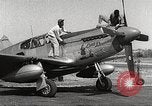
Ground crewmen of 332nd Fighter Group (Tuskegee Airmen) maintain and rearm P-51 aircraft in Italy, during World War II.
Activities of African American U.S. Army 332d Fighter Group, "Tuskegee Airmen," at Ramitelli Airfield, Termoli , Italy during World War 2. Ground crewmen perform maintenance and rearm P-51 aircraft with belt ammunition. One of the P-51s carries the name "Little Deanna" and another the name "Stinky." P-51 taxiing with a ground crewman sitting on its wing. Ground crew, in a flat bed jeep, bring a 75 gallon under-wing auxiliary fuel tank for a P-51. They carry the fuel tank to the airplane and fasten it in place.. A P-51B with Red Tail takes off from the airfield.
A man works on control parts of an aircraft and detects any flaw in the parts with the help of a machine in the United States.
Manufacture of United States Army Air Force B-26 Marauder medium bombers in the United States during World War II. Tiny equipment, rivets and other control parts of aircraft lying on a table. A man works on the parts. He photographs the parts with the help of a machine to find out any defect in them. He inspects the parts.
Men work and check parts of an airplane before it is taken out of a factory in the United States.
Manufacture of United States Army Air Force B-26 Marauder medium bombers in the United States during World War II. Men work on the bomber aircraft. Other men stand near the aircraft. An aircraft is camouflaged before it leaves the factory. The aircraft parked outside the factory. Men stand nearby. Men check the parts of the airplane.
Montage of World War 2 scenes from all theaters of Allied operations and scenes of the U.S.A.
Peaceful scenes of pre-war England, showing a church with sheep grazing on its lawn, and a college building with ivy growing on the walls. In contrast, explosion and results of German bombing is shown, with buildings collapsing and ruined from the German blitz over England. A long line of Chinese soldiers marching along the Great Wall of china. Shadows of three Japanese bombers flying over Chinese landscape. On May 4, 1942, Madame Chiang Kai-Shek decorates American fliers who made the first attack on Tokyo in World War 2. Wearing a Chinese decoration around his neck, Lieutenant Colonel Jimmy Doolittle, who led that raid by U.S. B-25 bombers from the Aircraft Carrier USS Hornet, poses with Madame Chiang and others of his group. Scenes of Moscow, Soviet Russia, including a T-70 light tank moving rapidly along a city street. A Soviet Petlyakov Pe-2 dive bomber taking off in a snow storm. U.S. troops on a halftrack in North Africa. British artillerymen firing a 25 pounder in the desert. Glimpses of smoke rising from enemy strikes at cities in England, Russia, and China. Scenes of destruction from bombing. Brief street scenes of unharmed and intact towns and cities in the United States, including brief New York City scene of pedestrians and traffic in Times Square. Defense workers in America going to work at Ranger Aircraft Engines factory (later part of Fairchild Aircraft and Engine Corporation), and a star flag showing war service by worker families. Farmers in Western U.S. harvesting grain. Railroad trains and river barges carrying harvest from U.S. farms. Herds of cattle and sheep being raised for the war effort in Western U.S. Aerial view of orchards and farms in America. A mining bucket filled with iron ore. Barge carrying the ore. A steel mill in operation. Scrap iron being recycled. View from production floor of U.S. bomber aircraft being built in a defense plant. Countless freight cars in a railroad marshaling yard at a port, where a tug boat and a freighter are seen in the water. War materiel piled up at the port. A convoy of supply ships underway.
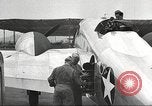
Camera crew members aboard airplanes in flight for the purpose of aerial photography in Culver City, California (WW2)
World War II activities of the First Motion Picture Unit of the United States Army Air Forces in Culver City, California. Airplanes parked at an air base. Camera equipment being loaded into United States Army Air Force Beechcraft AT-11 Kansan and a United States Army Air Force ( USAAF ) A-20 Havoc aircraft for aerial photography. Men in the cockpit of an airplane. A large formation of A-20s in flight. USAAF Curtiss P-40 aircraft in flight. The engine of a USAAF C-47 Skytrain stops and starts. A PT-17 aircraft flying at low altitude over airfields. A USAAF BT-13 Valiant performs an aileron roll. A USAAF Martin B-26C Marauder drops a large life raft and the BT-13 Valiant spins down. The U.S. flag atop a flag pole. Unit personnel at a retreat ceremony in a part of the main building.

Soldiers march during a meeting of Allied Generals in Ludwigslust, Germany at end of World War II.
Allied Generals meet in Ludwigslust, Germany at end of World War 2, in Europe. Formations of British and U.S. troops pass in review. Russian, U.S. and British Generals review the troops. U.S. Army Major General James M. Gavin, Commanding General ( CG ) of the 82nd Airborne Division, U.S. Major General Matthew B. Ridgway CG 82nd ABN, Lieutenant General Miles Dempsey Commanding General British 2nd Army and Soviet Colonel-General Ivan Tikhonovich Grishin, Commanding General 49th Soviet Army, at the reviewing stand.
CRITICALPAST.COM: About Us | Contact Us | FAQs - How to Order | License Agreement | My Account | My Lightboxes | Shopping Cart | Advanced Search | Featured Collections | Website Terms & Conditions | Privacy Policy ©2026 CriticalPast LLC.
License Agreement |
Terms & Conditions |
Privacy Policy
©2026 CriticalPast LLC.