


 Francais
 Deutsch
 Italiano

Refine Your Search
B-24-Burma stock footage and images
- Showing 3541 to 3546 of 3692 results more
 Hide
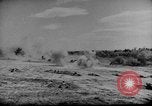
U.S. Army Quartermaster Corps prepare mortars, fire anti aircraft guns, and provide supplies during World War II.
Clip opens with brief World War I scene, circa 1917, of new American army recruits receiving army uniforms being issued by a U.S. Army Quartermaster. Clip then covers U.S. Army Quartermaster Corps' combat operations in various Theaters of Operations during World War II. Quartermaster Corps soldiers with rifles under the cover of a military truck during battle. Troops in trucks. An aircraft in low flight over a field. A U.S. Army truck. A Quartermaster fires an anti aircraft gun. Explosions occur and smoke rises. A British tank in a field. Soldiers beside a truck. Cans and barrels stacked on the ground. An enemy German tank in a field. Soldiers take cover. Quartermasters with guns in a trench. They come up the trench in prone positions. Dramatized battle scene with several Quartermaster corps casualties beside a wire fence. Soldiers prepare a mortar gun. An anti aircraft gun on an army truck. A soldier takes aim and fires a rifle during training. The Quartermaster flag hoisted on a pole. Actual footage shows aerial view of Bataan, and then ground views of groups of remaining U.S. Army soldiers around time of surrender of Bataan in April 1942. American soldier seen with their hands up and under guard of Japanese soldiers during Bataan surrender. Landing crafts arrive at a beach in North Africa. Supplies being offloaded at various battle fronts of World War 2. Soldiers and supplies off-loaded on the beach. Quartermasters seated on supplies boxes. Landing crafts arrive at a beach in the South West Pacific. Troops move across the beach. Troops disembark from landing crafts and move across a beach in Sicily, Italy. The Quartermasters unload boxes of supplies during various beach landings. They unload supplies and fire artillery on a beach head in Italy. Troops in trucks. A convoy of trucks loaded with supplies. Ammunition, ration and personnel in trucks move from Algeria to the front in Tunisia. Explosions occur and smoke rises. Trucks advance through smoke at night and in difficult conditions. Quartermaster General Major General E. B. Gregory speaks about the Quartermaster Corps. He says that the Quartermasters distribute goods to the army during training and combat. The movement of the Corps should be so regulated so as to deliver the goods at the right time in the right quantity.

Wounded U.S. soldiers are treated in field hospitals during the invasion of Italy in World War II.
Invasion of Italy by the United States during World War II. U.S. troops pull down damaged buildings as they advance. Wounded and injured U.S. soldiers on stretchers are taken to field hospitals for treatment. A U.S. Army doctor treats a patient. A U.S. nurse sitting with a soldiers. U.S. Army Air Force B-26 Marauder bombers en route to Naples drop bombs. Smoke billows up from bomb explosions.
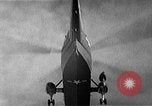
Events leading to Cuban Missile Crisis as United States military prepares for emergency in October 1962.
Events leading to the Cuban Missile Crisis of October 1962 when the United States and the Soviet Union confronted each other with nuclear destruction. A helicopter lands on the White House lawn in Washington DC. Scenes of Cuba and emergence of Castro in recent prior years. Beach views in Cuba. A military parade in an earlier time, with Cuban troops marching in front of the Monument to the Battleship Maine. Next scene shows desecration and destruction of the Battleship Maine Monument in Cuba.. A crowd of cheering Cuban people as Fidel Castro enters Havana, Cuba in 1959. Exterior view of United Nations building in New York City. Fidel Castro and Soviet Premier Nikita Khrushchev embrace during meeting in New York in September 1960. Deputy Premier of the Soviet Union Anastas Mikoyan deplanes and is greeted by Fidel Castro in Havana. A trade agreement between Russia and Cuba signed by Fidel Castro. Russian cargo ships en route to Havana. Cuban refugees in small boats. A map depicts proximity of Cuba to the U.S. U.S. surveillance aircraft heading for Cuba. A sign reads 'HQ. 4080 S W Intelligence Division'. Men examine reconnaissance photographs of Soviet nuclear missiles in Cuba. The photographs show transports and tents for fueling and maintenance. A sign reads 'Strategic Missile Facility GAM 77 Combined Systems'. U.S. missiles rolled out of hangar and readied for emergency. A U.S. Air Force B-52 bomber aircraft takes off from an airfield. U.S. Navy ships in the Atlantic Ocean. A U.S. submarine underway at sea.
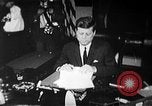
In the US, President Kennedy receives a message from Soviet Premier Khrushchev about dismantling of missiles in Cuba.
Events in the United States during the Cuban Missile Crisis of October 1962 when the United States and the Soviet Union confronted each other with nuclear destruction. U.S. President John Kennedy signs a quarantine order. U.S. Air Force B-52 Stratofortress bombers take off. U.S. Air Force interceptors and fighters take off from U.S. aircraft carriers at sea. Radar dishes moving. A U.S. battleship underway at sea. A U.S. aircraft intercepts a Soviet tanker and allows it to proceed. U.S. reconnaissance aircraft over Cuba. U.S. Air Force SAC (Strategic Air Command) bombers are prepared for a take off. U.S. missiles are prepared. Head Quarters of American Air Defense Command shows interiors of a control room. People wait for news. Exteriors of the White House in Washington DC. Exterior of the Kremlin in Moscow, Soviet Union. A press announcement about a message that President Kennedy has received from Soviet Premier Khrushchev saying that he will dismantle missiles in Cuba.

The Wright Brothers' aircraft takes off and in flight near the NCR building in Dayton, Ohio.
The history of famous airplanes. A demonstration of the Wright airplane at the National Cash Register Company in 1911. The Wright Brothers' aircraft (Wright Model B, number 27) taxis across a grassy area in front of the company building in Dayton, Ohio. The aircraft takes off. Pilot Rogers at the controls of the aircraft. The aircraft in flight near the NCR building.
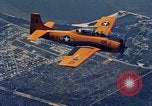
Film showing the type of Naval aviation training and kinds of assignments experienced by U.S. Marine officer, John Glenn, before his service as an astronaut.
Film that illustrates the kind of aviation training and early career experiences of American Astronaut John Glenn. Narrator discusses this throughout, but there are no images of John Glenn, himself in the film, which begins showing a formation of North American T-28 training planes from the U.S. Navy flight school at Pensacola, Florida, flying over water. Closeup of one doing a roll. Glimpse of instructor discussing Navy Mark 8-A Weems navigational computer in a classroom.. Cadets at Corpus Christi, Texas, in Altitude Chamber experiencing the effects of high altitude flight and learning about their individual symptoms of hypoxia onset. A cadet in the cockpit of an airplane as instructor standing on its wing points out features of the aircraft controls. A cadet using a sextant to shoot sun lines in daylight. Cadets engaged in calisthenics, and playing volley ball on a court set up on a flight line. A line of Navy Douglas AD Skyraider aircraft, with folded wings are parked in the near background. Cadets in dress whites leave a chapel following a service. Graduation parade and exercises in which the cadets are awarded their Navy wings of gold. A formation of four Navy Grumman F9F/F-9 Cougar aircraft in formation, viewed from above. Closeup of pilots in several parked Vought F4U Corsair aircraft, followed by Formation of several in the air ostensibly blasting enemy targets below, raising white smoke. A U.S. Navy Lockheed T-2V Seastar jet training aircraft performing a roll in flight at high altitude with condensation trails visible behind its wingtip tanks. Brief views of air combat during the korean War. Navy Vought F8U supersonic Crusader aircraft in flight. An X-15 aircraft being dropped from underneath a U.S. Air Force B-52 jet bomber. It rockets away rapidly from the Bomber.
CRITICALPAST.COM: About Us | Contact Us | FAQs - How to Order | License Agreement | My Account | My Lightboxes | Shopping Cart | Advanced Search | Featured Collections | Website Terms & Conditions | Privacy Policy ©2026 CriticalPast LLC.
License Agreement |
Terms & Conditions |
Privacy Policy
©2026 CriticalPast LLC.