


 Francais
 Deutsch
 Italiano

Refine Your Search
B-24-Burma stock footage and images
- Showing 361 to 366 of 3692 results more
 Hide

A pilot stands against a Ford airplane at a field during a commercial aircraft reliability tour in the United States.
Various aircraft during a commercial aircraft reliability tour for the Edsel B. Ford Trophy in the United States. A large Ford airplane numbered 8 and a small one man airplane numbered 24 parked side by side on a field. A pilot and a women stand against the Ford airplane.

Various bi planes take off from a field during a commercial aircraft reliability tour in the United States.
Various aircraft during a commercial aircraft reliability tour for the Edsel B. Ford Trophy in the United States. A bi plane numbered 22 being flagged off. People gathered on either side of a runway. Various bi planes on the runway. The airplanes being flagged off one by one. An airplane numbered 24 being flagged off.
U.S. aircraft bomb Japanese positions and ships in the Pacific Theater during World War II.
U.S. Army Air Forces aircraft bombard Japanese positions in the Pacific Theater during World War II. A map of the area. U.S. Army Air Force B-24 Liberator aircraft in flight over islands in the Pacific. The aircraft fly in formation. A Japanese cruiser underway at sea. The cruiser being bombed. A gun sight aiming point view of the cruiser being strafed. Explosions occur at sea. Enemy barges being attacked by the aircraft. Smoke rises at sea. U.S. aircraft bomb Munda Airfield. Smoke rises from the shoreline of the Munda island. Bombs being released over Bismarck Islands and the Solomon Islands. Bombs impact and columns of smoke rise.

Anna Roosevelt reviews troops and Jean Marie Faircloth MacArthur Christens the Australian Destroyer, Bataan the during World War II
Opening scene shows a Boeing B-24 Liberator bomber arriving at an airfield in the Caribbean during World War 2 . U.S. First Lady, Eleanor Roosevelt steps from the aircraft, stopping here on one of her many trips. She strolls among U.S. servicemen and others. She is escorted by a General and reviews American Troops on parade at an army base. Scene shifts abruptly to the Cockatoo Island Dockyard, Sydney in New South Wales Sydney Australia, where the Australian Destroyer, Bataan, is being Christened on 15 January 1944 by Jean MacArthur, the wife of General Douglas MacArthur. Dockyard workers drive wedges from beneath the destroyer's hull, to free her for launching. Mrs. MacArthur announces the name, Bataan, and swings a bottle of champaign to christen her. The ship proceeds down the ways. View from below of sailors on deck as she launches.
Launches of German V-2 ,Titan II from a missile test center in California, United States.
Rocket engine nozzle at launching. The engine rises slowly from launch pad. An engineer behind control panel. A rocket launches a captured German V-2 rocket/WAC Corporal Bumper 8 from Pad 3 of Cape Canaveral on July 24, 1950. Two United States Air Force Convair F-106As Delta Dart in flight. Aerial view of launch complexes. Titan II missile is launched. The Titan II missile explodes mid-air. A huge ball of fire from Titan II explosion. A scientist uses a tracking camera during a Titan II rocket launch. Footage from camera shows the first stage separation of the Titan II. The booster blasted away at second stage ignition. Various tracking stations covering the Atlantic missile range. A satellite dish recording telemetry data. Observatory dome with telescope rotating. The USS HH Arnold (T-AGM-9) missile tracking ship at sea. A re-entry vehicle is seen re-entering the atmosphere. A United States Air Force Lockheed JC-130B Hercules equipped with a trapeze structure snatching an Aero kite balloon suspended from a ship. Air Force Missile Test Center and its logo. View of Patrick Air Force Base in Brevard County, Florida (840 Falcon Ave. Building 720 Patrick AFB, FL 32925). Various missiles on display in front of the Air Force Missile Test Center Technical Lab at Patrick Air Force Base. Engineers working in the Air Force Missile Test Center Technical Lab. An engineer examines a magnetic tape from an IBM console in the EDP room. An Air Force Missile Test Center report. A Gemini space capsule is being lowered. NASA personnel watch the capsule. Sign reads “Gemini / Titan II Man Rated Complex Martin Company”. Lt. Colonel John G. Albert Chief of the Gemini Launch division, 6555th Aerospace Test Wing at the entering gate. A blockhouse in the background. Colonel Albert inspects Gemini’s boosters. He is at the launch control in the blockhouse.
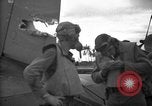
U.S. Marine Lieutenant Marshall, with his severely battle-damaged F4U Corsair at Torokina Air Strip in World War II
Flight operations at Torokina Air Strip on Bougainville Island during World War 2. U.S. Marine First Lieutenant Marshall, and another airman stand and smoke by the tail of the bullet-riddled F4U Corsair aircraft that he just landed on Torokina airfield. The aircraft, Corsair number 25 (BuNo 17736) is from Lieutenant Marshall's unit, VMF-216. They examine the damage on the aircraft. Lt. Marshall, who suffered head injury from cockpit shrapnel is being given first aid in an army tent. Views of damage to the aircraft, including tattered wing, flaps shot up, holes in the fuselage, and huge pieces shot out of the rudder. ( This mission took place on 19 Dec 1943. After flying cover for B-24 bombers over Rabaul, Three U.S. Marine Corps F4Us flown by Capt. Lawrence 'Cloudy" Faulkner, and First Lieutenants Marshal and Guv Kemper, were surprised and engaged by 20-30 Japanese Zekes (Zeros) diving from behind clouds . Lieutenant Marshal was the sole survivor of the encounter.)
CRITICALPAST.COM: About Us | Contact Us | FAQs - How to Order | License Agreement | My Account | My Lightboxes | Shopping Cart | Advanced Search | Featured Collections | Website Terms & Conditions | Privacy Policy ©2026 CriticalPast LLC.
License Agreement |
Terms & Conditions |
Privacy Policy
©2026 CriticalPast LLC.