


 Francais
 Deutsch
 Italiano
Refine Your Search
Baltimore Maryland USA 1958 stock footage and images
- Showing 9925 to 9930 of 25435 results more
more Hide
Hide
U.S. Army Air Forces Air Transport Command activities during World War II.
U.S. Air Forces Air Traffic Controllers on duty at a control Tower in an airfield during World War 2.. Several multi-engine aircraft are parked on the ramp, outside, including two Douglas C-54 transport aircraft. One controller looks through binoculars. Next, airmen are seen loading cargo into an aircraft from a truck backed up to its side. Air Forces ground crewmen are silhouetted against a light sky as they watch aircraft take off while being ferried overseas. Parked behind them is a USAAF Consolidated B-24 bomber. A Boeing B-17 Flying Fortress bomber taking off. A Douglas A-26 Invader aircraft landing. A North American B-25 Mitchell bomber taking off. Next, numerous Douglas C-47 transport airplanes are seen taxiing on an airfield. View from directly in front of a C-47 aircraft as it takes off, and passes over the camera. View from ground of a low flying C-47, and then of several in loose formation flying overhead.
As the United States enters World War II, U.S. military forces are seen, deployed in various places throughout the world.
American troops are seen in arctic gear moving on skis through blustery snowy weather in Iceland, during World War 2. They were sent in 1941 to relieve British troops occupying Iceland since 1940, during World War II. A guard post at the American camp, with Quonset Hut in background. Closeup of U.S. sentry in arctic gear holding rifle with bayonet affixed. View from above, of numerous tents partially covered with snow in the American camp. Change of scene shows U.S. troops disembarking from transport ships at the British Isles. They march with their combat gear onto a square where Army trucks wait to transport them inland. Another scene shows the American troops, viewed from behind, parading in London. Other scenes show them marching in various areas of London. Saint Paul’s cathedral is seen in the background of one scene. A large number of American M3 Stuart Light tanks move on a railroad train in Britain. Scene shifts to the Middle East, where railroad cars and various military supplies for Russia are be offloaded from American ships. A Russian officer is seen signing receipts for war materiel, from a U.S. Army Technical Sergeant. A row of American Army trucks are lined up behind them. The Russian and American exchange salutes, and shake hands. Next, a troop ship carrying American troops is seen arriving at a port in India, where they disembark with their gear. An American Army Sergeant in a pith helmet pays attention to a little Indian girl. Scene shifts to China, in 1942, where Brigadier General Claire Lee Chennault, Commander of the China Air Task Force, of the Tenth Air Force, that replaced the American Volunteer Group (Flying Tigers), is seen with Brigadier General Caleb V. Haynes, Commander of the India Air Task Force. A colonel joins their discussions. A Consolidated B-24 Liberator bomber is parked behind them. View of Curtiss P-40 Warhawk fighter planes, with Flying Tiger markings, parked on a flight line. A B-24 bomber landing on a runway, between hills, deep in China. Closeup of Nationalist China Generalissimo Chiang Kai-Shek, saluting. Huge numbers of Chinese troops assembling in a formation. Next, an expeditionary force of American troops is seen arriving on a troop ship in Australia. They line the ship’s deck and wave. General Douglas MacArthur arriving in Australia to assume the office of Supreme Commander, South West Pacific Area (SWPA). .Glimpses of U.S. Navy activities in Australia: setting up defenses of islands; unpacking a Kingfisher float plane and making it ready for use on a desert island. The final segments of the film show American forces in August ,1942 sailing to Adak in the Aleutian Islands, to strengthen American defenses there. Troops seen descending by rope ladder from the American transport ship USS J Franklin Bell (PA-34), into her landing craft for deployment on Adak Island. Scenes of landing craft reaching the beach and offloading troops, vehicles, and supplies. View of beach filled with supplies. One landing craft is clearly marked with ""P34" showing that it belongs to the USS J Franklin Bell ( later reclassified as APA-16).
The Pacific War Council and British and American General staffs meet at the White House in Second Washington Conference in World War II
Allies of the Pacific War Council met at the White House on June 25, 1942 Pictured with President Franklin D. Roosevelt and British Prime Minister Winston Churchill (both seated) and Canadian Prime Minister, Mackenzie King, standing immediately behind and between them. Others, standing behind are: Dutch Minister of Foreign Affairs, Eelco N. van Kleffens, Australian representative, Stanley Melbourne Bruce. The tall man behind Prime Minster King, is British Vicount Halifax (Edward Wood). To his left is Chinese Foreign Minister T.V. Soong, and Manuel L. Quezon, President of the Commonwealth of the Philippines. The last person standing at the right, is Walter Nash, New Zealand's minister to the United States. Scene shifts to military leaders of the combined British and American General Staffs, meeting in the so-called Second Washington Conference (Code named Argonaut). Closeup of U.S. Army Chief of Staff, General George S. Marshall, conversing with lieutenant General Henry H (Hap) Arnold, Commanding General of the U.S. Army Air Forces. Another closeup shows U.S. Navy Chief of Naval Operations, Admiral Ernest King, conversing with Admiral William D. Leahy, personal Chief of Staff to President Roosevelt. Glimpse of British Military General Staff members.
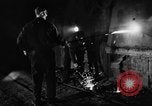
Steel production covers open hearth furnace, ingot molding, and hot strip milling.
Examines the steel industry in Youngstown, Ohio during World War II. Focuses on the steel production including the open hearth furnace and hot strip mill. Workers Mike Ubinski and Earl Strong remove a molten sample from an open hearth furnace and quench it in water. They then hammer the sample to prepare it for analysis. Earl Strong playing bass in the Youngstown Orchestra. The conductor is Michael Ficocelli, who is also time keeper at the steel mill. Shot of old man playing the violin. At the steel mill, the open hearth furnace is tapped. A 'pit gang,' several worker, throw alloy metal into the pit furnace from above. The 100 ton ladle containing molten steel is moved by crane and poured into ingot molds. A worker pulls another molten test sample from the ingots for testing. Ingots on train move from open hearth furnace to the ingot mill. Hot ingots being rolled by machine into slabs. Workers George Bannin and Clarence Ginny manipulate controls for machinery that rolls ingots into slabs. Worker Fred Ingram controls machinery that cuts steel slab using hydraulic sheers. Union workers gathered at a conference table as union leader Fred Ingram leads them in discussion. Hot strip mill where steels slabs are rolled into steel sheets. Sheet of hot steel moves down conveyor to end of mill. Steel workers leaving the steel plant at end of their shift. Exterior views of steel plant in Youngstown, Ohio.
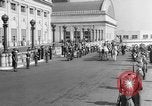
Franklin D. Roosevelt's funeral procession with horse drawn casket, Pennsylvania Ave (WW2)
Funeral procession of Franklin D. Roosevelt passes on streets of Washington DC. Horse drawn carriage with casket followed by honor guard and procession of cars. Troops drive various military vehicles. Funeral procession on Pennsylvania Avenue. Military units march. Crowd lined up on sidewalks. People's faces with sad looks. Various military units march. Airplanes overhead. (World War II period)
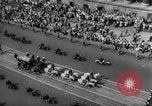
Funeral services for Franklin D. Roosevelt in Washington DC and at Hyde Park, New York (WW2)
Funeral procession of President Franklin D. Roosevelt on the streets of Washington DC. Horse drawn carriage with casket escorted by men on motorcycles. Crowd lined up on sidewalks. Various U.S. military units march. Funeral procession arrives at White House. Casket is carried into building. Casket is placed in East Room, lying in state. Scene change to funeral services for FDR at Hyde Park, New York. President Truman and Franklin D Roosevelt's wife among the mourners. A volley is fired over the president's grave. Symphonic music track in background is interspersed with audio quotations from Roosevelt, including, from his State of the Union on January 7, 1943: "Therefore, let us all have confidence, let us redouble our efforts. A tremendous, costly, long-enduring task in peace as well as in war is still ahead of us. But, as we face that continuing task, we may know that the state of this Nation is good--the heart of this Nation is sound--the spirit of this Nation is strong--the faith of this Nation is eternal." Also heard at the beginning of the clip is Roosevelt saying, "American fighting men looked to the statesmen of the world to finish the work of peace for which they fought and suffered. We failed them then. We cannot fail them again, and expect the world again to survive," from his address to Congress on Yalta, March 1, 1945 (World War II).
CRITICALPAST.COM: About Us | Contact Us | FAQs - How to Order | License Agreement | My Account | My Lightboxes | Shopping Cart | Advanced Search | Featured Collections | Website Terms & Conditions | Privacy Policy ©2026 CriticalPast LLC.
License Agreement |
Terms & Conditions |
Privacy Policy
©2026 CriticalPast LLC.