


 Francais
 Deutsch
 Italiano
Refine Your Search
Baltimore Maryland USA 1958 stock footage and images
- Showing 12079 to 12084 of 25435 results more
more Hide
Hide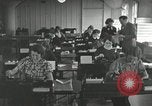
The Great Depression persists as President Franklin D Roosevelt takes the oath of the office in the United States.
Department of Labor women clerical employees seen typing letters and forms. Men in the department meet at a table. Women working inside a textile factory in the United States. Close up of man's face as he works at a factory job. Scene of early trading activity at the New York Stock Exchange. A biplane airplane at an air show event crashes through a wall (seemingly intentionally) while landing, as onlookers watch. The plane is heavily damaged but lands on two wheels. Bread lines and soup lines for the hungry and unemployed men during the Great Depression. Lines at the bank during bank panic or run on a bank during the Great Depression. Vacant lot, stopped idle factory, and stopped railway switch yard during the Great Depression. Busy city street (possibly New York City lower east side) with push carts of street market vendors selling to shoppers and pedestrians. A horse cart is also seen on the street. More scenes of soup kitchens and bread lines for needy. Children jump rope, gathered on a wooden porch. Two men arriving at factory job carrying lunch boxes. Children playing jump rope. Exterior of the Capitol building in Washington, D.C. as Franklin Delano Roosevelt takes his first oath for the President of the United States on March 4, 1933, and excerpt from his inaugural address focusing on jobs and putting people back to work.
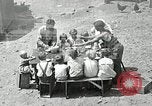
Enactment and effects of Social Security and Labor legislation during the Great Depression in the U.S.
Part of a documentary on the history of the Labor Department in the United States. Opening scene shows numerous children gathered around a large wooden picnic table outdoors, as a woman and two men serve them lunch, during the Great Depression of the 1930s, in the United States. The setting is a barnyard, with chickens walking about in the background. Scene shifts to many women working in an Emergency Employment Office of the U.S. Department of Labor. They are all engaged in various kinds of clerical activities. Next, men are seen receiving hot food at an outdoor "Soup Kitchen." People on a "bread line." A woman getting the last bit of food from an empty food kitchen pail. President Franklin D. Roosevelt, is seated at his desk, surrounded by interested persons, as he signs the Social Security Act on August 14, 1935, and appoints the Secretary of Labor as head of a committee to develop a Social Security Program which shall embrace and cover the hazards of old age, unemployment, the handicapped, and children. A rural family seen on their porch. Many unemployed men gathered on a building porch in a rural setting. Railroad cars and an industrial site can be seen in the background. Children gathered on an open porch. The U.S. Capitol building. Coal miners headed into a mine shaft, wearing helmets with lights and carrying their lunch pails. Workers on an automobile assembly line. Rural poor families near their makeshift houses. A woman airing out bedding outdoors. Men stoking a furnace. A large group of child laborers. A factory with multiple smoke stacks. Striking union members carrying signs on a picket line. Others carry signs identifying them as members of the International Seamen's Union. One of them carries a sign reading: "Radio is the only Hope. Insist on reliable radio protection." Other union members in an outdoor protest. A group of businessmen, ostensibly in peaceful negotiations, facilitated by the Department of Labor.
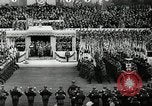
From Labor Department documentary. Montage of World War II scenes from start to finish,including American home front.
Opening scene shows Adolf Hitler reviewing German troops on parade. German paratroopers jumping from Junkers Ju-52 aircraft. View from the ground of paratroopers descending from three Ju-52s. The Japanese attack on Pearl harbor, December 7, 1941. Heavy smoke rising from the leaning USS Arizona after she is hit by bombs. Newspaper headline reading "Pearl Harbor Bombed!" American soldiers leaving Camp Stoneman, are seen assembled on a pier at the Pittsburg California waterfront to board one of the ferries that would take them to Piers 15 and 45 on the Embarcadero in San Francisco. A sign at pier reading:"Through these portals pass the best damned soldiers in the West." Glimpses of soldiers firing howitzers in World War 2. Glimpses of the civilians supporting the war effort. Auto factory workers walking near a war production plant during shift change. A new army truck leaves a factory. War production workers assembling the turret on a Sherman tank. Guns and turrets being manufactured. Factory floor filled with new pursuit airplanes. A B-25 Mitchell bomber aircraft taking off. Aerial view from bomber of its bombs exploding over enemy target below. Freight trains carrying United States military supplies. Supplies being loaded aboard a ship for the U.S. and Allies. The American battleship USS New Mexico firing a gun, and firing guns from triple turrets. Workers assembling aircraft engines in a war plant. A woman at work in a war materiel production plant. Gun camera images from warplane strafing a ground target. World War 2 Victory parade along 5th Avenue, New York City, in 1946. Washington Square triumphal arch in background. Various views of the parade. Laid off war plant workers looking for new jobs. Troops welcomed home: Ship carrying returning United States soldiers back home after the end of World War 2. Disabled soldiers and sailors, such as some who were wounded in battle and lost limbs like arms or legs, making their war to a Military Air Transport Service C-54 aircraft. More views of the disabled veterans who were injured during World War II.
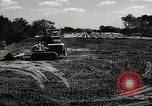
Inflation, labor unrest, and rising unemployment afflict America in decade following World War II.
Part of documentary by the U.S. Labor Department. Opening scene shows tractors pulling disc harrows to condition land at a construction site. The steel framework of a large sports complex under construction. Brick masons working on exterior of a large building. Two prize fighters in a ring being separated by referee as one is knocked to the canvas. Scenes of post-World War II labor strife in America. Police escorting persons to the safety of building entrance. Union protesters holding signs reading "Local 1173," (Machinists Union in California). Cars drive into a factory yard where workers are standing about. Narrator refers to busy schedule in history for the Labor Department Mediation Service. Workers crating completed washing machines for shipment. A parade in which a man on stilts represents high prices and another marching beside him representing low wages. A deserted commercial district in a small rural town, reflecting 1949 resurgence of unemployment problems. A mother and father with two small children, looking at baby carriages in a shop window. Men walking away from a factory office past a sign reading: "No Help Wanted." American soldiers engaged in combat during the Korean War. Narrator alludes to this bringing some relief to unemployment.
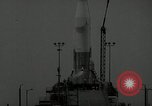
American labor challenged in the age of space exploration and advanced technology
Portion of a documentary on the history of the Labor Department in the United States.Opening scene shows first successful launch of an American Atlas ballistic missile from Cape Canaveral, Florida, on December 17, 1957. U.S. Astronaut, Alan B. Shepard emerging from the NASA Mercury Freedom 7 capsule on the deck of the USS Lake Champlain, after it was recovered from space flight in orbit and placed aboard the ship. Tape decks operating as part of an IBM early computer room. Machine controlled multiple drills in operation. Earth moving equipment at work on a construction site. Automatic equipment employed remotely in a hazardous environment. Robotic machine elements at work. Chemists in a laboratory. Remotely controlled devices handling radioactive materials in a radiation shielded space. A nuclear test explosion. Coal miners heading to work as they always have, with helmets including lights and their lunch pails. Children of the rural poor in a school yard with dirt paths in a rural area, possibly Appalachian. Automatic equipment speeding industrial production, but displacing unskilled workers. Highly trained technical workers in a company computer room. An older factory becoming obsolete. Large scale coal boring machinery seen boring in a mine, replacing the pick and shovel coal miner of the past. Automated farm machinery replacing the old-time farm hand.
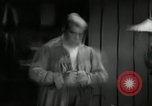
Problem of unemployment due to the introduction of advanced technology and equipment in the United States.
A segment of a documentary on the history of the Labor Department in the United States. Film begins with actor portraying a man who ostensibly invents a sewing machine but destroys it after considering its impact on the employment of hand seamstresses. Cartoon illustrations show early 19th Century textile worker followers of "King Ludd" (Luddites) in England who destroyed weaving machinery for fear it would replace them in the industry. Current views of Men at work with technical apparatus. Modest homes in a semi-rural setting in America, where people ostensibly replaced by machines or who for lack of training and education are shown as unemployed, and idle. .
CRITICALPAST.COM: About Us | Contact Us | FAQs - How to Order | License Agreement | My Account | My Lightboxes | Shopping Cart | Advanced Search | Featured Collections | Website Terms & Conditions | Privacy Policy ©2026 CriticalPast LLC.
License Agreement |
Terms & Conditions |
Privacy Policy
©2026 CriticalPast LLC.