


 Francais
 Deutsch
 Italiano
Refine Your Search
Baltimore Maryland USA 1958 stock footage and images
- Showing 13303 to 13308 of 25435 results more
more Hide
Hide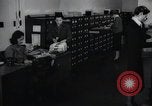
Mary Malloy at a teletype and others sort mails at the Time magazine office in Washington DC.
The office of the Time magazine in Washington DC. A reenactment : Mary Malloy, a correspondent for the Time magazine, at a teletype. She answers a telephone. A woman sorts letters and postal mail in a shelf. Correspondents for the Time magazine Harold Horan, Robert Sherrod and Mary Virginia Johnson sort telegrams and mail. A woman takes out books from shelves.
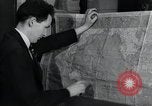
A man observes a map and women sort mails at the Time magazine office in Washington DC.
The office of the Time magazine in Washington DC. A reenactment : A man observes a map. A woman sorts mail. She reads a document. Another woman sorts mails. She reads a Time magazine issue. Women read and sort mail.
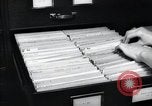
A woman sorts postal mail in a box and people discuss in the Time magazine office in Washington DC.
The office of the Time magazine in Washington DC. A reenactment : A woman sorts letters and mail in a box. A man and a woman discuss. The woman walks away. Another woman discusses a document with a man. A man writes on a paper as he smokes a cigarette.
Dayton Ohio street, Wright home, workshop, the Wright Museum and the first glider flight of the Wright brothers in the United States.
A film 'We saw it happen' about the history of aviation in the United States. In Dayton, Ohio: Houses seen along Hawthorn Street. A still picture shows the Wright brothers in their youth. View down Hawthorn Street with several 1940s and early 1950s cars parked along the Dayton street. Exterior view of 7 Hawthorn Street, home of the Wright Brothers. Interiors of the Wright home in Dayton. The workshop of the Wright brothers. Machines in the workshop. The "Wright Cycle Co" and Wright Museum (moved from Dayton to Greenfield village in Dearborn, Michigan.) A powered engine prepared in the workshop. Sweeping view of windswept beach area of Kitty Hawk, North Carolina where the Wright brothers conducted test flights in 1900-1902. Another view of Hawthorn Street in Dayton. A boy on the sidewalk. View of the 4 cylinder airplane engine first designed by the Wright Brothers. Narrator speaks of December 17, 1903 Wright Brothers flight. View of the Wright Flyer in flight overhead. Scene changes to aerial side view of Boeing B-52 Stratofortress aircraft in flight (this is aircraft YB-52,the second XB-52). The B-52 banks left and away.

Aviation history; historic early flight scenes; first hand accounts from persons who knew and worked with the Wright brothers.
Views of traffic on a city street around the turn of the 20th century. A mix of horse and buggies and motorcars and bicycles. People waiting for a trolley car. Reenactment of persons using an early telephone and of early filmmakers at work with camera on motion picture film. The Wright brothers home at 7 Hawthorne Street, West Dayton, Ohio. The Wrights' former housekeeper, Carrie Grumbach, recalls December 17, 1903, a telegram arriving about the Wright brothers successful first powered flight. Glimpse of Wright brothers machine shop. Charlie Taylor, who had worked in their shop, speaks of being pleased at their accomplishment. View of the Wrights flying gliders at Kitty Hawk, North Carolina. Charlie Taylor describing how he machined and built the motor for the Wright brothers airplane. Glimpse of that motor or a facsimile. Men positioning the Wright brothers airplane for launching, and French citizens gathered to watch a demonstration of their airplane in France. French aviation pioneer, Henri Farman with two other men in his Voisin-Farman I airplane. They begin takeoff. Closeup of Brazilian aviation pioneer, Alberto Santos-Dumont. Other early aircraft in flight. A Wright Flyer passing over the Fort Myer drill ground in Virginia. An Army balloon in the background. Retired United States Air Force Brigadier General, Frank P. Lahm, walks across the tarmac on an airport and speaks for interviewer (unseen). He speaks about the difficulty the Wright brothers had in convincing the U.S. Army of the value of their airplane. He tells that in December, 1907, Wilbur Wright was finally granted an interview with the Board of Ordnance and Fortifications, which led to a contract, in 1908, with the Signal Corps. Moving imagesof Orville Wright and assistants bringing a Wright Flyer to Fort Myer, Virginia, to conduct flight trials for the Army. Views of the airplane being flown all around the area, watched by spectators. (This footage is a mix of 1909 footage where the aircraft shows two half-rounds of canvas in the front elevator, and 1908 footage, taking off and flying, where the aircraft has a single half-round of canvas in the front elevator.) After landing on the 9th of September, 1908, then, Lieutenant Lahm, accepts Orville Wright's offer to fly with him. Lahm climbs aboard the airplane, sits next to Orville Wright, and they are seen taking off and flying about for six minutes and forty seconds. (Lahm is the first. military officer to ever fly in an airplane.) The next scene shows the wreck of a Wright Flyer, in which Army Lieutenant Thomas Selfridge was killed and Orville Wright injured, on September 17, 1908.
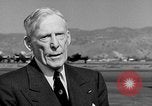
Former U.S. Army Lieutenants Lahm and Foulois recall their flights with Orville Wright in 1909
A film about the history of aviation in the United States. Retired Air Force Brigadier General, Frank Lahm talks about his first flight, as an Army Lieutenant, with Orville Wright on the Wright Flyer airplane, in July, 1909.Then, Retired Major GeneralBenjamin Foulois recalls how, as an Army Lieutenant, he flew the final cross-country and speed test flight from Fort Myer to Alexandria , Virginia, and back, again, with Orville Wright on 30th July, 1909. Film then shows that event, on July 30, 1909. Lt. Benjamin D. Foulois is seen climbing aboard the Wright Flyer airplane to accompany Orville Wright on the final cross-country and speed test required by the U.S. Army before it would purchase any aircraft. View of the Wright Flyer taking off with Wright and Foulois. Spectators watch in the background. View from another perspective of the aircraft taking off from Fort Myer, Virginia. View of the Wright Flyer being moved by several soldiers after landing back on the Fort Myer drill ground. (In his comments about this, Foulois notes that the flight set three world records: flying ten miles cross-country; attaining altitude of 600 feet, and speed of 42.5 miles per hour.)
CRITICALPAST.COM: About Us | Contact Us | FAQs - How to Order | License Agreement | My Account | My Lightboxes | Shopping Cart | Advanced Search | Featured Collections | Website Terms & Conditions | Privacy Policy ©2026 CriticalPast LLC.
License Agreement |
Terms & Conditions |
Privacy Policy
©2026 CriticalPast LLC.