


 Francais
 Deutsch
 Italiano
Refine Your Search
Baltimore Maryland USA 1958 stock footage and images
- Showing 13309 to 13314 of 25435 results more
more Hide
Hide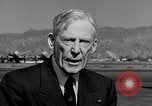
Lieutenant Law and Igor Sikorsky talk about their experiences and experimental aircraft in flight in the United States.
Part of a series of films about the history of aviation in the United States.Retired United States Air Force Brigadier General Frank P. Lahm is seen speaking about his aviation pioneering days, when Orville Wright taught him and Frederick E. Humphreys of Army Engineers (both Lieutenants at the time) how to fly the Wright Flyer airplane. Views of a Wright Flyer maneuvering in the air above Fort Myer, Virginia. Somewhat later, two are seen in flight at Fort Myer. An early Curtiss airplane.is maneuvered on the ground to face away from the camera. Russian, Igor Sikorsky in an early rear propeller airplane. Igor Sikorsky at a desk in a modern engineering office. Sketch of a helicopter on drawing board behind him. He talks about the early days of experimental flight in 1909 and 1910. View of Louis Bleriot sitting in the open cockpit of his airplane, and then of him flying overhead in his famous flight across the English Channel. Obeservers watching his progress through binoculars and a telescope. Sikorsky standing next to his first helicopter (which didn't fly).
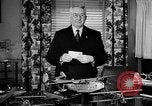
Early 1900s American aviation scenes; American flight pioneers speak about their associations with the Wright Brothers
Aviation pioneer, aircraft designer and builder, Glenn L. Martin, at his desk, stands behind a model of the Martin M-130 Clipper flying boat. He reads a 1910 postcard from the family doctor to his mother, warning that her son (Glenn) will kill himself if he persists in his aviation endeavors. Next, one of Martin's earliest employees and collaborators, Donald Douglas, Sr. is seen with his dog. He says his first memory of things in aviation, was seeing the first Wright airplane demonstrated for the Signal Corps in 1908, at Fort Myer. Period film shows the Wright Flyer airplane with twin rear propellers turning. Next view shows Orville Wright along with military officers and officials, standing near the launching tower (from which a propelling weight would drop). Orville Wright is seen climbing aboard the airplane, after the first flight demonstration, as Lieutenant Lahm joins him to be the first military officer to ever fly in an airplane. Next, the weight is seen falling from the launching tower, propelling the airplane along a single track to take off. It is seen flying above spectators at the Fort Myer drill field. View of a U.S. Army balloon in flight overhead. Scene shifts to pioneer Army balloonist, Roy Knabenshue, who was hired by the Wright Company in 1910. He holds a photograph of a balloon, and identifies Walter Brookins, in the photograph. (Brookins was taught to fly by the Wright brothers and became the first instructor for their Exhibition Team.) Knabenshue extols the skills of Brookins as a Wright Company pilot, along with Arch Hoxsey and Ralph Johnson. While Khabenshue is speaking, views of a Wright Flyer in the air at Fort Myer are seen.
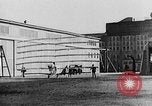
Early experimental failures in airplane development. Lawrence Sperry and his "Messenger" airplane
Film showing early history of flight with many early unsuccessful flying machines. As Igor Sikorsky speaks, in the background, about such earlier failures, the first scene shows a early 1900s seven wing airplane, with its propeller turning, being pushed by several men. Suddenly the the entire thing collapses into a heap, as the men run to safety. They quickly return to check on the occupant. Next, an experimental four-rotor helicopter is seen lifting above the ground, successfully, but not otherwise controllable. Then a contraption (labeled "Sky Car") employs a pulsating umbrella. It jumps up and down but does not accomplish anything else. A tricycle gear contraption, using an array of sails, and displaying the number, 691, moves along under power, but does not ever leave the ground. A helicopter of sorts, with several different size rotors falls sideways, as the pilot is adjusting it. He steps away to safety. Another glimpse of the "Sky Car." A wing-flapping contraption that does nothing else. Aviation pioneer, Lawrence Sperry, moves his early biplane up to a gasoline pump to refuel. He holds the fuel hose to his gas tank while another man pumps the fuel. Next, his airplane taxis along a public road, followed by a motorcyclist. The aircraft takes off. Sperry piloting his small single-place bi-plane "Messenger" aircraft, is seen flying above the U.S. Capitol dome, on March 22, 1922. Next, he lands on the Capitol Plaza and quickly turns the aircraft so it actually ascends several Capitol steps, before rolling back to park. Sperry climbs from the cockpit and is greeted by policemen and officials who surround him and congratulate him. (Sperry perished flying across the English Channel in 1924.) View of the Great Dome on Building 10 at the campus of MIT (Massachusetts Institute of Technology). Dr. Jerome Hunsaker, pioneer aeronautical engineer and educator, is seen in a laboratory. He speaks of beginning the aeronautical engineering education program at MIT in 1913, with Donald Douglas as an assistant.
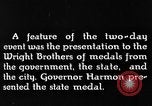
Orville Wright raises a flag and dignitaries including Quincy Gillmore, Edward Andrew Deeds present in the United States.
The 40th Anniversary of the Wright brothers first airplane flight in the United States. A picture of Ohio Governor Judson Harmon presenting a medal to the Wright brothers and people in a stadium arranged to form a flag. A flag being raised. The Wright brothers and other dignitaries surround a flag pole. Aviator Orville Wright raises a flag. A gun salute in front of Air Material building. Aviator Orville Wright, General Quincy Gillmore and U.S. Army Colonel Edward Andrew Deeds present.
Dignitaries grouped in front of the Wright House and Orville Wright with others at dedication of a memorial in the U.S.
The 40th Anniversary of the Wright brothers first flight in the United States. Conference members grouped in front of the Wright House. Orville Wright surrounded by a group. The group enters the house. Aviator Orville Wright, General Quincy Gillmore and U.S. Army Colonel Edward Andrew Deeds with others enter a Colonel Deed's aircraft "The King Bird" for trip to Washington DC. The aircraft taxis for a take off. Delegates posing in a group in Washington DC. Orville Wright in whose honor the conference was held. United States President John Calvin Coolidge, Jr. and United States Secretary of Commerce William Fairfield Whiting present. The group at Kitty Hawk in North Carolina. Orville Wright removes a cover from a stone memorial. Pigeons are released. A plaque commemorating the first successful flight of an airplane.
Pictures of the NCR Auditorium and Wright brothers, Edward Deeds, Henry Ford, Charles Kettering in the United States.
The 40th Anniversary of the Wright brothers first airplane flight in the United States. Still photo of the NCR Auditorium filled with people. U.S. Army Colonel Edward Andrew Deeds, aviator Orville Wright, the founder of Ford Motor Company Henry Ford and American inventor Charles Franklin Kettering present. A still photo of Orville and Wilbur Wright.
CRITICALPAST.COM: About Us | Contact Us | FAQs - How to Order | License Agreement | My Account | My Lightboxes | Shopping Cart | Advanced Search | Featured Collections | Website Terms & Conditions | Privacy Policy ©2026 CriticalPast LLC.
License Agreement |
Terms & Conditions |
Privacy Policy
©2026 CriticalPast LLC.