


 Francais
 Deutsch
 Italiano
Refine Your Search
Baltimore Maryland USA 1958 stock footage and images
- Showing 15445 to 15450 of 25435 results more
more Hide
Hide
Women convey messages from an operating table to a central point with belts in the United States.
A film on technological advancements in the United States. Use of belts to convey messages from an operating table to a central point. Women operate a multiplex system. They put a messages on a belt. Telegrams are routed by use of pigeon holes. The telegrams are dropped down a chute and are pigeon holed by a woman. Time is stamped on all the telegrams with an electric clock. A woman stamps the telegrams. Women put the routed telegrams in a carrier. The transmission of a message.
Men operate a ticker and a woman operates a piano keyboard type ticker in the United States.
A film on technological advancements in the United States. Use of fast stock ticker tape machine for sending New York quotations on a long distance circuit. A man operates a ticker machine. A fast stock wire sends stock quotations. Men look and work at a ticker tape. A woman operate a piano keyboard type ticker.
Men operate telegraph keys and an automatic perforator and transmitter in the United States.
A film on technological advancements in the United States. Messages from London, England to New York, United States are received on siphon recorders and are transmitted by a Morse sounder and are forwarded to all points in America. A man operates a telegraph key. A recorder in operation. Students are trained at a training school at a cable station. Manual sending and receiving of a duplex to and from England. A man with earphones receives messages. A man places a record on a machine. An automatic perforator and transmitter sends 100 words per minute. Operators at keyboards. A tape is fed through a machine.
A telephone, radiophone, phonograph, and Aldis lamp demonstrated in the United States.
A film on technological advancements, innovations, and inventions in the United States during the industrial age and industrial revolution. An actor portraying Benjamin Franklin talks to other men. A man explains to him how a wireless is operated. Benjamin Franklin actor at a telephone switchboard. An operator hands him earphones. Franklin listens. A radiophone in operation. A recording being played on a phonograph. Closeup view of the needle on the phonograph while the record is playing. Franklin listens to radio. Two men, standing near a biplane aircraft, operate a battery-powered Aldis lamp. (Slate incorrectly refers to Heliograph, which uses the sun as light source.) One man uses a sight to aim the lamp at the intended recipient of the message. The other man, holding the battery, sends coded message by operating a key on the battery box. Biplane in flight overhead signals back. Franklin seated at a desk writes in candlelight.

Men and women work on electronic computers for bank book keeping in the United States.
A film titled ' The second revolution in banking' on bookkeeping services and computer improved banking services in the United States. A Titan rocket is launched from a launching pad. Heavy columns of smoke rise as the rocket is launched. Narrator indicates the launching of the rocket implies electronic and technological advancements. The Titan rocket ascends in the sky. The first revolution in banking is book keeping machines during World War I. A man seated at a desk works. Several men and women seated at desks in an office. They work on book keeping machines. The machines are clumsy and use lots of papers. A man empties a sack of bundles of paper on a table. The second revolution is electronic computers. These computers can read, sort, print, process check numbers, record and store customer account information which can be retrieved in record time. The Merchandise National Bank of Chicago installs electronic computers. Men work on the computers in a computer room. Several symbols printed in magnetic ink on a check. The symbols enable the computer system to read information faster and accurately. A man works on a typewriter. He types customer information. Other men work on a machine. The machine reads the information. A reader sorter in operation. A woman at work. The information is read, sorted and interpreted.
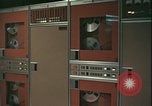
Computer room with tape units of computer systems in operation for book keeping in the United States.
A film on bookkeeping services and computer improved banking services in the United States. Computer system reads and records vital details and information. It records bank checking accounts. A tape unit in operation. The tape unit saves space in addition to operating with a high speed. A woman works on a machine. Several accounts and a detailed information can be stored on a tape. A printing machine in operation.
CRITICALPAST.COM: About Us | Contact Us | FAQs - How to Order | License Agreement | My Account | My Lightboxes | Shopping Cart | Advanced Search | Featured Collections | Website Terms & Conditions | Privacy Policy ©2026 CriticalPast LLC.
License Agreement |
Terms & Conditions |
Privacy Policy
©2026 CriticalPast LLC.